).png)
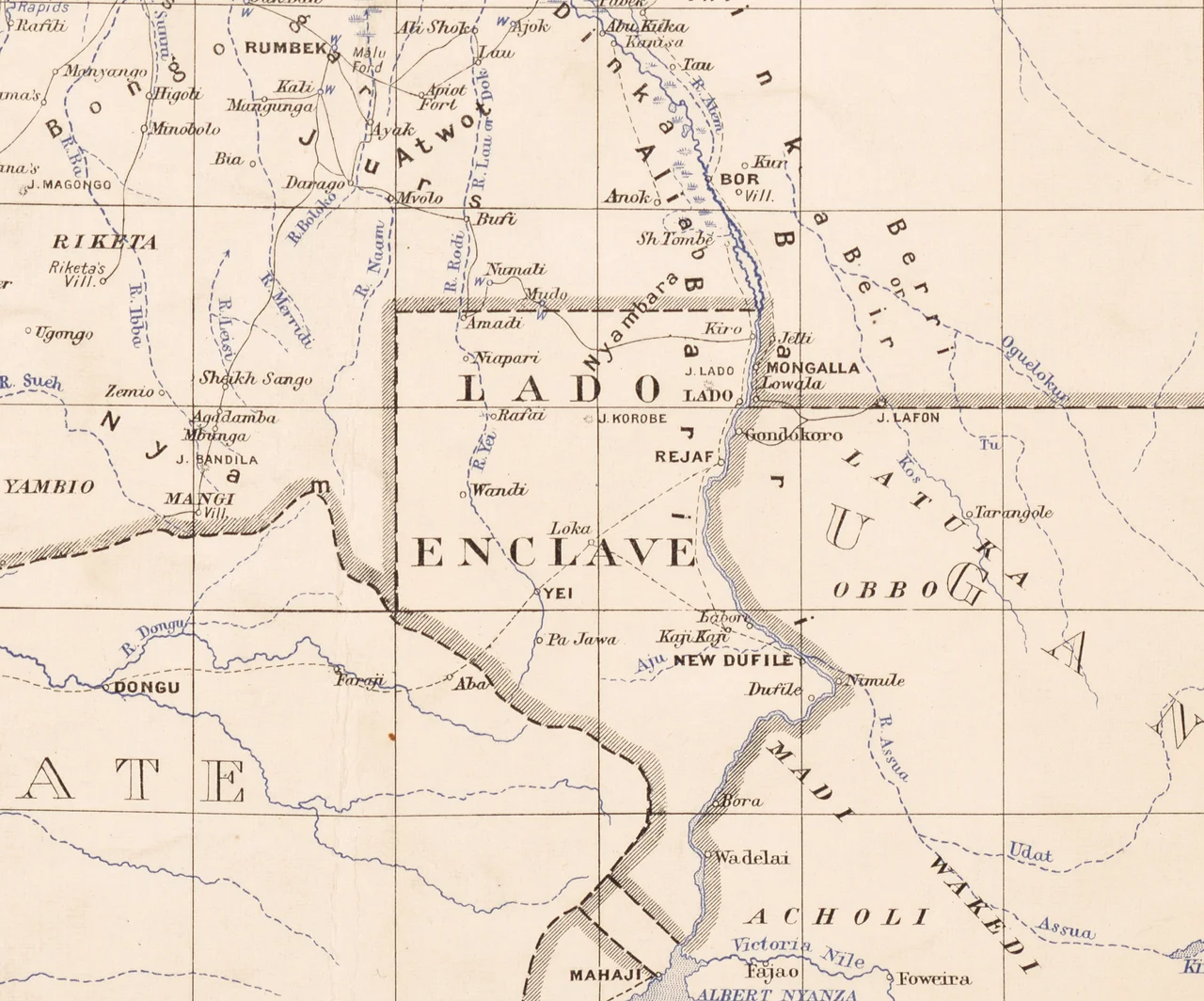
Lado Enclave
King Leopold II of the Belgians was given a strip of the Upper Nile to keep until the day he died, and not one day longer. That single, strange condition shaped everything about the Lado Enclave. Leased to Leopold in 1894 under a treaty with Britain, this muddy triangle on the river's west bank, in what is now South Sudan and north-west Uganda, existed only for the length of one man's life. Everyone involved knew it would revert to British rule the moment his heart stopped. A territory governed by a death watch could never be governed well, and Lado became a byword for the exotic and the lawless, a place world leaders visited and adventurers exploited.
A Town on the Nile
Long before the lease, this was home to the Lugbara, Kakwa, Bari, and Moru peoples. Then the outsiders came. Egypt claimed the region, and in 1869 Samuel Baker set up an administration at Gondokoro and moved to suppress the slave trade. Charles Gordon succeeded him in 1874 and, disliking Gondokoro's climate, founded a new centre downstream that he named Lado, laying it out like an Indian cantonment with wide straight streets and shade trees. He pushed cotton, sesame, and sorghum. His successor, Emin Pasha, built Lado into a real town with a mosque, a Koranic school, and a hospital, until by 1881 it counted more than five thousand round mud huts. A Russian explorer fleeing the Mahdist revolt praised its brick buildings and tidy lanes.
Leopold's Lease
Britain wanted a Cape-to-Cairo railway and a buffer, so it handed Leopold the Nile basin south of the tenth parallel for his lifetime, linking his Congo to the navigable river. France forced him to renounce any push further north. It took until 1897 for his forces under Chaltin to fight their way to the Nile and break the Mahdists at the Battle of Rejaf, securing the claim. But Leopold could never make Lado work. Rejaf became the head of navigation, where Nile rapids stopped the boats, and a single European commander held the post. Twelve heavy Krupp guns were dragged in to defend it. Yet because the enclave would die with Leopold, the Congo Free State never built a real government, and civil unrest festered. Many Bari simply crossed the Nile to escape Free State rule entirely.
The No Man's Land
Leopold died in December 1909, and the lease died with him. On 10 June 1910 the enclave became a province of the Anglo-Egyptian Sudan, with a British administrator appointed. But on the ground, almost nothing happened. The Belgians withdrew, the British neglected to move in, and for a stretch the place was simply ungoverned, a genuine no man's land roughly the size of a small country with a population of around a quarter of a million. Later the southern half went to Uganda and was renamed West Nile, the region best known as the homeland of Idi Amin. The old river towns of Gondokoro, Kiro, Lado, and Rejaf were eventually abandoned, fading off the maps entirely.
The Last Great Elephant Hunt
Into that ungoverned gap poured the ivory hunters. Within about six weeks of Leopold's death, gentlemen adventurers were crossing the Nile from Uganda, shooting elephants by the dozen, and carrying the tusks back before any official could stop them. The enclave became, in the phrase of the time, the site of the last big elephant hunt on the continent. Between roughly 1907 and 1909, hunters from around the world converged and killed several thousand elephants; one resident herd estimated at two thousand animals was all but wiped out. The most famous of these men, Walter Bell, known as Karamojo Bell, shot more than a thousand elephants across his career. The slaughter made fortunes and emptied the land. Lado entered legend as the supposed site of the mythical elephants' graveyard, an exotic byword in the stories of Churchill, Kitchener, and Hemingway, who all knew its name.
From the Air
The Lado Enclave occupied a strip of the Upper Nile's west bank centred near 4.83°N, 29.83°E, in present-day South Sudan extending into north-west Uganda. Its old capital, Lado, lay close to modern Juba; the head of river navigation was at Rejaf, just south of the city. The defining landmark is the White Nile itself, threading north through flat, often swampy lowlands; a fault-line escarpment runs west of Rejaf toward Lake Albert. Nearest major airport is Juba International (HSSJ), only a short hop south. Expect heat haze, seasonal smoke, and afternoon convective storms in the wet season over the Nile floodplain.
Nearby Stories
- Garamba National Park 81 km away
- Juba–Terekeka–Rumbek Road 111 km away
- Juba 149 km away
- Bidibidi Refugee Settlement 169 km away
- 2018 South West Aviation Let L-410 crash 186 km away
- Lakes State 189 km away
- Ironstone Plateau 234 km away
- Okapi Wildlife Reserve 296 km away