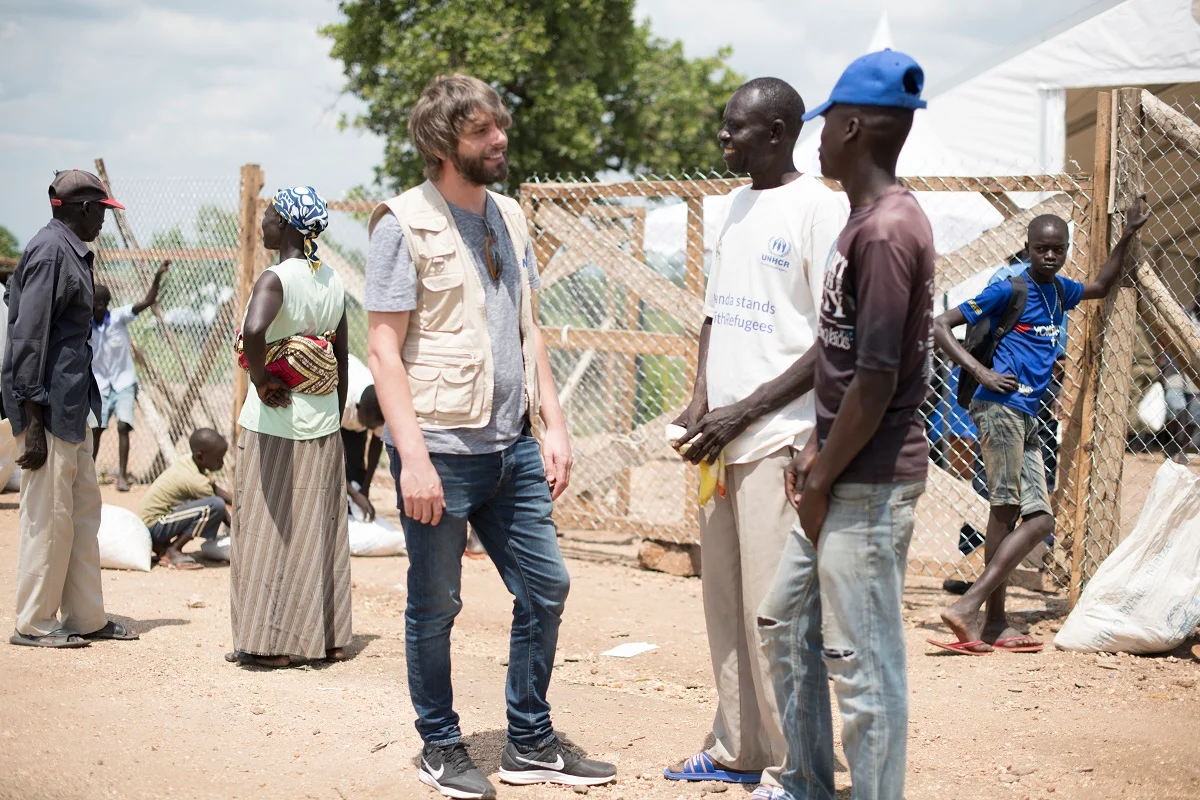

Bidibidi Refugee Settlement
In the summer of 2016, this was empty scrub near a small Ugandan border town, rolling hills of rocky soil that nobody farmed. Within months it held more people than many cities. They came across the border from South Sudan in a hurry no one chooses, families carrying what they could carry, fleeing a civil war that had turned their towns into killing grounds. By the end of 2016 the settlement of Bidibidi, in Uganda's Yumbe District, sheltered some 285,000 of them, and by 2017 it was described as the largest refugee settlement in the world. The numbers are staggering. But Bidibidi is not a number. It is roughly a quarter of a million individual decisions to live.
The People Who Arrived
They are not a faceless mass. Most are Bari speakers from Central Equatoria, including Bari, Mundari, Kuku, Kakwa, Pojulu, and Nyagwara families. Others come from Eastern Equatoria, the Ma'di and Otuho, the Didinga and Lopit and Acholi, and from further across South Sudan, Nuer and Shilluk, Azande and Dinka. Many had been living in Juba when the violence flared again in 2016. A 2018 census of the settlement counted the shape of a displaced society in its rawest form: tens of thousands of small children, thousands of elders over sixty, and a great many women raising families with the men either absent or lost. Each figure is a person who once had an address, a garden, a normal Tuesday, before the war took it.
Building a Town from Nothing
Uganda made an unusual choice. Rather than fence people into a holding camp, the government and its partners set out to build a settlement, something closer to a town that might one day stand on its own. Bidibidi is organised into five zones, subdivided into clusters and villages, governed by elected Refugee Welfare Councils that mirror Uganda's own local structures, chairperson by chairperson, under the eye of the Office of the Prime Minister. Schools that began as tarpaulin and poles are being rebuilt in brick, meant to serve refugee children and the Ugandan host community alike. It is a slow, deliberate transformation: a place designed not merely to contain people but to let them put down something like roots.
Making a Living on Hard Ground
Survival here is daily work. Most families live on subsistence farming and rations from the UN refugee agency and the World Food Programme, and the land does not give easily, the soil thin and rocky, good seed scarce. Newcomers receive saucepans, jerry cans, solar lamps, and mattresses, but these wear out and are rarely replaced, so households share and take turns cooking. Some rent plots from Ugandan neighbours or farm land allocated by aid agencies, planting cassava, beans, millet, maize, and sweet potatoes from seed handed out by groups like the Uganda Red Cross. The host community and the refugees face many of the same shortages, and that shared scarcity has, in its way, bound the two together rather than driving them apart.
Voices and a Stage
What lifts Bidibidi above mere endurance is that people insisted on culture. Bidibidi FM, a community radio station set up with the UN refugee agency and partners, carries information and, just as importantly, the voices of residents telling their own stories on their own terms. In December 2023, the Bidibidi Performing Arts Centre opened, designed by the studio Hassell with the platform To.org and local builders. Made of earth bricks pressed from the soil underfoot, its funnel-shaped roof harvests rainwater for the community while its walls shelter a stage and a recording studio. People play football and netball; children fill the schools. A place that began as a refuge for the displaced is, person by person, becoming somewhere to belong.
From the Air
Bidibidi lies near 3.53°N, 31.35°E in Uganda's Yumbe District, in the West Nile sub-region, close to the South Sudan border. The terrain is low, rolling hills of rocky ground, the settlement spread in dispersed zones rather than a single dense block, which makes it hard to read from altitude. The White Nile runs to the east, and the town of Yumbe is the nearest settlement of note. Closest airport is Arua Airport (HUAR), roughly 80 km southwest; Juba International (HSSJ) in South Sudan lies to the north. This is a populated humanitarian zone deserving of dignity and distance; expect dry-season haze and smoke from grass burning, and afternoon storms in the rains.
Nearby Stories
- Imatong Mountains 99 km away
- Juba 111 km away
- Murchison Falls National Park 115 km away
- Lado Enclave 163 km away
- Garamba National Park 192 km away
- Komanda Massacre 255 km away
- Nyero Rock Paintings 284 km away
- Kakuma 319 km away