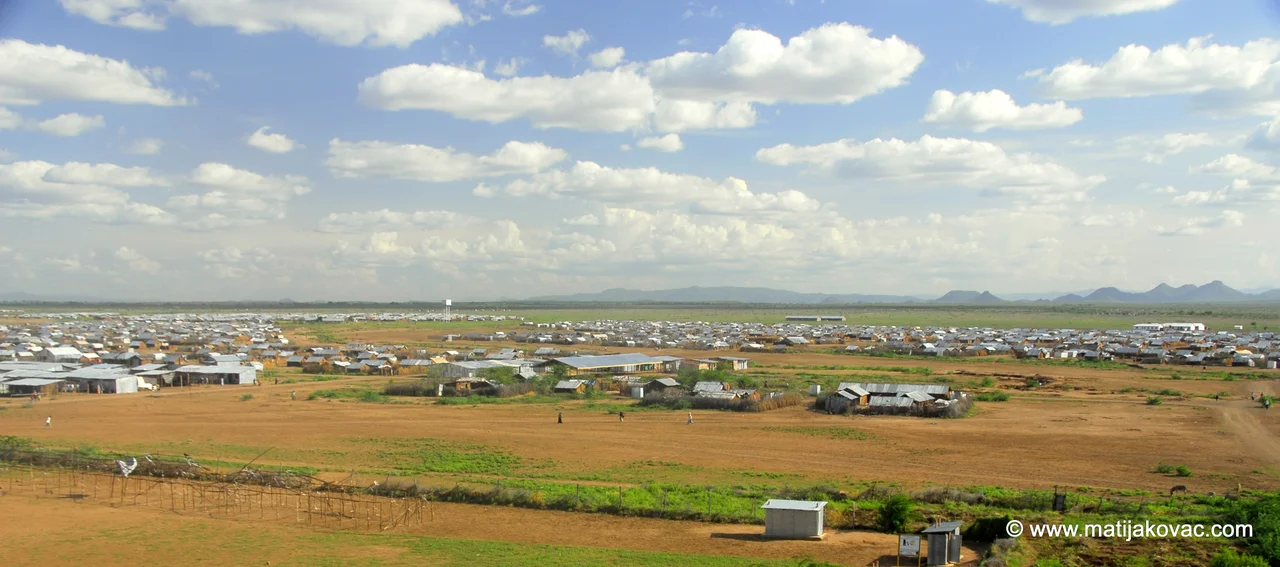

Kakuma
In 1992, thousands of children arrived at a dusty patch of northwestern Kenya with almost nothing, having walked for months and across borders to escape a war that had swallowed their childhoods. They were the unaccompanied minors of Sudan's civil war, the boys and girls the world would come to call the Lost Boys, and Kakuma was built to receive them. More than three decades later, the camp has not closed. It has grown into something its founders never planned: a sprawling, semi-permanent city of the displaced, wedged between two dry riverbeds in the Turkana desert, home to a couple of hundred thousand people from across Africa who are still, in the eyes of the law, only passing through.
The Children Who Walked
Kakuma's origins lie in one of the great forced migrations of the late twentieth century. As Sudan's long civil war tore through the south in the late 1980s, tens of thousands of children, most of them boys, were separated from their families and set off on foot in search of safety. They crossed hundreds of miles, through camps in Ethiopia and onward, losing companions to hunger, thirst, and danger along the way. Many thousands eventually reached Kakuma when the camp opened in 1992. A number were later resettled in the United States, and the story of the Lost Boys of Sudan put a human face on a war that much of the world had ignored. They were not a curiosity. They were children who had survived what no child should have to.
A City That Was Never Meant to Be
Kakuma was designed as a stopgap, and it became a home. Today the complex spans four sections, Kakuma I through IV, with the newer Kalobeyei settlement added nearby in 2015, together sheltering well over 200,000 people. They come from more than twenty countries, with large communities from South Sudan, Somalia, Ethiopia, the Democratic Republic of Congo, Burundi, and beyond. New arrivals are handed a sheet of reinforced plastic, four meters by five, and must build their own shelter around it from mud brick, scavenged wood, and cane. Neighborhoods organize themselves by nationality, and each has raised its own markets, coffee shops, churches, mosques, and libraries. A place built for a temporary crisis has, year by year, taken on the texture of a permanent town.
Building a Life on Rations
Daily life in Kakuma is shaped by scarcity and by rules that hold residents in limbo. The climate is brutal: temperatures climb past 40 degrees Celsius, dust storms scour the camp, and the rare rains can flood the riverbeds. Kenyan law restricts refugees from formal employment, so those who work for aid agencies are paid modest incentives rather than wages. Most depend on the monthly food ration from the World Food Programme, calibrated to a minimum of around 2,100 calories a day, supplemented since 2015 by small digital cash transfers sent to mobile phones. Yet within these constraints people have built a genuine economy. The camp supports hundreds of shops and a thriving market, with restaurants, repair stalls, and businesses that move hundreds of thousands of dollars a month. Survival here is not passive; it is relentless, inventive work.
Where the World Sends Its Help, and Its Neglect
Kakuma runs on an unusual coalition of caretakers. The UN refugee agency oversees the camp alongside the Kenyan government, while a roster of organizations divides the labor: the International Rescue Committee for health, the Lutheran World Federation for primary education and security, Jesuit and Salesian groups for schooling and vocational training. In 2021 the camp opened what was described as the first pediatric operating theater in any refugee camp anywhere, built by a Scottish charity and staffed by a team trained by surgeon Dr. Neema Kaseje. But the lifeline is fragile. For years the United States was a major funder of the humanitarian work here, and when American aid was sharply cut in 2025, the consequences were measured in hunger and, by some accounts, in lives lost. Distant decisions land hard in a place this dependent.
Talent the Desert Could Not Hold
For all its hardship, Kakuma has been a launching point for remarkable lives. From its schools and dusty training pitches have come fashion models like Halima Aden and the supermodel Adut Akech, Olympic runners including Rose Nathike Lokonyen and Lopez Lomong, professional footballers such as Awer Mabil, and basketball player Duop Reath. Refugee-run schools and eLearning projects have stretched scarce resources, and boarding schools built specifically to keep girls in classrooms have pushed against traditions that would have married them off young. None of this erases the desperation that many in Kakuma still live with, the long waits, the faltering rations, the hope of resettlement that may never come. But it insists on the truth too easily lost in the word refugee: these are people with futures, not figures in a tally.
From the Air
Kakuma lies at approximately 3.71 degrees north, 34.87 degrees east, in northwestern Turkana County, Kenya, near the Ugandan and South Sudanese borders. The terrain is flat, hot, semi-arid scrub, and from altitude the camp reads as a large, dense grid of low structures and grading tracks set between two dry riverbeds, a striking patch of human density in an otherwise empty desert. The nearest significant airfield is Kakuma Airport, a dirt strip serving the humanitarian operation and light aircraft, with Lodwar Airport to the southeast offering a longer runway. Expect strong, gusty winds and frequent blowing dust that can sharply reduce visibility; afternoon temperatures routinely exceed 40 degrees Celsius. The Lotikipi plain and the distant Rift escarpment frame the surrounding landscape.
Nearby Stories
- Lothagam North Pillar Site 34 km away
- Lomekwi 41 km away
- Lake Turkana 56 km away
- Ilemi Triangle 112 km away
- Central Island 119 km away
- Imatong Mountains 178 km away
- Sipi Falls 242 km away
- Nyero Rock Paintings 297 km away