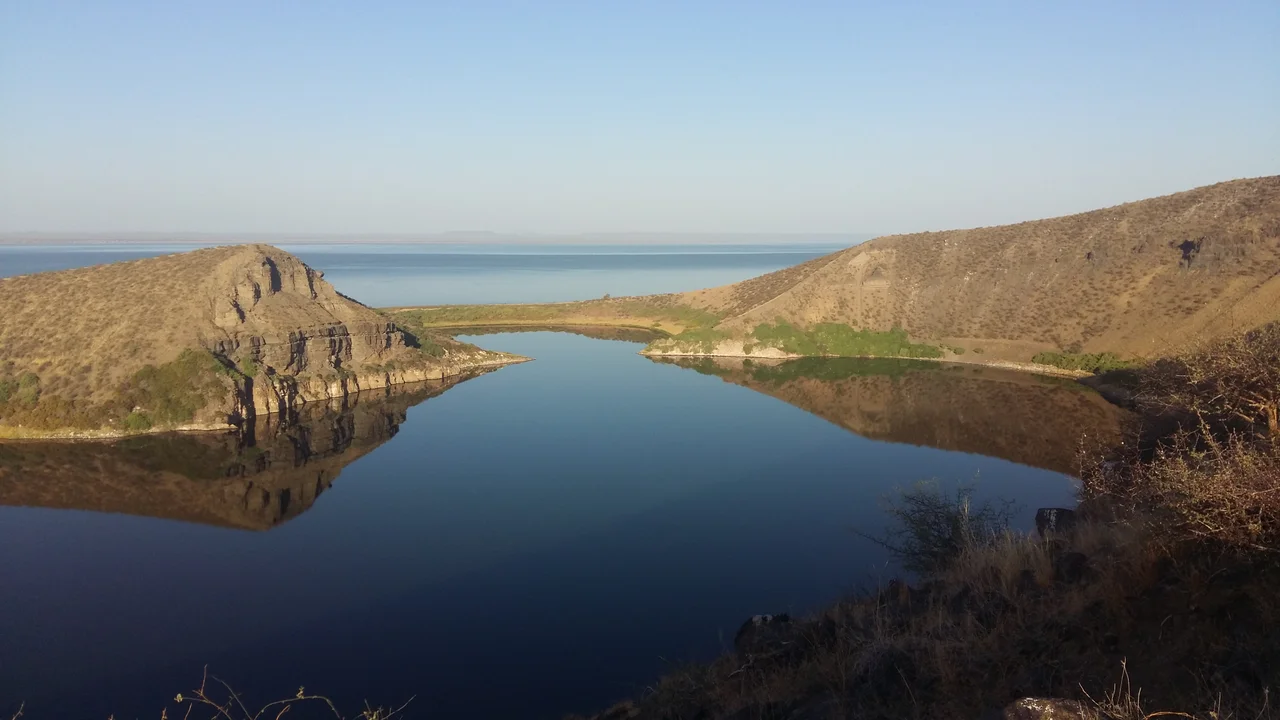

Central Island
The crocodiles got there first, and they named the place. Local Turkana call this volcanic island Chooro, Crocodile Island, and the title is earned: the lakes cupped in its craters hold the largest concentration of Nile crocodiles on Earth. Central Island rises from the middle of Lake Turkana, a jade-green inland sea stranded in the deserts of northern Kenya. Three kilometers across and built from more than a dozen craters and cones, it is not some ancient relic. The volcano still breathes, venting sulfur and steam, while reptiles older than the surrounding mountains breed on the shores of its hidden lakes.
An Island Still Cooking
Central Island is no extinct curiosity. Its youngest lavas and ash may date to the Holocene, geologically yesterday, and the volcano remains restless. Fumaroles vent along the rim of the central crater, and visitors in the 1930s watched sprays of yellow sulfur jet from the ground. In 1974, observers on the distant mainland saw intense emissions of molten sulfur and towering clouds of steam pour off the island. The land here is dominantly basaltic, its high point reaching 550 meters, and an east-west chain of explosion craters slices across the eastern flank. Beneath the lake's surface, more cones and lava plugs lurk, drowned remnants of a fire that has not gone out.
Three Lakes Within a Lake
The island's strangest feature is water held inside water. Three of its craters have filled to become lakes in their own right, each given a name for what lives or gathers there. Crocodile Lake and Flamingo Lake fill the two largest craters, basins nearly a kilometer wide and roughly 80 meters deep, their floors sitting close to sea level even as they perch inside an island in a lake. A third, Tilapia Lake, completes the set. Each crater lake has evolved its own small ecosystem, isolated from its neighbors by walls of volcanic rock. Stand on a rim and you can look down into one colored pool while the vast green expanse of Turkana stretches beyond.
The Crocodile Nursery
Each April and May, the shores of those crater lakes become one of Africa's great reptilian spectacles. Female crocodiles haul out and bury their eggs deep in the warm sand, beyond the reach of monitor lizards and raptors that would dig them up. When the time comes, the hatchlings begin squeaking from inside their buried shells. The sound carries, and the mothers come scrambling to excavate their young and carry them gently down to the water in their jaws. The lake's crocodile population, estimated in the thousands, descends from a lineage that has barely changed in well over a hundred million years. Central Island is their nursery, undisturbed and almost entirely without people.
A Crossroads for Migrating Wings
Crocodiles are only the loudest residents. The island and its lakes draw an extraordinary density of birds, with dozens of water-bird species recorded on and around it. Lesser flamingos wade the shallows of the volcanic lakes, tinting the water pink at the edges. Goliath herons and African skimmers breed here, and each spring the island fills with European migrants pausing on their long journey north. For a speck of rock in a desert lake, the variety of life crowding its shores is startling, a reminder that even the most forbidding landscapes can become essential waypoints.
Protected and Almost Untouched
Today the whole island is Central Island National Park, managed by the Kenya Wildlife Service and part of the Lake Turkana National Parks World Heritage Site. There are no towns, no roads, no permanent inhabitants, only the volcano, the crocodiles, the birds, and the wind off the lake. Reaching it means a boat across open and often rough water from the Turkana shore, and the reward is a place that feels genuinely primeval. To climb a crater rim here, with steam venting somewhere behind you and hatchlings calling from the sand below, is to stand inside a landscape still being made.
From the Air
Central Island lies at 3.5 degrees north, 36.05 degrees east, squarely in the middle of Lake Turkana. From altitude it is a distinct dark landmass roughly 3 kilometers across, set against the milky jade-green water that gives the lake its nickname, the Jade Sea. Look for the circular crater lakes pooled on its surface, the largest nearly a kilometer wide, and for the chain of explosion craters cutting across the eastern side. The island's highest point reaches 550 meters, about 190 meters above the lake. Active fumaroles may show as faint steam or discoloration along the central crater rim. The nearest sizable airstrip is at Lodwar to the west; Eliye Springs and other lakeside strips serve light aircraft. Winds over Turkana are frequently strong and gusty, kicking up surface chop; expect turbulence and haze from blowing dust over the surrounding desert.
Nearby Stories
- Lomekwi 32 km away
- Nataruk 52 km away
- Kakuma 71 km away
- Chalbi Desert 88 km away
- Ilemi Triangle 175 km away
- Lower Valley of the Omo 188 km away
- Marsabit 199 km away
- Cherangani Hills Forest 208 km away