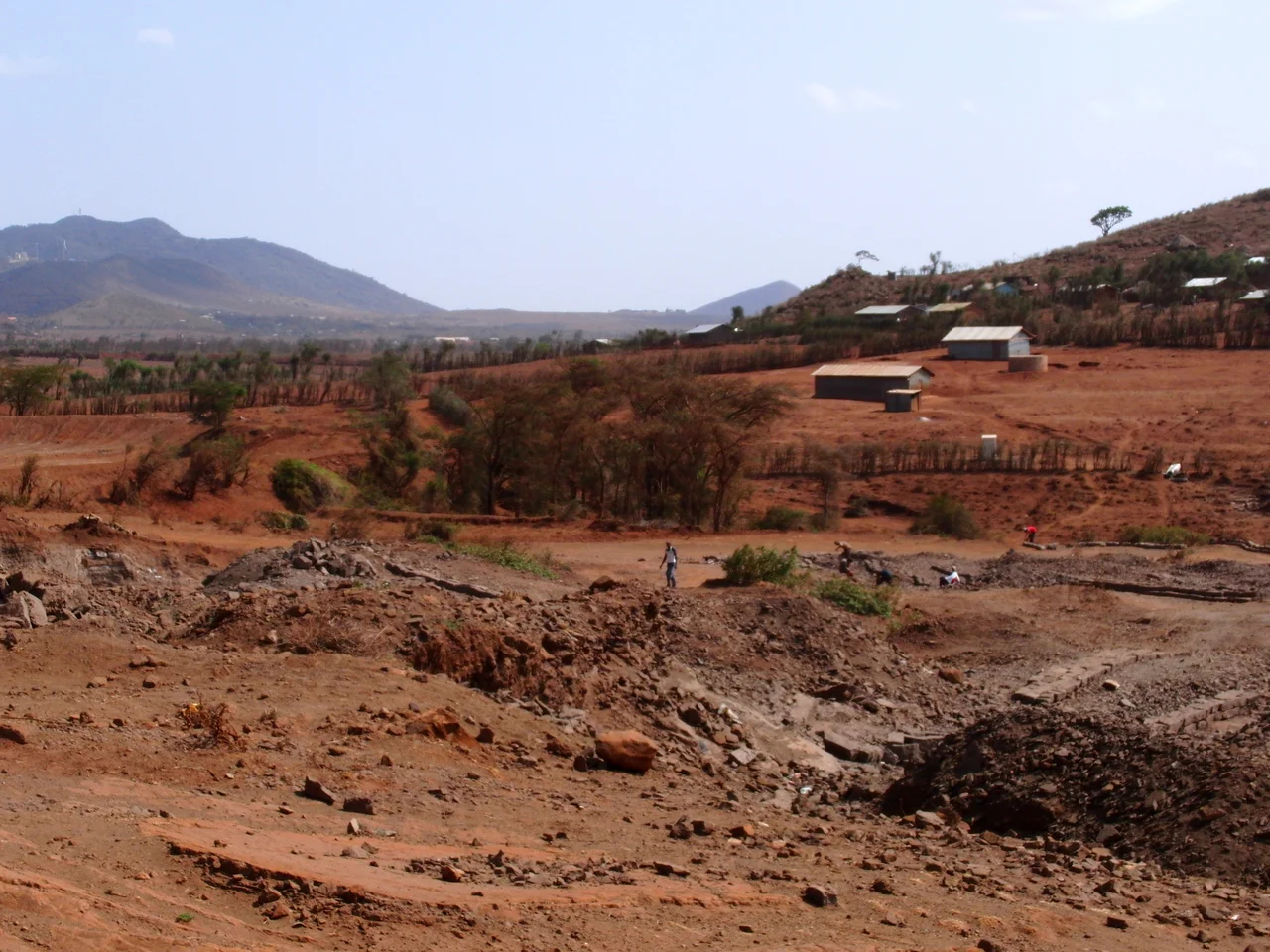

Marsabit
Drive north from Isiolo across the gravel plains and the heat does the thinking for you. The Chalbi Desert shimmers, the scrub thins to nothing, and the horizon flattens into a hard bright line. Then a single mountain lifts out of the haze, green where everything else is brown, its summit wrapped in cloud. This is Marsabit, an extinct volcano that catches the clouds the lowlands cannot hold and wrings them into forest. The town sits on its shoulder, a kilometer above the desert floor, an outpost of cool air and tall trees in one of the most remote corners of Kenya.
A Forest That Floats
Marsabit is an island, though no water surrounds it. Mount Marsabit rises almost a thousand meters above the surrounding desert, high enough to snag the moisture-laden Turkana Jet, a strong wind that sweeps in from the Indian Ocean. The clouds pile up against the slopes and release their rain, and the result is a dense montane forest perched on a sea of sand. The Rendille name for the place captures the sight exactly: clouds engulfing a dark peak. Step from the parched lowlands into this canopy and the temperature drops, the light goes green, and elephants move through the undergrowth. The forest grows its own weather, and within it lives an ecosystem cut off from anything for hundreds of kilometers in every direction.
Craters Called Gofs
The mountain is pocked with the scars of old eruptions, deep volcanic craters the Borana people call gofs. The most beautiful cradles Lake Paradise, a still sheet of water held inside a caldera whose forested walls rise some 150 meters around it. Elephants and buffalo come down to drink at its edge, and the name needs no defending. Nearby lies Gof Sokorte Dika, which means small sweet-water crater, and the rim of Gof Bongole stretches ten kilometers around. These hidden lakes, ringed by forest and visited by game, draw the anthropologists and naturalists who have long treated Marsabit as a living laboratory of how life adapts to isolation.
The Singing Wells
Water is the organizing fact of life here, and nowhere is that clearer than at the singing wells just outside town. To reach the water table, herders dig deep shafts and form human chains down into the earth, passing buckets hand to hand toward the surface. As they work, they sing, each clan with its own melody, and the cattle and camels learn to come when they hear their family's song. The rhythm coordinates the labor and calls the animals at once. In a landscape where a wrong turn means thirst, this music is both an irrigation system and a memory passed down through generations of Rendille, Borana, Gabra, and Burji who share these slopes.
Ahmed, the King of Marsabit
For a time, the most famous resident of Marsabit was an elephant. Ahmed carried tusks so enormous they were said to brush the ground, and as poaching surged, Kenyan schoolchildren wrote letters to President Jomo Kenyatta begging him to spare the giant. Kenyatta issued a presidential decree in 1970, placing Ahmed under round-the-clock guard, the first elephant in Kenya protected by name. Five armed rangers shadowed him until 1974, when they found him dead beneath a tree, fifty-five years old, taken by age rather than a bullet. His body was preserved and now stands in the Nairobi National Museum, a monument to one mountain's most celebrated inhabitant.
Crossroads of the North
Despite its isolation, Marsabit is no backwater. The town of roughly five thousand serves as the capital of Marsabit County and a vital trading post on the long tarmac road that runs from Nairobi to the Ethiopian border at Moyale. Goods from Ethiopia move south through here, goods from Nairobi move north, and the streets mix Cushitic-speaking pastoralists with traders, farmers, and government workers. Camels rest beside market stalls. The place has known friction too, including long-running disputes between Borana and Gabra communities that elders have repeatedly gathered to resolve. But for the traveler arriving from the desert, Marsabit is first and foremost relief: a green mountain, cool air, and the sound of singing rising from the wells.
From the Air
Marsabit sits at 2.33 degrees north, 37.98 degrees east, at an elevation of roughly 1,300 to 1,400 meters atop an extinct volcano. From the air it is unmistakable: a dome of dark green forest standing alone above the tan desert, often capped by cloud where the Turkana Jet forces moist air up the slopes. Look for the circular crater lakes set into the forest, especially Lake Paradise in its 150-meter caldera. The town has two airstrips for charter and light aircraft, Marsabit Airstrip near town toward Moyale and Segel Airstrip toward the Chalbi. Mission Aviation Fellowship runs scheduled light flights. The area is notably windy; expect turbulence on the lee side of the mountain and reduced visibility when low cloud caps the summit. The Chalbi Desert lies to the northwest as a flat, pale reference.
Nearby Stories
- Chalbi Desert 53 km away
- Suguta Valley 123 km away
- Wagalla Massacre 145 km away
- Nataruk 168 km away
- Samburu National Reserve 179 km away
- Central Island 252 km away
- Dadaab 316 km away
- Bale Mountains National Park 462 km away