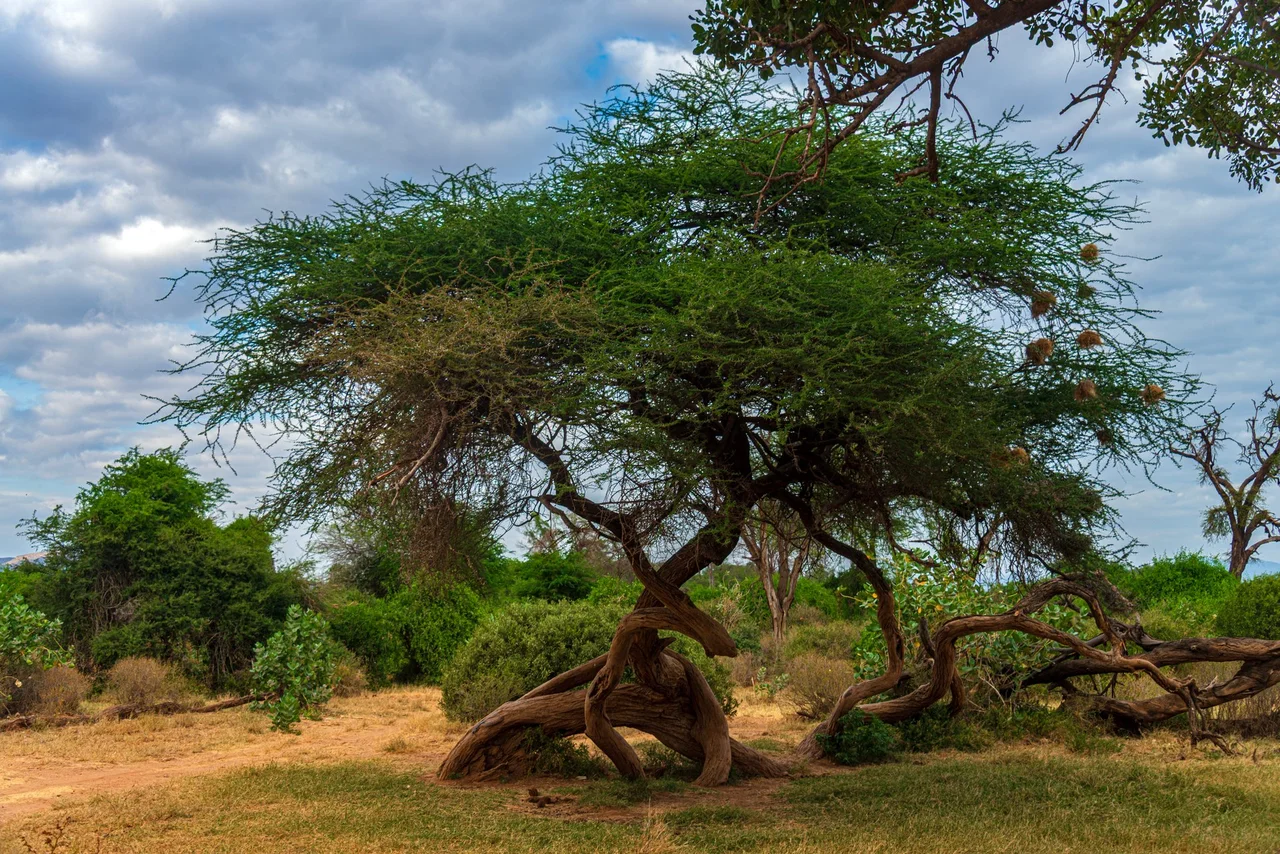

Samburu National Reserve
A lioness should eat an oryx calf. That is the order of things on the savanna, written into instinct over a million years. But in December 2001, on the dry plains of Samburu National Reserve, a young lioness did the opposite. She guarded a newborn oryx as if it were her own cub, defended it, refused to hunt - and when it was eventually lost, she found another, and then another. The Samburu people who watched her named her Kamunyak, 'the blessed one.' Her story made this reserve in northern Kenya famous around the world. But the land had its own quiet magic long before she appeared, and keeps it still.
The River Called Brown Water
Everything here bends toward the river. The Ewaso Ng'iro - its name means 'brown water' in the Maa language - flows down from the Kenyan highlands and cuts through the heart of the reserve, lined with doum palms and dense riverine forest before it loses itself in the distant Lorian Swamp. In this dry country, the river is life. Elephants come to drink and bathe, big cats stalk the banks at dusk, and great Nile crocodiles bask in numbers along the shallows, occasionally clashing with lions over a kill at the water's edge. Two mountains preside over the reserve, Koitogor and the sheer flat-topped massif of Ololokwe, a sacred landmark to the Samburu. Away from the water, the land runs to acacia, thorn scrub, and grassland, baking under a northern sun.
The Special Five
Most safaris chase the big five. Samburu offers something rarer: a roster of dry-country animals found in few other places, known to guides as the Samburu Special Five. There is the gerenuk, a slender gazelle that stands on its hind legs to browse high branches, looking almost giraffe-necked. There is the reticulated giraffe, its coat a mosaic of clean polygons. There is the Grevy's zebra with its fine, dense stripes, the towering Somali ostrich, and the Beisa oryx, a desert antelope armed with long rapier horns. Around these specialists gathers the broader cast of the African plains - lion, cheetah, leopard, elephant, buffalo, and hippo, along with olive baboons, dik-diks, impala, and waterbuck. Black rhinos, wiped out here by poaching, have been reintroduced after an absence of a quarter century. Overhead and underfoot, more than 350 bird species fill the reserve, from lilac-breasted rollers to the stalking, improbable secretary bird.
Born Free Country
This corner of Kenya helped write one of the most beloved animal stories of the twentieth century. Samburu was one of two places where the conservationists George and Joy Adamson raised Elsa, the orphaned lioness they returned to the wild - the story Joy told in her bestselling book Born Free, later an award-winning film that shaped how a generation saw Africa's wildlife. The reserve's bond with its lions and elephants endures. The Elephant Watch Camp, directed by Saba Douglas-Hamilton, sits within the park, continuing a tradition of close, careful observation of the herds. From 2005 the reserve has been recognized as part of a Lion Conservation Unit, one node in the wider effort to keep the great cats roaming a landscape that has known them for ages.
The People Behind the Name
The reserve carries the name of the Samburu, the pastoralist people of this region, and it is owned and managed by the Samburu County Government - the land and its wildlife held by the community whose home this has always been. Closely related to the Maasai and sharing a form of the Maa language, the Samburu are herders of cattle, goats, and camels, moving with their animals across the semi-arid north in a way of life shaped by the same scarce water that draws the wildlife to the Ewaso Ng'iro. The reserve's long isolation - far from industry, hard to reach for many years - preserved a rare serenity here. It also preserved the connection between a people and a place, so that the name on the map and the people on the land remain, fittingly, one and the same.
From the Air
Samburu National Reserve lies at 0.62°N, 37.53°E, in Samburu County, northern Kenya, on the banks of the Ewaso Ng'iro river. From the air, the reserve's defining feature is that river - a green ribbon of doum palms and riverine forest winding through otherwise dry acacia bushland and grassland. Look for the distinctive flat-topped massif of Ololokwe and the rise of Koitogor within the reserve. The dedicated Samburu Airport (HKSB) serves the reserve directly with an airstrip for safari traffic; the larger Isiolo Airport lies to the south. Best viewing is early morning or late afternoon, when game gathers at the river and the low sun rakes across the bushland; midday brings strong heat haze and thermals over the semi-arid plains.
Nearby Stories
- Lewa Wildlife Conservancy 17 km away
- 2007–2008 Kenyan crisis 28 km away
- Great Rift Valley, Kenya 77 km away
- Aberdare National Park 85 km away
- Suguta Valley 142 km away
- Marsabit 162 km away
- Kanapoi 221 km away
- Wagalla Massacre 254 km away