.jpg)
Lewa Wildlife Conservancy
A cattle ranch is an unlikely cradle for a conservation legend, but that is where Lewa began. For more than fifty years this stretch of northern Kenya, in the foothills below Mount Kenya, ran cows. Then, in the early 1980s, a single endangered species changed everything. The owners fenced off a corner for black rhinos, and that corner grew until it swallowed the whole ranch. Today Lewa Wildlife Conservancy is a UNESCO-listed haven of more than 250 square kilometres, a place where rare rhinos graze and the largest herd of Grevy's zebra on Earth drifts across the plains - and, as it happens, where a prince once knelt to propose.
From Cattle to Rhinos
The Craig family were given this land by the British colonial government in 1922, and for over half a century they ran it as a cattle ranch called Lewa Downs. The turning point came in 1983, when the Craigs joined forces with the conservationist Anna Merz, who funded the creation of the fenced, guarded Ngare Sergoi Rhino Sanctuary at the ranch's western edge. It was a refuge for a species being slaughtered toward extinction. The sanctuary worked, and it grew. A decade later it had expanded across the rest of the ranch, and in 1994 the neighbouring Ngare Ndare Forest Reserve was folded inside the fence. The conservancy as we know it was formally established in 1995, the cattle largely gone, the wildlife returned.
The Stripes That Aren't Like the Others
Look closely at a Grevy's zebra and you see a different animal entirely from the common plains zebra: taller, with large rounded ears and stripes so fine and tightly drawn they look almost printed. It is the largest wild member of the horse family, and it is endangered, its global numbers a fraction of what they once were. Lewa is its stronghold. The conservancy holds the single largest population of Grevy's zebra in the world - roughly 350 animals - along with reticulated giraffe, sitatunga, and the full roster of the big five: lion, leopard, elephant, rhino, and Cape buffalo. Most consequentially, Lewa protects over twelve percent of Kenya's entire eastern black rhino population, the very species whose plight first set this land on its new course.
The Race Through the Wild
Once a year, the plains of Lewa host one of the strangest marathons on the planet. Runners line up for a full 42-kilometre course that winds through open savanna patrolled by elephants, rhinos, and lions, with rangers and spotter planes watching the route in case the wildlife takes an interest in the runners. The Lewa Safari Marathon was founded by the Tusk Trust and first run in 2000, and it has become a fixture of the conservation calendar, raising substantial sums for wildlife protection and community development across the region. It is a singular thing - to run a measured marathon and know that the spectators along the course are not crowds but herds, and that the marshals are armed not against rival runners but against the wild itself.
Rangers, Royalty, and a Recognized Landscape
Lewa's story is bound up with people as much as animals. The men and women who guard the rhinos do dangerous work, and in 2015 the conservancy's head of anti-poaching, Edward Ndiritu, received the Tusk Wildlife Ranger Award from Prince William - recognition for those who stand between poachers and the last of a species. The royal connection runs deeper still: it was here at Lewa, in October 2010, that Prince William proposed to Catherine Middleton. And the wider world has taken notice too. In 2013, Lewa was inscribed as part of a UNESCO World Heritage Site, joined to the Mount Kenya listing whose forested slopes rise to the south - an acknowledgement that this former cattle ranch had become something of global value, a working model for how land can be given back to the wild.
From the Air
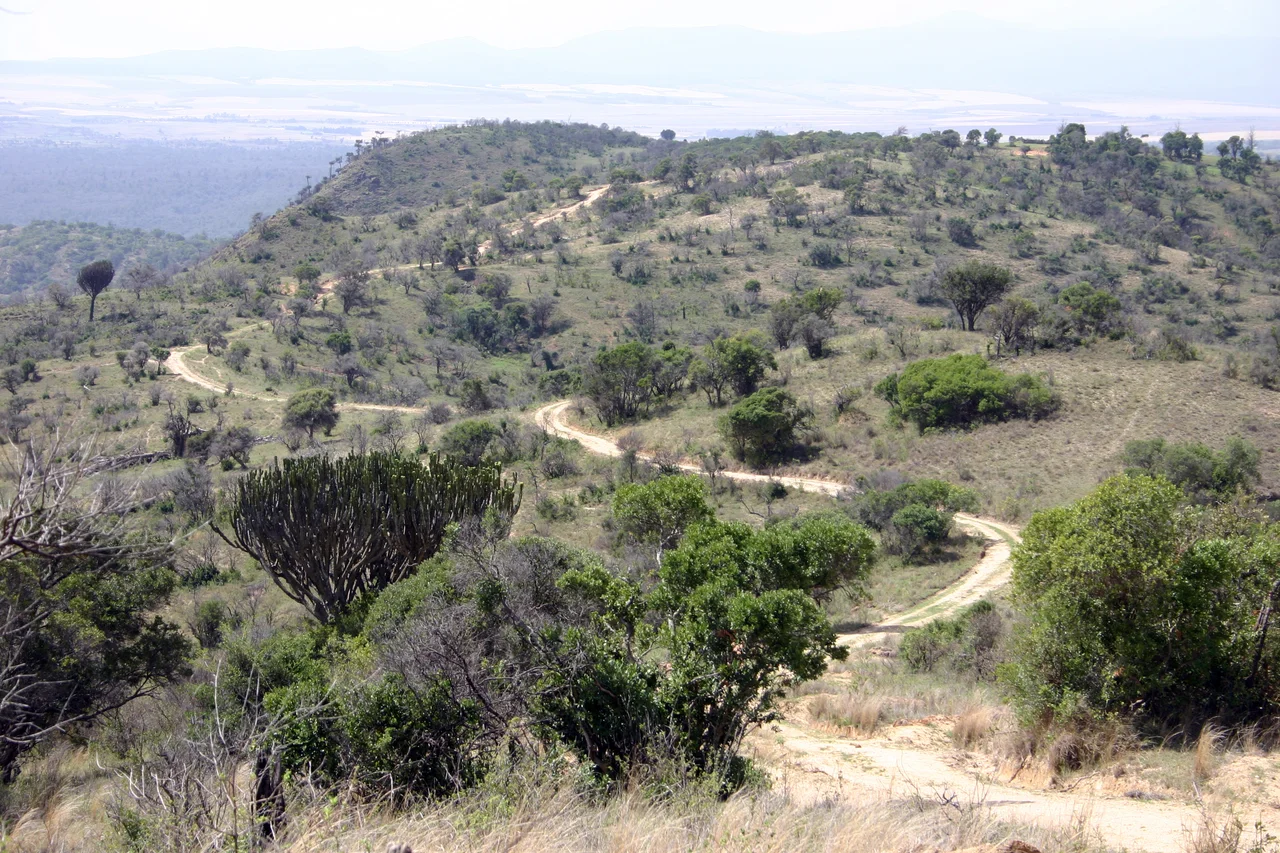
Lewa Wildlife Conservancy lies at 0.20°N, 37.42°E, in northern Kenya, in Meru County south of Isiolo town and north of Mount Kenya. From the air it presents as open rolling savanna and grassland threaded with acacia, bounded by the Ngare Ndare Forest to the south and rising toward the dark, often cloud-wrapped massif of Mount Kenya beyond. Lewa has its own airstrip serving safari traffic; the nearest major airfields are Nanyuki Airport (HKNY) to the southwest and the larger Isiolo Airport to the north. Best viewing is early morning, when the air is clearest and the foothills below Mount Kenya stand sharp before midday cloud builds over the mountain. Watch for game on the open plains and the distinctive fenced boundaries of the conservancy.
Nearby Stories
- Samburu National Reserve 14 km away
- 2007–2008 Kenyan crisis 19 km away
- Aberdare National Park 49 km away
- Great Rift Valley, Kenya 78 km away
- Lake Baringo 93 km away
- Mount Longonot National Park 150 km away
- Marsabit 201 km away
- Tsavo East National Park 322 km away