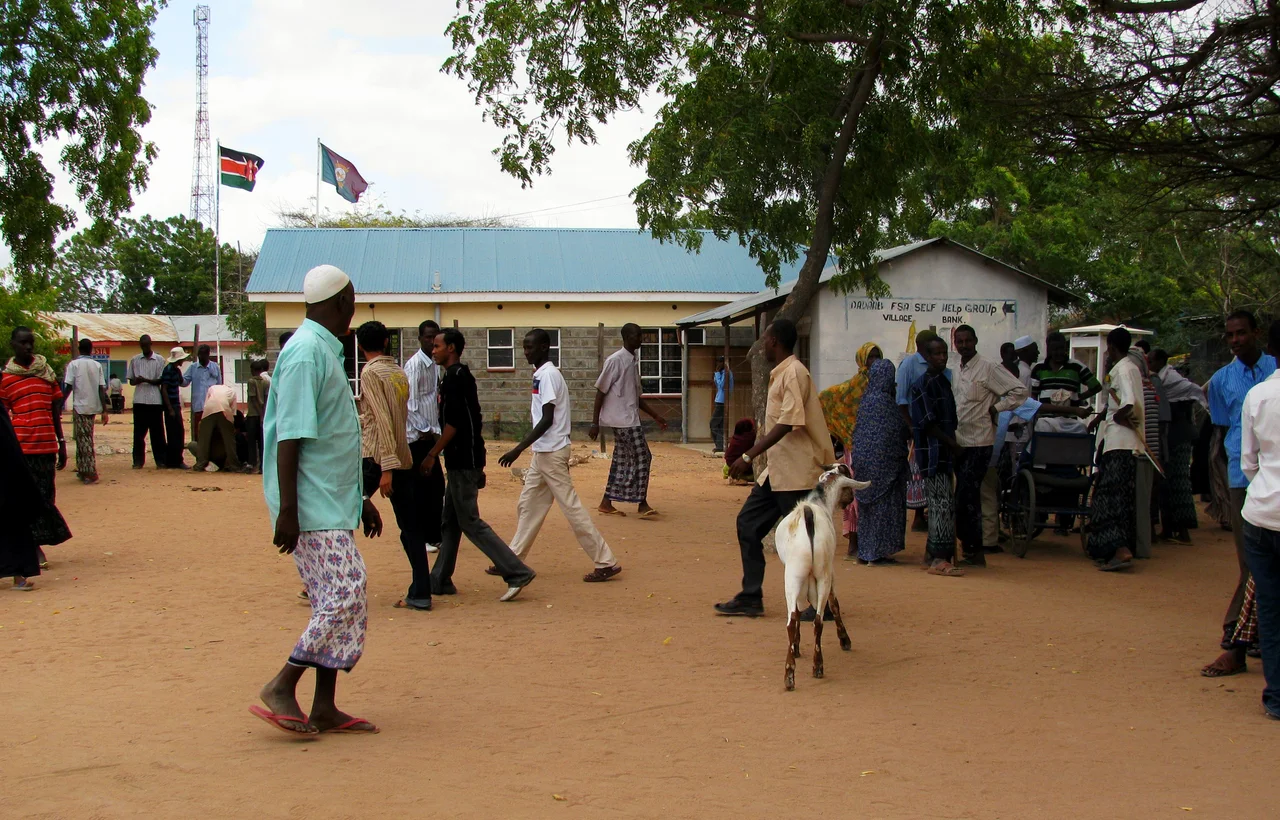

Dadaab
It was supposed to last a few months. In 1992, aid workers laid out the first camps near a small market town in the thornbush of northeastern Kenya, expecting to shelter people fleeing Somalia's collapse until the fighting stopped. The fighting did not stop. More than three decades later, Dadaab is still here, and so are the families who arrived with nothing and built lives in a place that was never meant to hold them. By the spring of 2025, the complex registered more than 432,000 refugees and asylum seekers, making it one of the largest such settlements in the world. Behind that number are people who have raised children, buried parents, and grown old waiting to go home.
A City That Was Never Planned
Dadaab grew the way few cities ever do: not by design, but by necessity. The original camps of Dagahaley, Hagadera, and Ifo were built in 1992 for roughly 90,000 people. When drought and famine struck the Horn of Africa in 2011, more than 160,000 new arrivals walked in over a matter of months, and the population swelled past 500,000. For a time, Dadaab was the single largest refugee camp on the planet, larger than many Kenyan cities. The United Nations refugee agency manages the complex, while organizations like CARE handle water and sanitation and the World Food Programme distributes rations. Aid has rarely kept pace with need. New arrivals once waited an average of twelve days before receiving their first food rations, sleeping in the open while the registration lines crept forward.
The People of Dadaab
The vast majority of residents are Somali, roughly 97 percent in recent years, most having fled the civil war and the droughts that followed it. Four in five are women and children. Before the camps existed, this land belonged to nomadic herders who moved their camels and goats across the dry country with the seasons, and some of that older world persists at the edges of the settlement. But Dadaab today is something else: a place where a generation has been born and raised who have never seen Somalia, who know home only as a story their grandparents tell. They are not a faceless crowd. They are students and shopkeepers, teachers and traders, people building dignity inside circumstances they did not choose.
Classrooms in the Thornbush
Education is the quiet engine of Dadaab. By 2024, the camp schools served more than 70,000 students, taught in buildings of stone and overflow classrooms made of long white tents. Scholarships reward the brightest, sending a handful on to universities far beyond the camp's fences. The challenge is staggering, but so is the ambition: families who lost everything still send their children to school each morning, betting on an education as the one inheritance the war could not take. Since 2015, the complex has run the largest solar-powered borehole in Africa, its 278 panels pulling roughly 280,000 litres of water a day from deep underground for tens of thousands of residents.
Living in Limbo
Life in Dadaab is shaped by impermanence. The Kenyan government has threatened more than once to close the camps, citing security concerns, and each threat sends a current of anxiety through a population with nowhere certain to go. Some families have chosen to return to Somalia under repatriation programs; many cannot, because the home they remember no longer exists. Floods have washed away thousands of shelters; droughts have driven thousands more to arrive. Residents have learned to build with what the land offers, raising homes of mud, metal sheeting, and tree branches against the relentless heat. It is a hard place, but it is not a hopeless one. It is a community that has insisted on continuing, year after improbable year.
From the Air
Dadaab lies at 0.05°N, 40.31°E, on a flat semi-arid plain in Garissa County, northeastern Kenya, only about 80 km from the Somali border. From the air the complex reads as a vast grid of low structures and access tracks spread across the thornbush, with the town and its airstrip at the center. The nearest major airfield is Garissa Airport (ICAO: HKGA), roughly 90 km to the southwest; Wajir Airport (ICAO: HKWJ) sits to the north. The region is hot and dry for most of the year, offering long stretches of clear high-visibility skies broken by occasional seasonal dust and the brief, dramatic rains that periodically flood the plain.
Nearby Stories
- Wagalla Massacre 163 km away
- 2007–2008 Kenyan crisis 192 km away
- Samburu National Reserve 246 km away
- Tsavo East National Park 308 km away
- Barawa 371 km away
- Tsavo Man-Eaters 371 km away
- Ajuran Sultanate 421 km away
- Ethiopian Airlines Flight 961 1276 km away