
Nataruk
Among the dead was a woman in the last weeks of pregnancy, her hands apparently bound. She lay where she fell, beside men, women, and children who would not be buried, on the shore of a lake that no longer exists. They had been dead for roughly ten thousand years when researchers found them in 2012, scattered across a stretch of dried mud near a place in Turkana County called Nataruk. Twenty-seven people in all. What happened to them has become one of the most debated questions in the study of human violence - and a reminder that the people at the heart of it were exactly that. People.
The People of the Lakeshore
They were hunter-gatherers, and they had chosen well. Ten thousand years ago Nataruk sat at the edge of a shallow, fertile arm of Lake Turkana - a long beach that drew animals to drink and made for superb fishing, the richest such ground in that part of the basin. Forested deltas to the east and north were more dangerous; mountains pressed the lake elsewhere. Here, life was good. The dead include eight men and eight women, with five adults whose sex could not be determined, and the partial remains of six children. They are not statistics. They were a community - families who fished and foraged a generous shore, and who, on one particular day, met something they could not survive.
What the Bones Record
The injuries are hard to read and harder to forget. Dr. Marta Mirazón Lahr and her colleagues, excavating as part of the IN-AFRICA Project, described extreme blunt-force trauma to skulls and cheekbones, broken hands and knees and ribs, arrow wounds to the neck, and stone projectile tips lodged in the skull and chest of two men. Some of the dead, including the pregnant woman, appear to have had their hands tied. The weapons suggest intent: clubs of at least two sizes, arrows, and stone blades - a combination of distance and close-quarters arms that the team read as planning rather than a chance brawl. Two of the embedded projectiles were obsidian, a stone rare in the area, hinting that the attackers came from somewhere else. To the researchers, it looked like a deliberate assault by one group upon another.
Massacre, or Something Else?
Not everyone agrees, and the disagreement matters. In a formal response in Nature, the anthropologist Christopher Stojanowski and colleagues challenged the interpretation on two grounds. Much of the apparent injury, they argued, could have happened after death - as bodies were crushed and distorted by the sediment that buried them over millennia. And the bodies themselves, they noted, were mostly articulated, organized in space, and consistent in position, which is not how the dead usually lie at confirmed massacre sites. Mirazón Lahr has stood by her reading, pointing to companion cases of violent trauma nearby. The honest answer is that we cannot be certain what unfolded at Nataruk. What is not in doubt is that real people died there, violently or otherwise, and that their remains have outlasted ten thousand years to make us ask the question at all.
How Old Is War?
Nataruk lands a blow on a comfortable assumption. Organized violence, the old thinking went, arrived with settled life - with farms, granaries, property, and the walls built to defend them. But Nataruk's people owned no fields and stored no harvest, and still, on at least one reading, they were attacked as a group. If Mirazón Lahr is right, the seeds of inter-group conflict run deeper than civilization itself. The comparison most often drawn is to Jebel Sahaba in Sudan, a slightly older Nile-valley cemetery where many of the buried also died violent deaths - but those dead were carefully interred, again and again, suggesting a settled community returning to bury its own. Nataruk is different. There was no cemetery, no ritual, no return. There was a shore, a community, and a day that ended them - and a debate, still unresolved, over what that day can tell us about ourselves.
From the Air
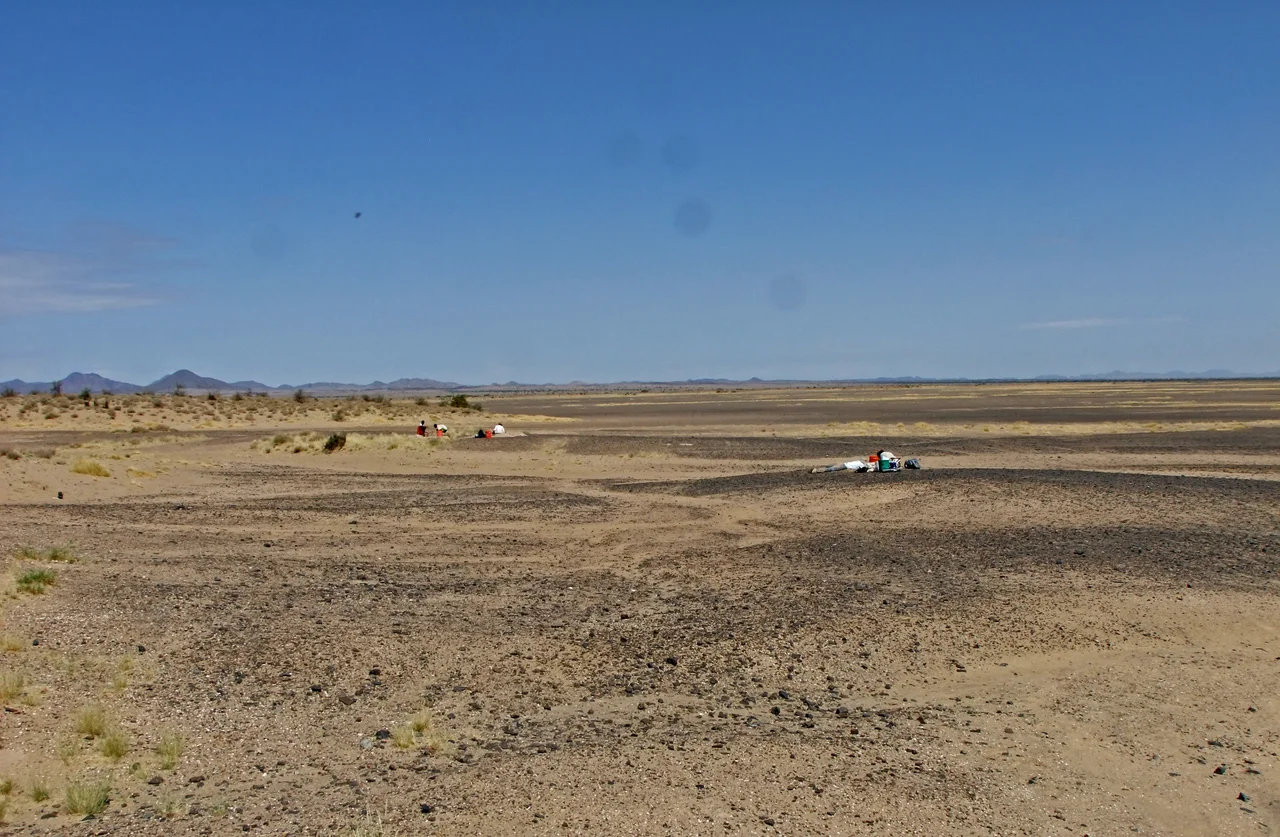
Nataruk lies at 2.71°N, 36.14°E, in Turkana County, Kenya, on the western side of Lake Turkana within the Turkana Basin. From the air, the site is an unmarked expanse of arid, eroded sediment - the bed of a long-vanished arm of the lake - set back from the present shoreline of Lake Turkana's pale jade waters to the east. Nearby landmarks include the dry deltas of the Kerio and Turkwel rivers and the older fossil ground of Lothagam, about 20 km to the north. The nearest sizable airfield is Lodwar Airport (HKLO), roughly 40 km southwest; Lokichoggio (HKLK) lies farther northwest. The basin is extremely hot and dry; fly early for the clearest air, as midday thermals and heat haze rise strongly over the exposed ground.
Nearby Stories
- Kanapoi 16 km away
- Lothagam North Pillar Site 55 km away
- Chalbi Desert 87 km away
- Kakuma 107 km away
- Cherangani Hills Forest 130 km away
- Marsabit 159 km away
- Kapenguria 171 km away
- Samburu National Reserve 258 km away