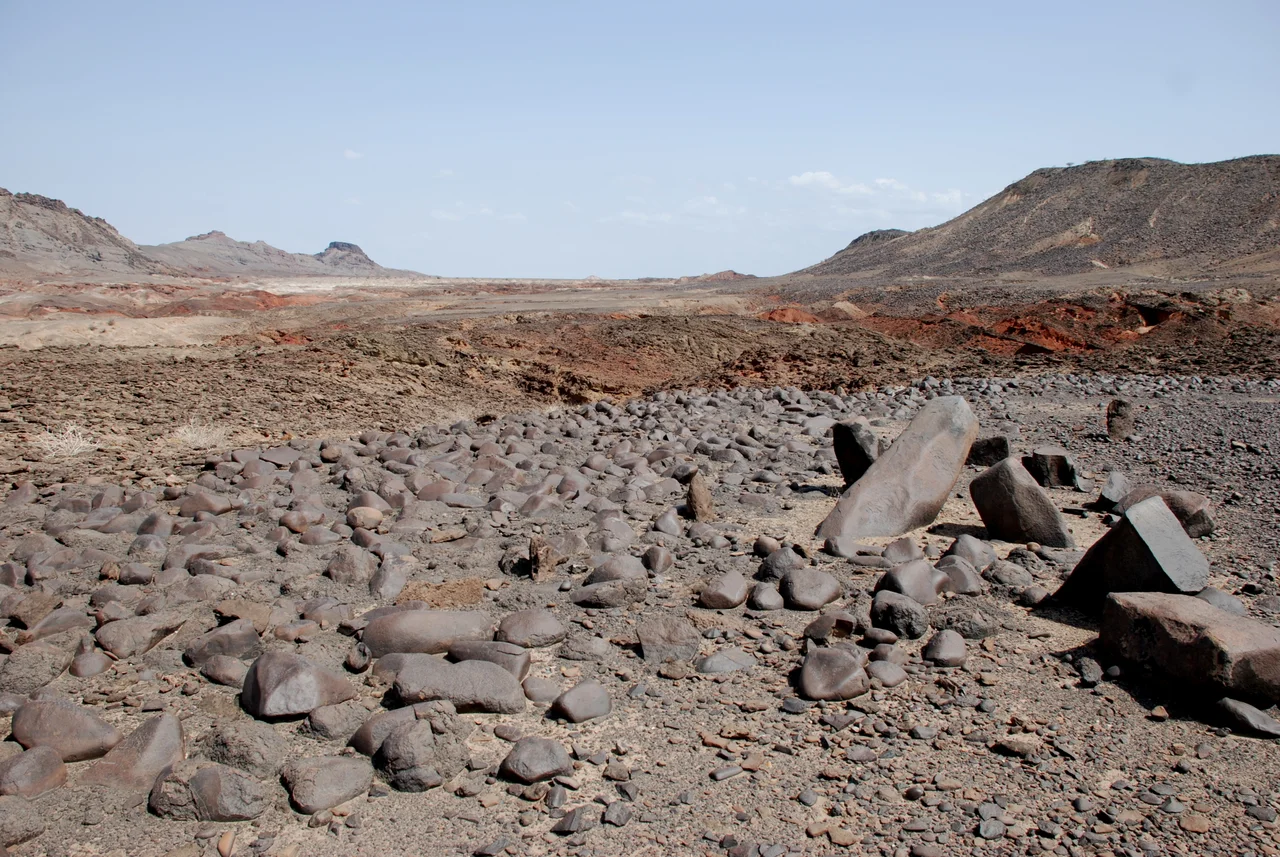

Lothagam North Pillar Site
Their world was coming apart, so they built something that would last. Five thousand years ago, on the western shore of Lake Turkana, the region's earliest herders watched the rains fail and the lake pull back from its old margins. Pastures shrank. The certainties of one generation no longer fit the next. In the middle of that slow upheaval, these mobile cattle-keepers gathered to dig an enormous grave and raise stone pillars over it, returning again and again across nearly five centuries to bury their dead together. Archaeologists call it the Lothagam North Pillar Site, eastern Africa's largest and earliest known monumental cemetery.
A Lake in Retreat
To understand the monument, picture the climate that produced it. During the early and middle Holocene, the Sahara was green and wet, and the first herding economies spread fast, sheep and goats and cattle moving down through the Central Sahara and the Nile Valley. Then the long humid period began to close. Aridity crept back across North Africa, populations shifted south, and around Lake Turkana the water receded as rainfall declined. The people here were among the very first in eastern Africa to live by herding livestock, and they did so on a landscape that was visibly changing beneath them. They still fished and hunted aquatic creatures, still made pottery, still adapted from one year to the next. Construction at Lothagam North began amid exactly this instability, between roughly 3000 and 2300 BCE.
Building the Grave
The scale of the work is hard to overstate for a society without metal tools or cities. On a platform ringed by boulders, covering some 700 square meters, the builders cleared the beach sand away down to the sandstone bedrock to open a great mortuary cavity. Into it they laid their dead, each person buried roughly a meter deep in a smaller pit, and where the bedrock was soft they carved still more graves into the stone at the bottom. Estimates of how many people rest inside run from about 580 to more than a thousand. Excavators have opened only thirty of those burials so far, recovering the remains of at least forty-four individuals, men and women of every age, infants alongside elders.
Buried With Beauty
Nearly everyone interred here was adorned. The dead wore ornaments of stone beads, carved ivory, and rings, and among the most striking finds were beads fashioned from animal teeth, including hundreds of tiny gerbil incisors painstakingly drilled and strung. There is care in these graves, and there is craft, but there is something else just as telling: there is no hierarchy. The ornaments are spread broadly rather than concentrated on a privileged few. No outsized tomb marks a chief, no lavish burial sets one person above the rest. Whatever distinctions existed among the living, in death these people met the earth as equals.
Monuments Without Kings
That absence of rank is what makes Lothagam North quietly revolutionary. For a long time, the standard story held that grand communal monuments required stratified societies, that you needed rulers and elites and chains of command to marshal the labor. Lothagam North tells a different story. Here a small-scale, mobile, egalitarian people coordinated a centuries-long building project on their own terms, without anyone in charge. The study that brought the site to wide attention, led by archaeologist Elisabeth Hildebrand of Stony Brook University and published in 2018, argues that monumentality itself was the social glue. A fixed, shared place to gather and bury the dead gave scattered herders a reason to come together.
A Meeting Place in Stone
Imagine what the cemetery did for people whose lives were defined by movement. In a time of strained resources and shifting boundaries, a permanent landmark on the lakeshore offered something rare: a reason to assemble, year after year, generation after generation. Coming together to honor the dead also meant trading news, arranging marriages, sharing intelligence about water and grazing, and planning the great seasonal movements of the herds. The monument was a memory and a map and a promise, all at once, a way of declaring unity when almost everything else was uncertain. Researchers studying how pastoralist societies have endured now look to Lothagam North for lessons about cooperation under stress, the same pressures, climate change among them, that the world faces again today.
From the Air
The Lothagam North Pillar Site sits at roughly 3.42 degrees north, 35.80 degrees east, on the southwestern side of Lake Turkana in Kenya's Rift Valley. The Lothagam ridge is a prominent geological landmark west of the lake, and the broad green-to-jade waters of Turkana lie just to the east as the dominant visual reference in an otherwise stark desert basin. The site itself is a low archaeological feature, not visible from cruising altitude, so navigate by the Lothagam ridgeline and the lakeshore rather than the cemetery. The nearest airstrip of consequence is Lodwar to the southwest; lakeside strips such as Eliye Springs and Kalokol serve light aircraft on the western shore. Expect strong, gusty winds funneling down the Turkana basin and frequent haze from blowing dust; the surrounding terrain is hot, arid, and sparsely populated.
Nearby Stories
- Lomekwi 31 km away
- Kakuma 32 km away
- Nataruk 72 km away
- Suguta Valley 124 km away
- Chalbi Desert 134 km away
- Turmi 145 km away
- Kapenguria 214 km away
- Sipi Falls 248 km away