
Lakes State
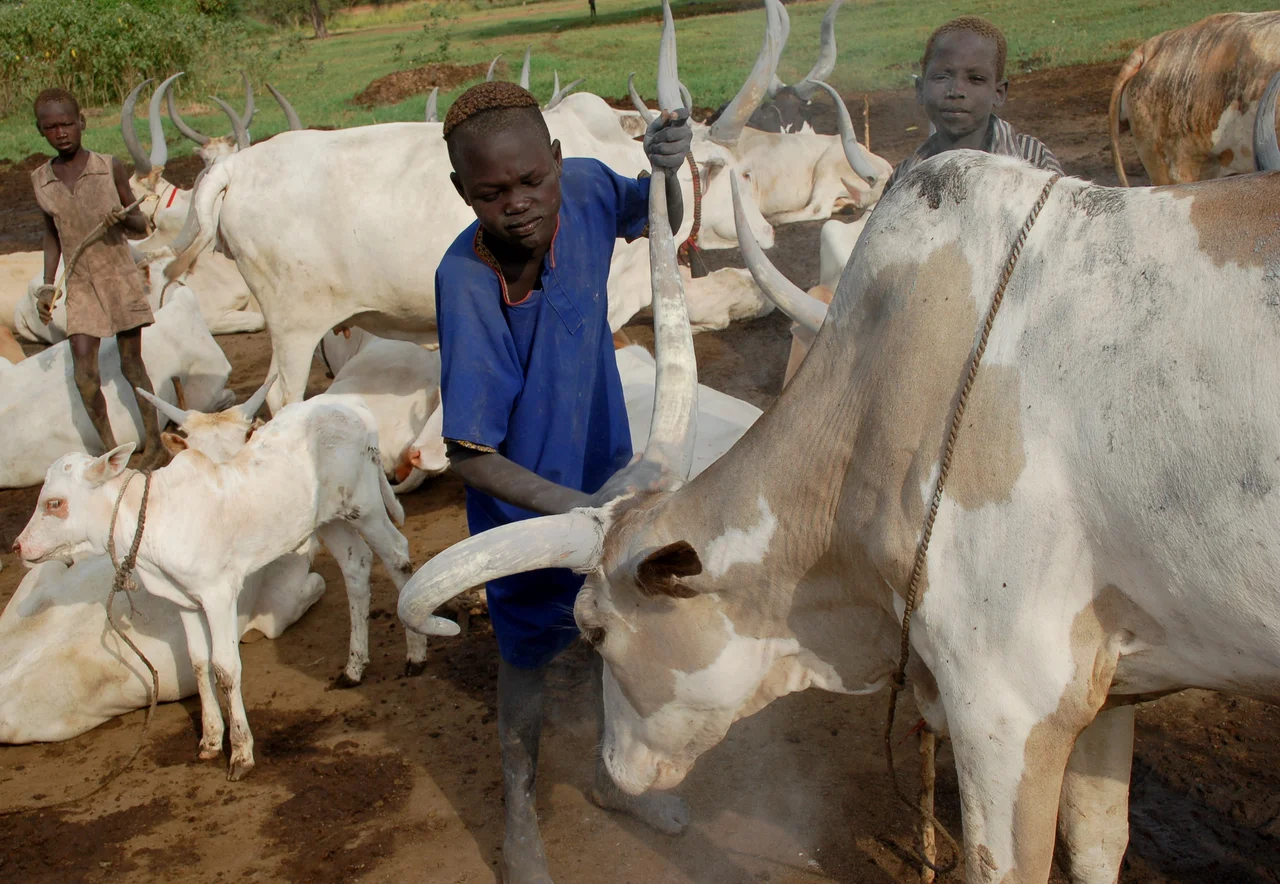
Drive at dawn past a cattle camp in Lakes State and you pass through woodsmoke thick enough to taste. Herders stand among the ash, letting the smoke wash over them and their cattle to drive off biting flies, and the long-horned Ankole cows glow orange-gray in the rising light like something out of a much older world. For the Dinka communities who make up most of the population here, these camps (toch in their language) are not primitive leftovers from some earlier century. They are functioning, elaborate, highly organized social institutions, each with its own rules and songs and praise-names given to favored bulls. Lakes State is 43,595 square kilometers of this, plus the lakes that give it its name, plus a patch of bush where the national government may one day decide to build a new capital.
Between Two Niles and the Ghazal
Lakes sits in the center of South Sudan, one of four states (alongside Northern Bahr el Ghazal, Western Bahr el Ghazal, and Warrap) that make up the historic Bahr el Ghazal region. The White Nile forms its eastern boundary, separating it from Jonglei State. Unity State lies to the northeast. Warrap wraps around the northwest. Western and Central Equatoria press in from the south. The state's southeastern corner holds a cluster of seasonal lakes (Lake Yirol and others) whose waters rise and fall dramatically with the summer monsoon. In the dry months, cattle are walked long distances to find these residual waters. In the wet season, much of the state becomes seasonally impassable floodplain. Rumbek, the state capital, sits near the center, a market town that has been absorbing returnees ever since the Comprehensive Peace Agreement of 2005 ended the Second Sudanese Civil War.
A Capital That May Never Be Built
In July 2011, as South Sudan was taking its first breath as an independent country, the federal government publicly floated the idea of moving the capital from Juba to a site called Ramciel, in northern Lakes State. The reasoning was partly geographic (Ramciel sits roughly in the country's center, whereas Juba is a short drive from Uganda) and partly symbolic. No planning ministry has yet broken ground. A spur off the Juba-Rumbek highway is being laid toward the site, but the city itself remains a line on a map. The question of whether South Sudan will ever build its promised inland capital, or whether Ramciel will remain the name of a hopeful intention, has drifted through more than a decade of civil war, peace agreements, and the daily business of holding a country together.
The 28 States That Weren't
In October 2015, at the height of the South Sudanese Civil War, President Salva Kiir issued a decree dividing the country's ten states into 28. Lakes was split into three: Eastern Lakes, Gok, and Western Lakes. The move was widely read as an attempt to reshape political constituencies along ethnic lines while the SPLM-IO opposition was fighting the government in the bush. Internationally, the reorganization was criticized as a unilateral redrawing of borders that violated the 2015 peace deal. In 2020, under the revitalized peace agreement, the 28 states were dissolved and the original ten, including Lakes, were restored. The episode left a residue: Local administrators who had briefly held governorships, boundaries that had been surveyed and then un-surveyed, and communities that had been moved into one administrative bucket and then moved back.
Cattle, Raids, and a Journalist
Cattle are everything and nothing in Lakes. Everything in the sense that Dinka social life, marriage, and inheritance all pivot on them. Nothing in the sense that Western economic accounts routinely fail to register their importance. Inter-communal cattle raids have been a periodic affliction here, old tensions between clans inflamed by the proliferation of AK-47s that every civil war has added to the landscape. Reporting on this came in part from Manyang Mayom, a human rights journalist from the region who won the Human Rights Watch Award in 2010 for his coverage of government oppression in Lakes. In November 2021 Mayom was expelled from neighboring Warrap State for his reporting for UNMISS radio, a reminder that journalism in South Sudan is not a job one takes up lightly. The cattle camps remain. The smoke still rises at dawn. The conversation about how to secure them, across a state that has changed hands, names, and boundaries so many times, goes on.
From the Air
Lakes State occupies central South Sudan, approximately 6-8°N and 28-31°E. The state capital Rumbek lies near 6.8°N, 29.7°E. Primary airport is Rumbek Airport (HSMK). The seasonal lakes of the southeast are visible at cruise altitude during the wet season (July-October). The White Nile forms the eastern border. Wet season brings heavy convective buildup; dry season visibility is often reduced by haze and smoke from agricultural burning.
Nearby Stories
- Rumbek 17 km away
- Tonj 45 km away
- Wau 92 km away
- Nyal, South Sudan 114 km away
- Ironstone Plateau 135 km away
- Bahr el Ghazal (region of South Sudan) 147 km away
- Ramciel 155 km away
- Lado Enclave 207 km away