
Kisenge
The railway reaches Kisenge from an unexpected direction. Most Congolese rail lines run north-south, spoke to hub. This one - a branch of the Benguela Railway - arrives from the Atlantic coast, thousands of kilometers away, having climbed up through Angola. Kisenge sits near the tail end of it, in the southern tip of Lualaba Province close to the Angolan border, surrounded by dense tropical forest. The village is small. The railway is why.
A Border of Forest
Kisenge is a village in the province of Lualaba, in the southern Democratic Republic of the Congo, close to the frontier with Angola. The climate is tropical and the surrounding country is dense forest. The rainy season here runs from roughly May through September - unusual timing for central Africa, though this far south the seasons invert in ways that catch travelers off guard. Official population figures for the village are hard to find; estimates put it around 3,500 residents. The nearest large settlements are across the border in Angola or much further north in Lualaba Province's mining towns. This is, by any measure, a quiet corner of the Congo.
Manganese and the Long Line
Kisenge matters to the geography of the region because of its railway branch. The Benguela Railway was completed in 1929, running from the Angolan port of Lobito across the continent to the Congolese copperbelt. A spur reached into Kisenge to serve a manganese-mining operation that developed here in the colonial period. The line hauled ore out to the Atlantic coast for export, with the Congolese branch eventually connecting to the city of Divuma. Civil wars in Angola interrupted the main Benguela Railway for decades after Angolan independence in 1975; rehabilitation work, much of it backed by Chinese and Angolan investment, has restored much of the line over the last twenty years. The manganese trade is no longer what it was, but the rails are still there, still threading through the forest.
Languages and Migrations
The village is linguistically and religiously layered in a way that surprises visitors. The population is mostly Catholic Christian, with smaller communities following Sunni Islam or traditional African religions. French is the language of administration, as it is across the Congo. But because of Angola's proximity and decades of cross-border movement - particularly after Portugal withdrew from its African colonies in 1975 and large numbers of Angolans settled nearby - Portuguese has become a second lingua franca for a substantial share of the village's residents. Brazilian and Angolan investment has deepened the Lusophone influence. The older Bantu languages of the area remain in use, especially among elders; French and Portuguese dominate the younger generations' speech.
The Paint Factory
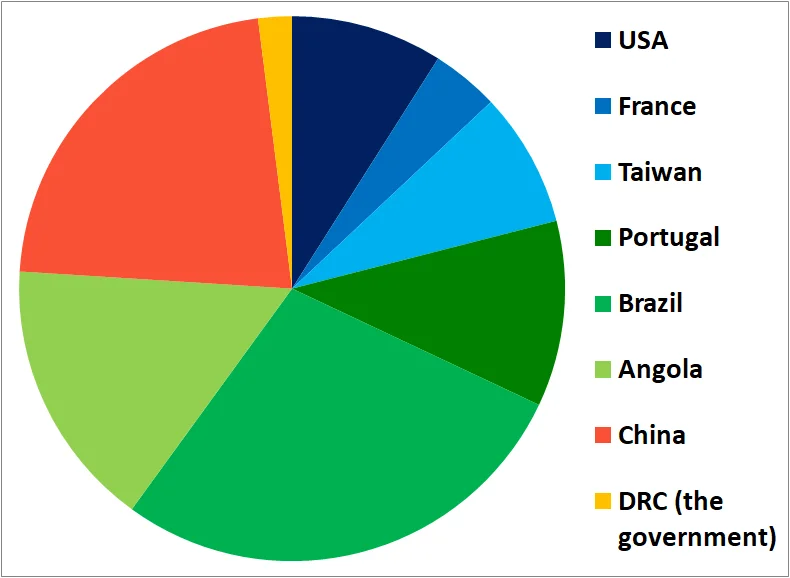
In 2011 Chinese investors opened a paint factory in Kisenge, employing, according to local accounts, about a quarter of the adult population. The factory polluted the village's lake - the details of the effluent have not been fully documented, but residents reported changes in water color and fish kills. The same Chinese investors began building a language school and a housing complex for Chinese workers. In 2012 the residents of Kisenge revolted. Protesters destroyed the unfinished buildings. The factory's future since then has been uncertain; the half-built compound remains as a reminder of what a small community can and cannot tolerate when someone else's economic project arrives in its backyard. The village has also received investment from Portugal, France, and, in smaller measure, the United States and Taiwan, directed at infrastructure, telecommunications, a health center, and a bilingual school teaching Portuguese and French.
A Village on the Line
There is a Kisenge Airport - small, infrequently served - and there are the rails. The village sits in a forested corner of the Congo that most maps render as green emptiness. From the air it would be easy to miss: the canopy closes over the settlement, and only the clearings and the thin scratch of the railway betray its presence. Life continues at its own pace here. The forest is cleared in patches for wood sales, the railway carries what freight it carries, and the village balances its small scale against the very long supply lines that have, at various moments, made it briefly matter to people in Beijing, Luanda, Lisbon, and Kinshasa. Kisenge has been part of larger stories for a century. It has also, for most of that time, simply been itself - a village where the forest crowds close and the tracks continue toward somewhere else.
From the Air
Kisenge sits at 10.68°S, 23.18°E in the far south of Lualaba Province, close to the Angolan border. The terrain is tropical forest mosaic at roughly 1,200m elevation. Kisenge Airport is a small airfield serving light aircraft. Kolwezi Airport (FZQM), about 150nm northeast, is the nearest paved field with regular service. From cruise (FL200+) the Lualaba River valley is a useful reference to the north; the Angolan highlands rise to the south and west. The railway trace provides another visual cue. Dry season (May-September here, inverted from most of central Africa) offers the clearest VFR; rainy season brings strong afternoon convection.
Nearby Stories
- Kalene Hill 75 km away
- Sakeji School 106 km away
- Lumwana 252 km away
- Haut-Lomami District 255 km away
- Ciments du Katanga 325 km away
- Portuguese Angola 584 km away
- Cuito Cuanavale 619 km away
- Battle of Quifangondo 1013 km away