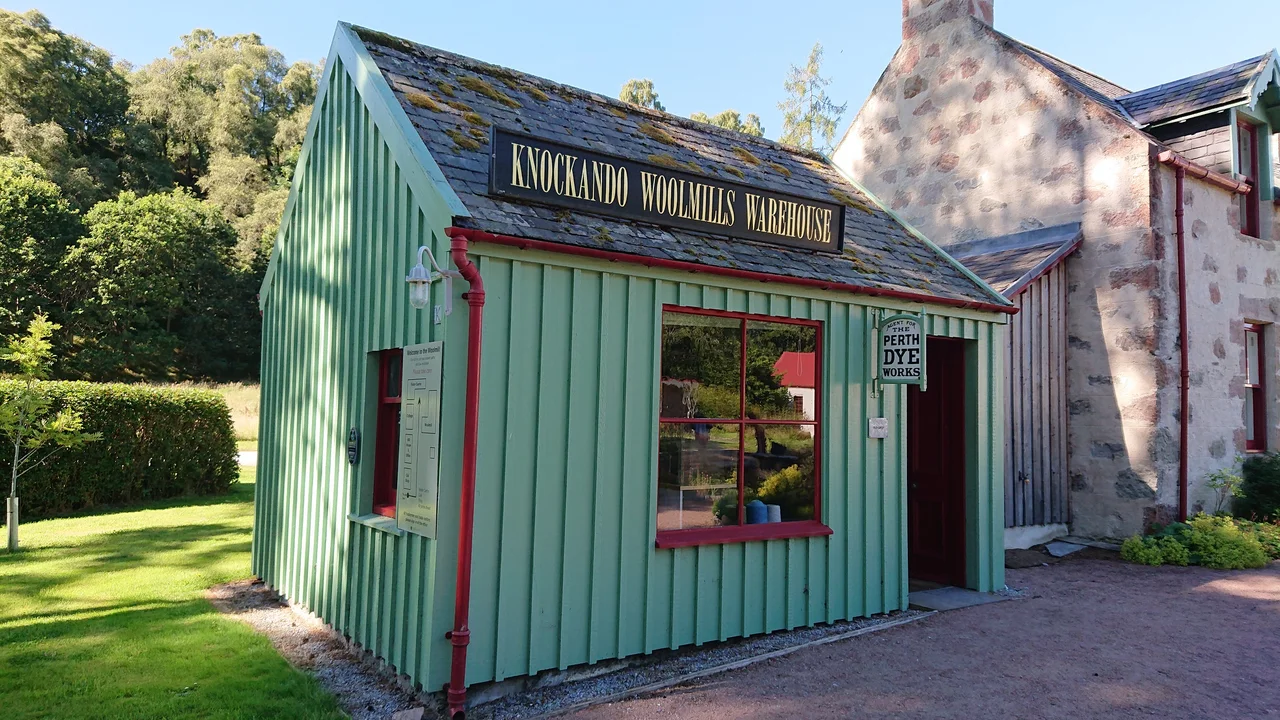

Knockando Woolmill
The corrugated iron roof at Knockando is rust-red, and that rust is deliberately commemorated in the mill's own tartan. Designed in 2010 by John B Gillespie, the registered Knockando Woolmill tartan weaves red for the roof, blue for the burn that powers the looms, and green for the surrounding Moray fields. It is a self-portrait in cloth, and you can only buy it where it is made. That kind of literal stitching of place into product is rare in modern manufacturing. At Knockando, it is the whole point.
A Mill Since at Least 1784
Records from 1784 reference a waulk mill operated by the Grant family at Knockando, and the Grants are mentioned again in the 1851 census still running the place in the traditional manner. Waulking was the old Gaelic process of pounding new tweed to thicken and soften it, often done communally by women singing rhythmic waulking songs to keep time. The surviving site is more recent than the original mill but still old: the rectangular single-storey core, then the L-plan extension that added a two-storey carding and spinning mill, then the late-19th-century weatherboarded lean-to housing more equipment. Rubble walls, corrugated iron roofs, water power from the burn. None of it was designed to be picturesque. It was designed to make cloth, and it still does.
The Miller's House
Two dwellings stand on the site. The mill house, built around 1910, has two storeys of rubble construction and an elegant staircase with cast iron balusters — a detail that hints at the relative prosperity of the owner. A mill in a rural Moray glen was not a get-rich operation, but it provided steady work and steady cloth for steady customers, and the balusters are the kind of small flourish a working family allows itself when business is good. The other dwelling is humbler. Together they make a complete portrait of a Victorian textile operation: the place where the work happens, the place where the workers live, the burn that links them.
Saved by a Trust
By 2000, the buildings and machinery were in dangerous disrepair. The mill had been designated a Category A listed building in 1995 — Scotland's highest heritage protection — but listing alone does not stop wood from rotting or cast iron from seizing. A charity called the Knockando Woolmill Trust formed to take on the renovation. By 2009 the trust had raised £3.3 million, including a £1.3 million grant from the National Lottery Heritage Fund, and ownership transferred to the trust. The achievement was recognised in 2016 when Knockando Woolmill won the Europa Nostra EU Prize for Cultural Heritage in the Conservation category. In 2017, Highlands and Islands Enterprise funded an expansion of production and workforce. The mill went from a candidate for ruin to a functioning piece of working heritage.
Open from April to September
The mill continues to make fabrics on its historic machinery — the same carding engines, the same spinning frames, the same looms that operated when Queen Victoria was on the throne. Visitors arrive between 18 April and 26 September, when the site is open to the public. The pattern that comes off the looms includes the registered Knockando tartan and a range of other Scottish weaves, dispatched to customers worldwide. The trust deliberately kept the production model traditional rather than industrialising. Every piece of cloth from Knockando is a small declaration that the slow way of doing things still works, if someone is willing to keep the burn flowing and the machinery turning.
From the Air
Located at 57.466 N, 3.355 W in Speyside, Moray, Scotland. The mill sits in a quiet glen near the River Spey about 6 km southwest of Aberlour. Cruise at 3,000-5,000 feet AGL — the corrugated iron roof catches sunlight distinctively against surrounding green pasture. Inverness (EGPE) is about 45 nm west, Aberdeen (EGPD) about 55 nm east. The whisky country gives this airspace a particular character: dozens of distilleries scattered through the same valleys, identifiable from the air by their pagoda-roofed kilns.
Nearby Stories
- Spynie Palace 3.6 km away
- Findlater Castle 4.7 km away
- Battle of Slioch 6.6 km away
- Battle of Lumphanan 6.6 km away
- Tomatin distillery 9.8 km away
- Nigg Stone 11 km away
- Balmoral Castle 12 km away
- Highland Folk Museum 16 km away