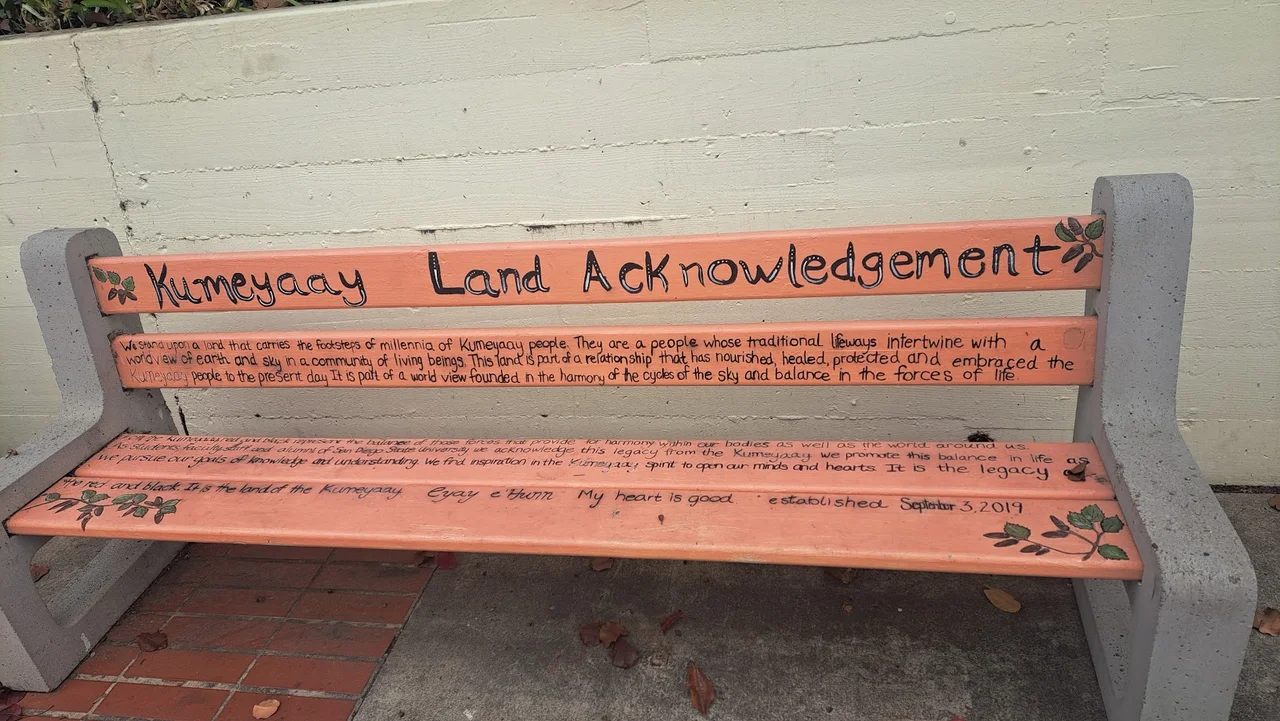

Kumeyaay
The Kumeyaay name carries a geographic instruction: it translates roughly as 'People of the West,' with meyaay meaning 'steep' or 'cliff' — a description of the coastal terrain their ancestors occupied for at least twelve millennia before the first European arrived. Their territory ran from what is now Oceanside, California, south to below Ensenada, Mexico, and east to the Colorado River: a swath of land crossed today by Interstate 8, the US-Mexico border, and the San Diego Trolley's Sycuan Green Line, the naming rights to which the Kumeyaay purchased themselves.
Three Groups, One People
The Kumeyaay consist of three related groups whose territories were divided by geography. The Iipay (also called Northern Diegueño) lived in the north, from Escondido to Lake Henshaw. The Tiipay (Southern Diegueño) occupied lands to the south, including the Laguna Mountains, Ensenada, and Tecate. The Kamia lived in the eastern desert regions that included Mexicali, bordering the Salton Sea. The San Diego River served as a loose boundary between Iipay and Tiipai homelands.
All three groups speak languages belonging to the Delta-California branch of the Yuman language family. Native speakers have traditionally been able to understand and speak across the dialects. Kumeyaay is transmitted through oral narratives, song cycles, and ceremonial practices; bird songs, which recount migratory journeys and ancestral histories, remain among the most culturally significant forms of verbal art. Language preservation efforts operate on both sides of the US-Mexico border through Kumeyaay Community College (founded by the Sycuan Band), university collaborations, and individual reservation programs.
Spanish, Mexican, and American
The first European to reach Kumeyaay territory was Juan Rodríguez Cabrillo in 1542. Sebastián Vizcaíno followed in 1602, meeting Kumeyaay during the feast of San Diego de Alcalá — a meeting that gave the region its Spanish name. Colonial settlement didn't come until the Portolà expedition of 1769, which established a presidio over the Kumeyaay village of Cosoy and founded Mission San Diego de Alcalá. The Spanish brought livestock that degraded local ecology and soldiers whose conduct provoked a Kumeyaay revolt that burned the mission and killed Father Luis Jayme. The mission was rebuilt; Spanish control was eventually consolidated.
After Mexican independence in 1821, Mexican troops confiscated coastal Kumeyaay lands, beginning the California rancho era. Smallpox and malaria epidemics in 1827 and 1832 reduced the population. The American period brought its own dispossession: the 1852 Treaty of Santa Ysabel, negotiated between Kumeyaay clans and Commissioner Oliver Wozencraft, was one of eighteen California treaties sent to the US Senate and rejected under pressure from white settlers. A Kumeyaay village in what is now Balboa Park was demolished in the early 1900s to make way for the 1915 Panama-California Exposition.
The Casino Economy
A 20-year drought in the mid-20th century crippled the dry farming economy on Kumeyaay reservations. Cuts in federal Native American welfare programs under the Reagan and Bush administrations left reservations searching for alternative income. The 1982 court victory in Barona Group of the Capitan Grande Band of Mission Indians v. Duffy allowed high-stakes bingo operations, which expanded into a full casino industry.
The Kumeyaay now operate six casinos: Barona Valley Ranch Resort and Casino, Sycuan Resort and Casino, Viejas Casino and Resort, Valley View Casino and Hotel, Golden Acorn Casino and Travel Center, and Jamul Casino. The economic success of those operations has allowed tribes to purchase the naming rights to the Sycuan Green Line of the San Diego Trolley and the SDSU Viejas Arena. The Sycuan Band acquired the US Grant Hotel in San Diego. The Sycuan Band became the first Native American tribe to own part of a professional soccer franchise by acquiring co-ownership of San Diego FC, an MLS expansion team — and the second Native American tribe to hold any stake in a professional sports team.
Across the Border
The US-Mexico border bisects Kumeyaay territory, and Kumeyaay communities on both sides have navigated the economic constraints of their respective positions differently. On the Mexican side, traditional craftwork is manufactured and sold at Kumeyaay gift shops and casinos on the American side of the border. Many Kumeyaay in Baja California have migrated to urban areas for employment as depopulation allows neighboring ejidos to encroach on village lands.
One response to those pressures has been tourism. Kumeyaay communities in the Guadalupe Valley — wine country in Baja California Norte — have launched wine tours and festivals, attracting visitors from Southern California and cruise passengers at Ensenada. The same people whose ancestors traded salt, seaweed, and abalone shells with the mountain Kumeyaay for acorns and agave now host wine tastings in a valley whose geography their ancestors mapped across centuries before any Spanish missionary arrived to name it something else.
From the Air
Kumeyaay territory spans the coastal and inland terrain visible on any flight from San Diego County south to Ensenada. The modern reservations — Barona, Sycuan, Viejas, Campo, Jamul, La Jolla, and others — are distributed across the San Diego County foothills and mountains, roughly east of Interstate 15 and south of Lake Henshaw. The border crossing at Tecate is within Kumeyaay ancestral territory. Best surveyed at 6,000-10,000 feet AGL for a panoramic view of the full extent of the homeland.
Nearby Stories
- Museum of Creation and Earth History 6.8 km away
- Borrego Valley Maneuver Area 11 km away
- Martinez Canyon Rockhouse 13 km away
- Manzanita Band of Diegueno Mission Indians 13 km away
- Aliso Canyon 21 km away
- Cahuilla Band of Indians 22 km away
- Mission Basilica San Juan Capistrano 47 km away
- USS Agerholm 198 km away