
Lagosa
A loudspeaker strapped to a roof broadcasts the audio of a European football match across the beach, and people who cannot afford the small entry fee gather in the sand to listen. This is one of the signature sounds of Lagosa, a village on the eastern shore of Lake Tanganyika so remote that the road south of the village center narrows until cars stop fitting. There is no airport. There is one guesthouse with ten rooms. The main reason anyone who doesn't live here ever comes here is the MV Liemba - a German-built ferry, now more than a century old, that still works its way up and down the longest freshwater lake in the world.
The Ferry That Arrives Wednesdays
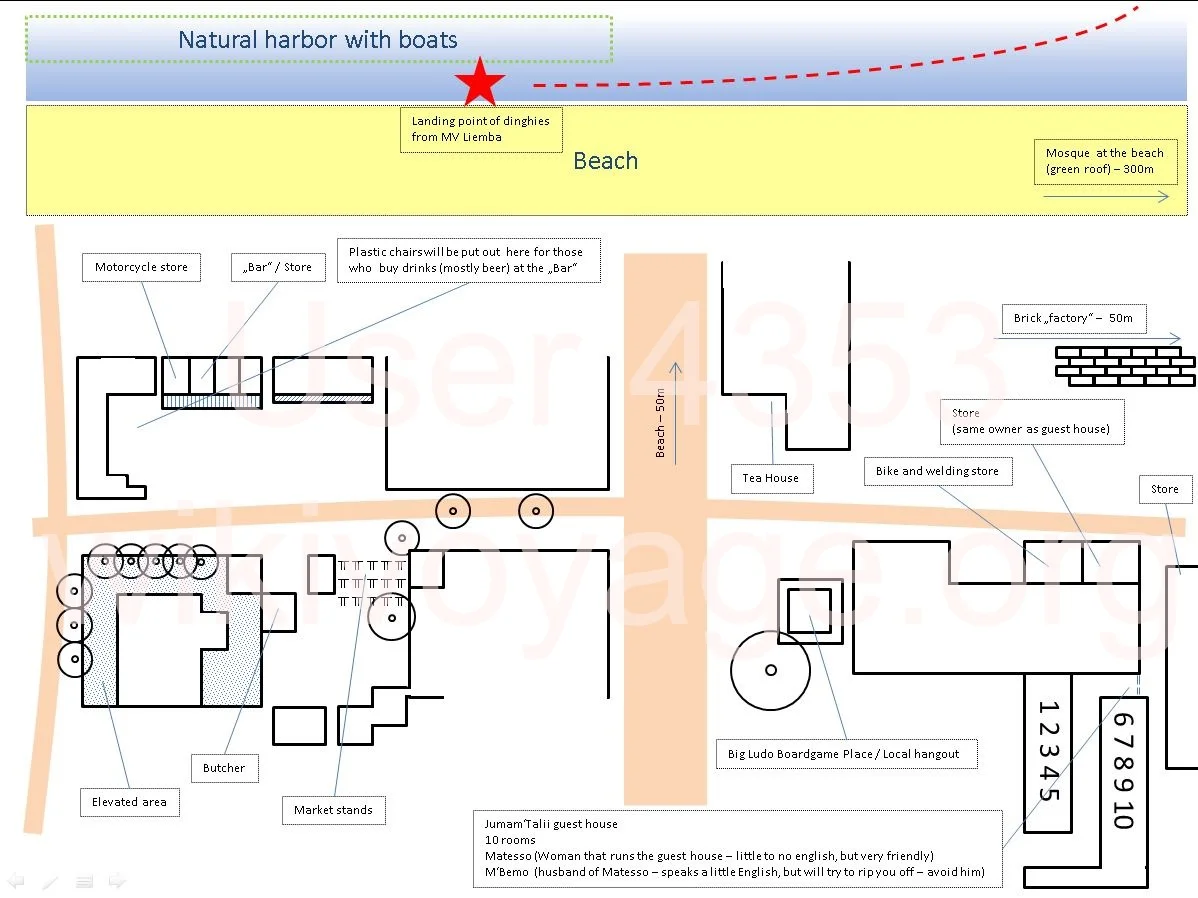
Lagosa exists, from a traveller's point of view, because the Liemba stops here. Travellers heading to Mahale Mountains National Park - the chimpanzee park across the hills - get off the ferry at Lagosa. To get back to Kigoma afterwards, they climb aboard the Liemba again here. There is not much in between. The lake laps the sand. Motorcycle taxis handle the few errands that require more speed than walking. A handful of places called 'businesses' and a small market cluster in the village center. The ship's arrival is an event: you can hear the whistle and see villagers drift toward the water long before the hull appears on the horizon.
Speaking With Hands And Feet
Only a few people in Lagosa speak English. Basic Swahili helps. Without it, travellers fall back on gestures and patience, and the village meets them most of the way there. Children are easy company; a paper boat or a folded plane earns a lot of goodwill. The beach is where days unspool. There are no newspapers for sale. There are no books. The stores carry a minimum of goods because a minimum is what the village buys from them. In the village center, one shop sells beer and sets out chairs, which is enough - people gather there when the Liemba is expected, killing time and swapping news.
A House With Electricity
One house on the beach has a television and the electricity to power it. For a small donation, you can go inside and watch European football at night or films and series during the day. The audio broadcasts outside through a speaker on the roof, so people who do not pay linger nearby and listen. The building is easy to find - you follow the sound. It is a small economy of screen and sound, patched together with extension cords and generosity. A separate bar down at the waterline may or may not be open on any given evening. At the market, fried bread bought fresh in the morning is one of the village's reliable pleasures. A tea house does chapati and tea.
Room For The Night
The guesthouse in Lagosa has ten rooms. A double goes for something like 5,000 to 7,000 Tanzanian shillings - a few US dollars - and is genuinely basic. But if the Liemba is not running, or you miss it, or you need a night on land before or after Mahale, those ten rooms are what stands between you and the lake. From here the next stop up the shore is Kigoma, the largest town on the Tanzanian side, and to the south the ferry runs to Mpulungu in Zambia. From Lagosa itself, the Mahale Mountains rise a little inland, where wild chimpanzees have been studied since 1961. Most visitors who bother with Lagosa are passing through on their way to those forests. A handful stay long enough to learn that the village rewards patience more than itineraries.
From the Air
Located at 5.98°S, 29.86°E on the Tanzanian side of Lake Tanganyika, roughly 70 nautical miles south of Kigoma. Nearest airport is Kigoma Airport (ICAO: HTKA), a small regional field. No paved roads serve the village. From cruise altitude the eastern shore of Tanganyika appears as a long, narrow, very deep-blue ribbon bounded by the forested escarpment. Clearest in the dry season (June to October); the lake generates its own haze and afternoon storms in the wet months.
Nearby Stories
- Mahale Mountains 33 km away
- Karema, Tanzania 78 km away
- Mpanda 105 km away
- Tanganyika Province 136 km away
- Niemba Ambush 189 km away
- Kipupu Massacre 227 km away
- Bujumbura 252 km away
- Battle of Tabora 292 km away