
Landing at Saidor
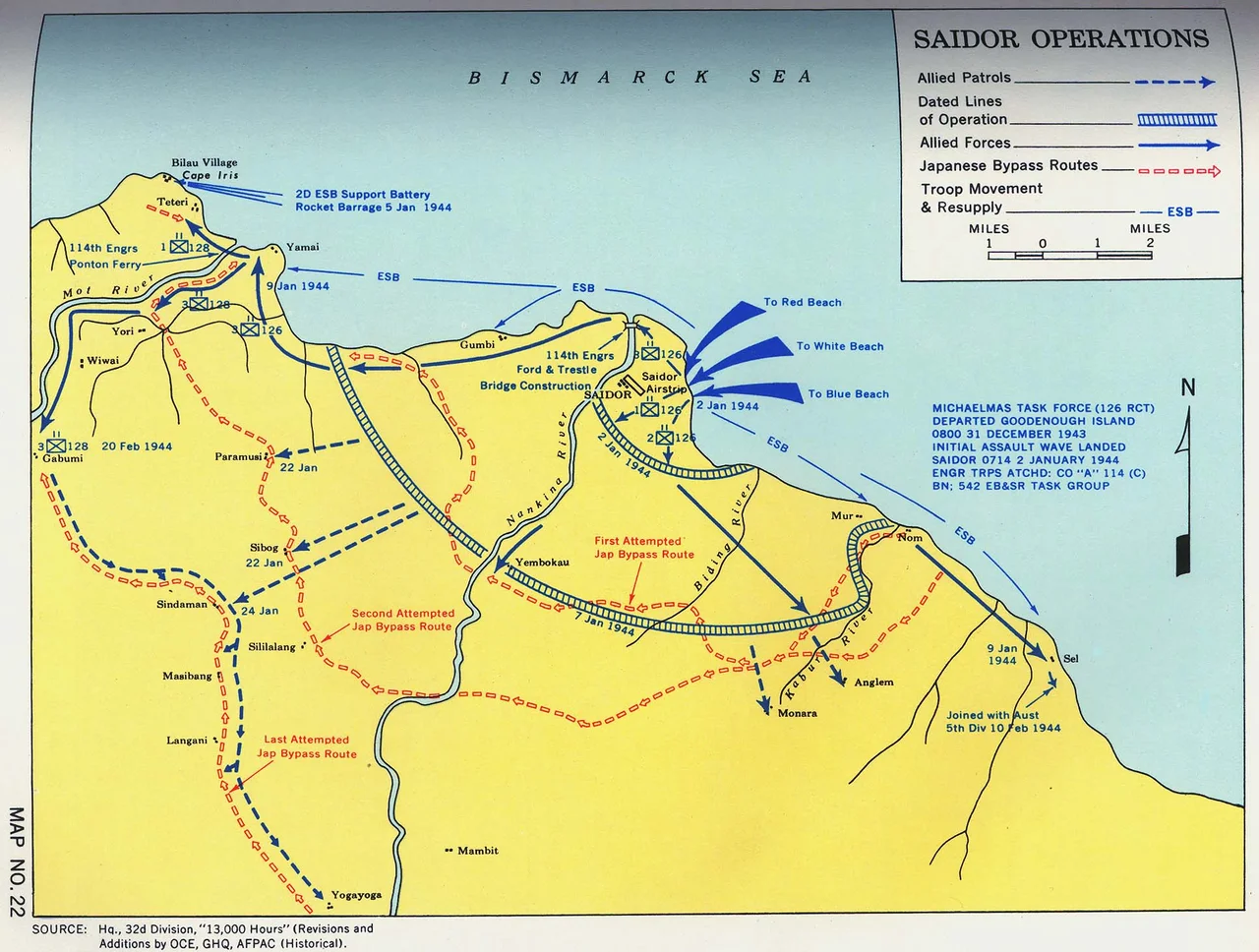
Before dawn on 2 January 1944, six Landing Ships Tank, ten high-speed transports, and seventeen Landing Craft Infantry pushed into Dekays Bay on the north coast of New Guinea. Low cloud sat on the water. Drizzle obscured the shoreline. Admiral Daniel Barbey pushed H-Hour back twice, from 06:50 to 07:25, to give his destroyers enough light to bombard three beaches codenamed Red, White, and Blue. The bombardment fired 1,725 five-inch rounds. Rocket LCIs added 624 more. When the first wave of Americans reached the beach at 07:30, eleven Japanese had been killed by the shelling. Perhaps a hundred and fifty others had already vanished into the interior. Operation Michaelmas, the landing at Saidor, was designed to cut off 6,000 Japanese troops retreating west along the coast. It came very close to being a complete trap.
The Idea
Douglas MacArthur's original plan for the New Guinea campaign had Australian troops taking Lae, then Finschhafen, then jumping directly to Madang. The distance from Finschhafen to Madang was simply too far for the landing craft of 1943 to cover in one night. In August, the commander of Allied Land Forces, General Sir Thomas Blamey, recommended an intermediate objective. A tiny coastal settlement called Saidor was chosen because it had something almost no other point on that coast could offer: accessible beaches, a sheltered harbour, and a pre-war airstrip. Saidor sat roughly halfway between Finschhafen and Madang. If the Allies seized it, they could cover the Dampier and Vitiaz Straits and put airfields within range of the great Japanese anchorages at Wewak and Hollandia. MacArthur's headquarters gave the operation the codename Michaelmas.
Unopposed and Unfinished
Brigadier General Clarence A. Martin commanded the Michaelmas Task Force, built around the 126th Regimental Combat Team of the 32nd Infantry Division, a unit rebuilt after the grinding Battle of Buna-Gona. Intelligence in Brisbane put fewer than 4,500 Japanese forward of Sio and only 1,500 more between there and Madang. Given those numbers, Martin decided against a preliminary aerial bombardment, which let him land at dawn instead of in the late morning glare. The decision proved right. The beaches, described later as narrow, rocky, and exposed to heavy seas, were nearly empty. American casualties that first day were one soldier killed, five wounded, and two sailors drowned. By 11:45 the six LSTs had finished unloading. The Shore Battalion of the 542nd Engineer Boat and Shore Regiment was already laying mesh to carry vehicles across the beach.
The Trap That Held and Did Not
At Rabaul, General Hitoshi Imamura's staff argued briefly about whether to counter-attack or bypass. The 20th and 51st Divisions were in no condition to fight their way through an American perimeter. Imamura ordered Lieutenant General Hatazo Adachi's Eighteenth Army to withdraw overland from Sio to Madang, giving Saidor a wide berth. Adachi placed Lieutenant General Hidemitsu Nakano in command of the forces east of Saidor and told him to march. The Japanese route ran through the foothills of the Finisterre Range, across rivers made impassable by the monsoon, and over ridges where nights at altitude turned bitterly cold. Chief of Staff Kane Yoshihara later recalled the march in terms that read like a chronicle of atonement: men died of exhaustion, of drowning, of hunger, of exposure. Sick and wounded had to make their way through trackless country with little food and less medicine. US troops in the Saidor perimeter, hampered by terrain, weather, signal failures, and an enemy that had simply refused to stand and fight, could not close the net. Large numbers of Japanese survived the march. Many did not.
The Airfield That Mattered
The geography that had made Saidor tempting in the first place proved out. Nadzab, the great airbase in the Markham Valley further south, was surrounded by mountains that made night operations dangerous. Saidor had no such walls. During March 1944, B-24 Liberators of the Fifth Air Force staged through Saidor for night attacks on Hollandia, raids that helped soften the next great objective of MacArthur's westward advance. The airbase that cost one American soldier his life on landing day went on to reach targets hundreds of miles ahead of it. This was what Operation Cartwheel, the broader campaign to isolate Rabaul, was designed to produce: a bounding advance of airfields, each one built on the ruins of the last.
What the Ground Remembers
Saidor today is a quiet settlement on the north coast of Madang Province, a place most travellers pass over in favour of towns with better roads or bigger reefs. The beaches where the LSTs grounded are still there. The old airstrip still shows up on satellite imagery, a straight scar in jungle that has crept back almost to its edges. Somewhere in the country to the south, in the Finisterres that the Japanese crossed on foot rather than face the 32nd Division in open ground, are the unmarked graves of men who never made Madang. The war memorials, such as they are, are mostly in Australia and Japan, far from where the events happened. The ground itself does not argue. It just grew over everything.
From the Air
Saidor sits at 5.625°S, 146.4725°E on the north coast of Madang Province, between the Finisterre Range and the Bismarck Sea. The original airstrip remains operational as Saidor Airport (AYSA). Nearest major airports: Madang (AYMD) about 100 km to the west, and Lae/Nadzab (AYNZ) about 160 km south through the Finisterres. Weather is often cloudy over the ranges; the coast itself is relatively clear. Best viewed from 3,000-5,000 feet to pick out the beaches of Dekays Bay and the wartime airstrip.
Nearby Stories
- Ramu Nickel Mine 15 km away
- Vitiaz Strait 15 km away
- Landing on Long Island 21 km away
- Markham, Ramu and Finisterre Campaigns 24 km away
- Battle of Madang 28 km away
- Kainantu 35 km away
- Madang 74 km away