
Lefkandi
For a long time, the centuries after the fall of Mycenae were called the Greek Dark Ages, and the name was meant literally. The palaces had burned, writing had vanished, and historians assumed the survivors lived small, poor, and isolated lives until the rise of the classical world. Then, in 1980, archaeologists dug into a mound at Lefkandi and found something that did not fit. Beneath it lay the largest building anyone had ever found from that supposedly impoverished age, and inside it, a warrior's ashes, a woman in gold, and the bones of four sacrificed horses.
The Promontory of Xeropolis
Lefkandi today is a modest coastal village, but it sits on ground people have used for thousands of years. The settlement occupied a promontory the locals call Xeropolis, jutting into the Euripus Strait with small bays on either side that served as natural harbours. It lies almost exactly between Euboea's two great ancient cities, Chalkis and Eretria, and that location is part of its mystery. Some scholars believe Lefkandi is actually "Old Eretria," the original settlement whose people were forced to abandon it and move up the coast after losing the Lelantine War to Chalkis. Whatever its real name, occupation here ran continuously from the Early Bronze Age through the Dark Ages and into historic times, only to be abandoned around the start of the seventh century BC.
A Light in the Dark Ages
What makes Lefkandi matter to archaeologists is its timing. When the Mycenaean palace system collapsed around 1200 BC, many sites across Greece were simply abandoned. Lefkandi was not. It carried on through the period archaeologists label Late Helladic IIIC, the very era that had been almost invisible in the record. The deep, layered deposits dug here in the 1960s finally gave scholars a reliable sequence of pottery styles for those obscure centuries. Lefkandi joined a small cluster of central Greek sites, including Mitrou and the sanctuary at Kalapodi, that kept going when so much else stopped. And the objects pulled from its cemeteries told an even more surprising story: pottery and goods that pointed to active trade with Cyprus and the Levant, contact with a wider world that the Dark Ages were not supposed to allow.
The Building at Toumba
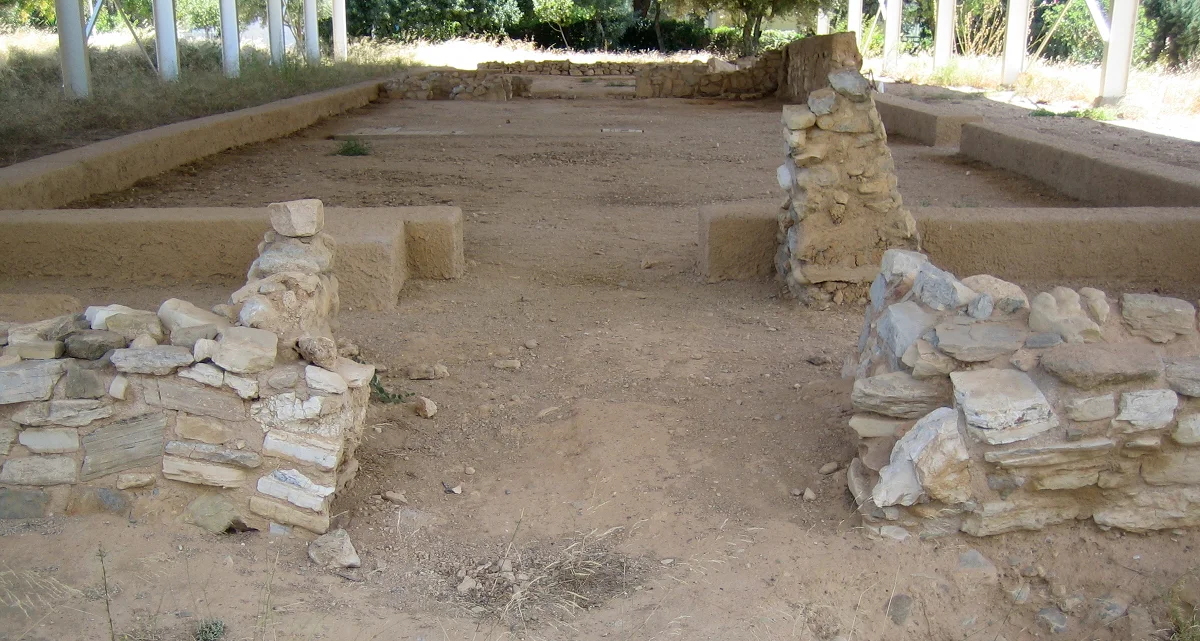
The discovery that changed everything came in 1980, when Evi Touloupa and the British School at Athens excavated a large mound and found two shaft graves beneath it. Over them had stood an enormous structure, built around 950 BC, that one reconstruction puts at fifty meters long and almost fourteen wide, wrapped in a wooden colonnade. That detail is the astonishing part. A ring of posts around a building is the basic idea behind the Greek temple, and temples like it were not supposed to appear for another two hundred years. Some archaeologists call the building a heroon, a hero's shrine; others argue it was simply the grand tomb of a locally powerful couple. The dispute continues, but no one disputes its scale. At a time historians had imagined as bare survival, someone here commanded the labor to raise a monument.
The Warrior and the Woman
The two graves held a man and a woman, and they were treated very differently. The man had been cremated, his ashes wrapped in a fringed linen cloth and sealed inside a bronze amphora brought from Cyprus, engraved with a hunting scene and set within an even larger bronze bowl. A sword lay near him. The woman was not burned. She was laid against a wall and adorned with treasure: a ring of electrum, a bronze brazier, and a gilded gorget from Babylonia that was already a thousand years old when it went into the ground beside her. An iron knife with an ivory handle rested by her shoulder. Whether she was sacrificed to accompany him in death, in a practice some compare to the South Asian custom of sati, or whether she was a powerful figure in her own right buried later, no one can say for certain. The four horses in the adjacent grave, two still wearing their iron bits, were killed deliberately and placed there with care.
Did Homer Sing Here?
The cremation in a bronze vessel, the sacrificed horses, the grand funeral monument, all of it echoes the heroic burials described in Homer's poems, written down centuries later. That resemblance has tempted scholars with an irresistible question, posed in the title of one famous essay: did Homer sing at Lefkandi? There is no way to prove it. But standing at Xeropolis, with the strait below and the harbours where Cypriot bronze once came ashore, it is easy to feel that the so-called Dark Ages were never as dark as their name. Excavations under the British School at Athens have continued for decades, and the ground here keeps insisting that the story we told about post-Mycenaean Greece was far too simple.
From the Air
Lefkandi sits on the southwestern coast of Euboea at 38.41°N, 23.67°E, on a low promontory overlooking the Euripus Strait, roughly midway between Chalcis to the north and Eretria to the southeast. From the air, look for the small coastal village and the headland of Xeropolis pushing into the gulf, flanked by twin bays. The nearest major airport is Athens International (LGAV), about 55 km to the south; Nea Anchialos (LGBL) lies to the northwest. Best viewed at low altitude in clear conditions, with the bridges at Chalcis visible up the strait.
Nearby Stories
- Hellenic Police 2.9 km away
- Tower of Aliartos 8.5 km away
- Great Sand Beach 13 km away
- John the Russian 22 km away
- Saint George Monastery, Aidipsos 23 km away
- Sousaki Volcano 25 km away
- Skyros 32 km away
- Carystus 46 km away