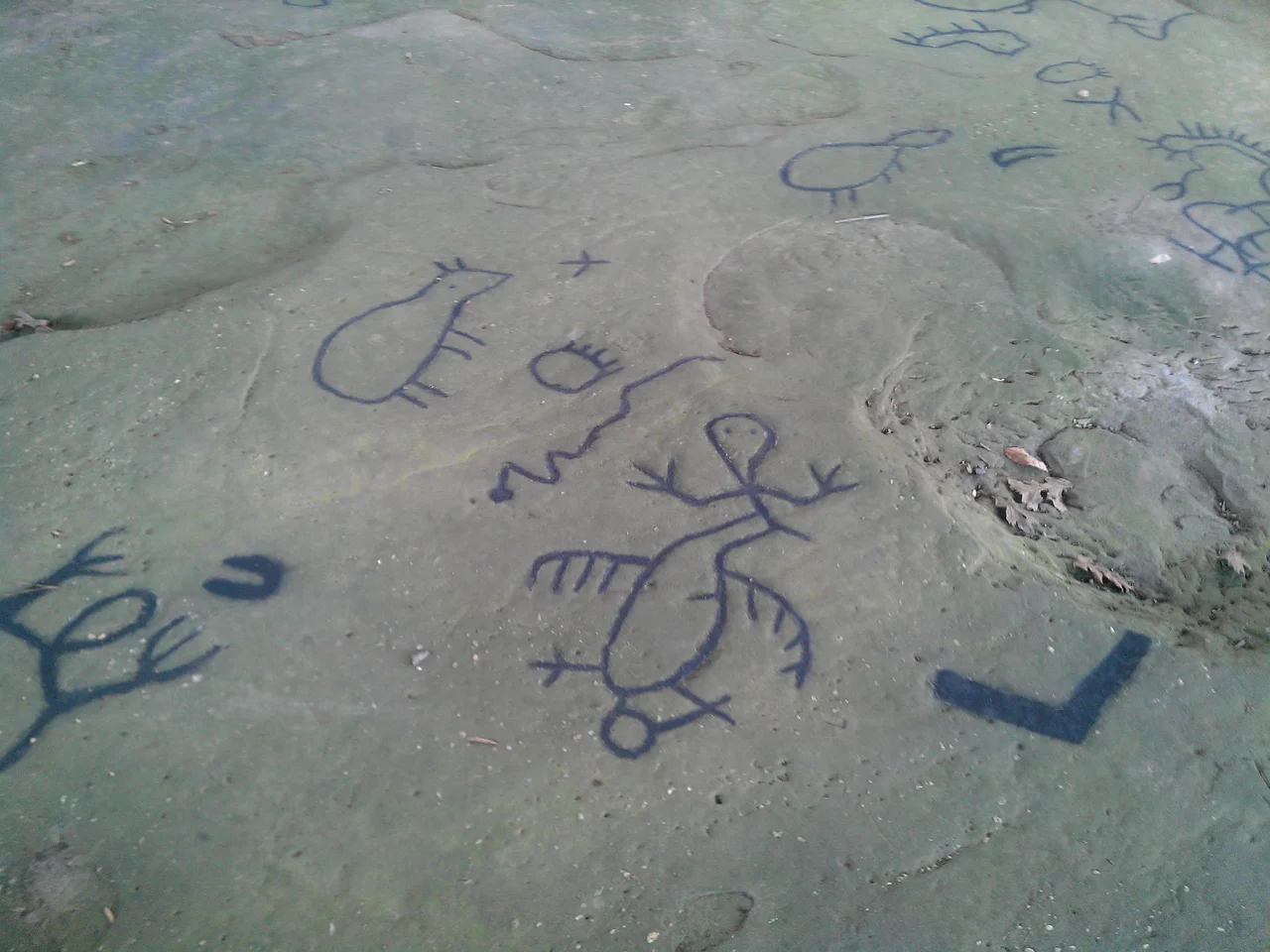

Leo Petroglyph
Nobody knows what they mean. The 37 images carved into the sandstone slab at Leo - human figures, animals, footprints belonging to each - were made by Fort Ancient people sometime between AD 1000 and 1650, and the artists left no key. There are no accompanying inscriptions, no surviving oral tradition that maps directly onto these specific marks. Archaeologists can read style and date, but they cannot read intent. The figures stand on the stone in silence, a message addressed to someone the carvers expected to understand.
Carvings on the Bluff
The Leo Petroglyph sits at the edge of an unglaciated sandstone cliff in Jackson County, the same southerly extension of weathering-resistant Mississippian-period rock that produces the Hocking Hills and Lake Katharine. The carving slab is shallowly horizontal, the kind of broad flat sandstone surface that lent itself to deliberate work. The Fort Ancient artists pecked the figures into the rock using harder stones, probably quartzite. Some images are clearly anthropomorphic - stick-figure humans with limbs spread. Others show four-legged animals, possibly deer or canids. Each figure is accompanied by what appears to be footprints of the corresponding human or animal, as though the carvers wanted to document both the maker and what the maker had left behind.
Who the Fort Ancient Were
The Fort Ancient culture occupied southern Ohio, eastern Indiana, northern Kentucky, and western West Virginia from around AD 1000 until the 1600s. They were settled maize-bean-squash farmers who lived in palisaded villages along major river valleys, used pottery tempered with crushed mussel shell, and traded with Mississippian peoples to the south for shell ornaments and eventually European copper that reached them through long-distance networks. Their relationship to historic-era Shawnee and other Ohio Valley peoples is debated among archaeologists, though most contemporary scholarship views them as ancestral to several historic groups. By the time European explorers reached the Ohio Valley, the Fort Ancient towns had been abandoned for decades.
What the WPA Built
The Works Progress Administration, the Depression-era federal program that put millions of unemployed Americans to work on public projects, built a wooden shelter over the petroglyph slab during the 1930s. The shelter is itself now a piece of New Deal history, joining the carvings under its own historical significance. The structure shields the soft sandstone from rain and freeze-thaw cycles that would slowly erase the marks. Without it, six centuries of weathering would already have rounded the figures into illegibility. With it, the petroglyph has survived another ninety years, and the carvings remain crisp enough that visitors can trace the human figures with their eyes.
Protected and Pondered
On November 10, 1970, the Leo Petroglyph was added to the National Register of Historic Places. The Ohio History Connection maintains the site, which is open to the public free of charge year-round. Visitors walk a short trail through the woods to reach the shelter, where the slab sits at ground level. Most stand quietly for a while, then move on. The meanings remain unknown. Hypotheses include hunting magic, clan markings, territorial signs, mythological narrative, or some combination. None has been confirmed. The petroglyph functions less as a known historical document and more as a deliberate silence - 37 figures carved by people who once lived here, signed in a language no one alive can read.
From the Air
Located at 39.15 N, 82.67 W in Jackson County, southeast Ohio, near the small village of Leo. John Glenn Columbus International (KCMH) is about 80 miles north. Best viewed at 3,000-5,000 feet on clear days, with the wooded ridge country of the Western Allegheny Plateau spread below.
Nearby Stories
- Gallipolis 6.9 km away
- Skatopia 11 km away
- Hardin Village Site 16 km away
- Hopewell Culture National Historical Park 18 km away
- Ripley and the Underground Railroad 47 km away
- Fort Ancient 66 km away
- The Y-Bridge of Zanesville 67 km away