
Mac Clark (Acacia peuce) Conservation Reserve
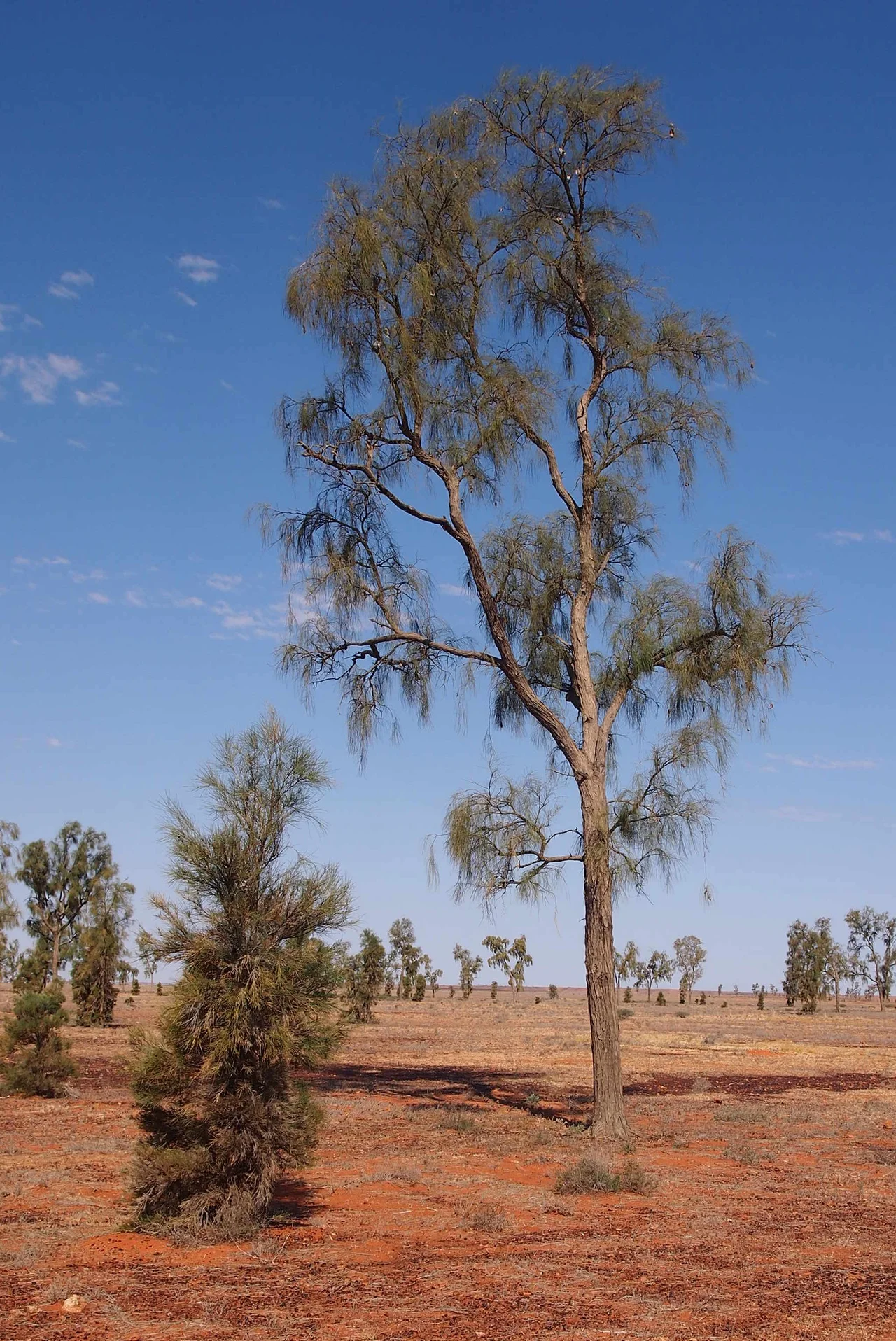
Count the trees and you reach a thousand. Then the plain runs flat to the horizon and the count stops. This is one of just three places in the world where Acacia peuce still grows wild, and the other two lie hundreds of kilometres east, near Boulia and Birdsville in Queensland, marooned across the dunes of the Simpson Desert. Here on a stony, wind-raked flat near Old Andado Station, on country the Arrernte people have walked for tens of thousands of years, the rare tree the locals call waddywood holds its ground where almost nothing else can.
A Relic That Refuses to Die
Acacia peuce is a survivor from a wetter Australia. Hundreds of thousands of years ago, when central Australia was greener, the tree may have spread across vast stretches of the interior. As the climate dried and the sand seas advanced, it retreated to a handful of refuges, and the encroaching Simpson Desert cut those refuges off from one another. What remains is extraordinary. The tree grows slowly, perhaps fifteen to seventeen metres tall over a span of centuries, and a single waddywood can live for as long as five hundred years. Its wood is famously hard and dense, with a dark, purple-tinged heartwood, and its needle-like foliage hangs in fine pendulous sprays that shrug off the heat. In a place that receives less than 150 millimetres of rain a year, that endurance is the whole story.
Stone Tools and Old Knowledge
The land here carries deep human time. The traditional owners are the Arrernte, whose presence on this country stretches back thousands of years, and the plains are rich in stone artefacts left by generations who lived and travelled through. The pastoral lease that surrounds the reserve, Andado, takes its name from a Southern Arrernte word meaning stone tool, a small linguistic memory of how long people have been making things here. Aboriginal people knew the dense timber of waddywood and put it to work, shaping the hard, heavy wood into tools and weapons. It was a use that demanded both skill and restraint, for the wood took centuries to grow and could not simply be replaced. To take from such a tree was to take from time itself, and the knowledge of how and when to do so was its own inheritance, passed down across the generations who called this country home.
Cattle, Sheep, and a Couple Named Clark
Europeans reached this corner of the desert in the 1880s and took up the land for grazing, first sheep and later cattle, in country that offers little forgiveness to either. In 1955 Malcolm Clark, known to everyone as Mac, came to Andado Station with his wife Molly. Mac died in 1978, but Molly stayed on, and in 1987 she carved out a small lease around the homestead and gave it the name Old Andado, keeping the place alive as a window into outback station life. The reserve that now protects the waddywood grove carries Mac Clark's name, a quiet tribute attaching a pastoralist's memory to a tree far older than any fence line.
Why a Thousand Trees Matter
It is easy to drive past a flat of scattered trees and see nothing remarkable. That is the trap of this place. The roughly thousand mature waddywoods standing here are not just trees but the genetic core of a species clinging to existence, one of three populations holding a 500,000-year-old lineage in trust. Protect this grove and the species has a future; lose it and a strand of deep Australian time frays away. The reserve exists for exactly that reason, drawing a line around something most travellers would never think to value, in one of the most remote and least-visited landscapes on the continent.
From the Air
The Mac Clark (Acacia peuce) Conservation Reserve sits at roughly 25.12 degrees S, 135.51 degrees E, on the stony eastern fringe of the Simpson Desert near Old Andado Station in the Northern Territory's far south-east. From altitude the grove reads as a faint stippling of trees on an otherwise bare reddish plain, with the dune fields of the Simpson rising to the east. Recommended viewing altitude is 3,000 to 5,000 feet AGL for the cleanest sense of the isolated tree stand against open gibber country. The nearest tracked airfield is Alice Springs (YBAS), about 290 km to the north-west; far-southern South Australia traffic may reference Oodnadatta (YOOD). This is genuinely remote terrain with no services, extreme summer heat, and minimal navigational landmarks, so carry full fuel reserves and confirm survival equipment before overflight.
Nearby Stories
- Old Andado 26 km away
- Simpson, Northern Territory 66 km away
- Australian Overland Telegraph Line 68 km away
- Colson Track 87 km away
- Deserts of Australia 140 km away
- Connellan Air Disaster 156 km away
- Ansett Australia Flight 232 178 km away
- Poeppel Corner 209 km away