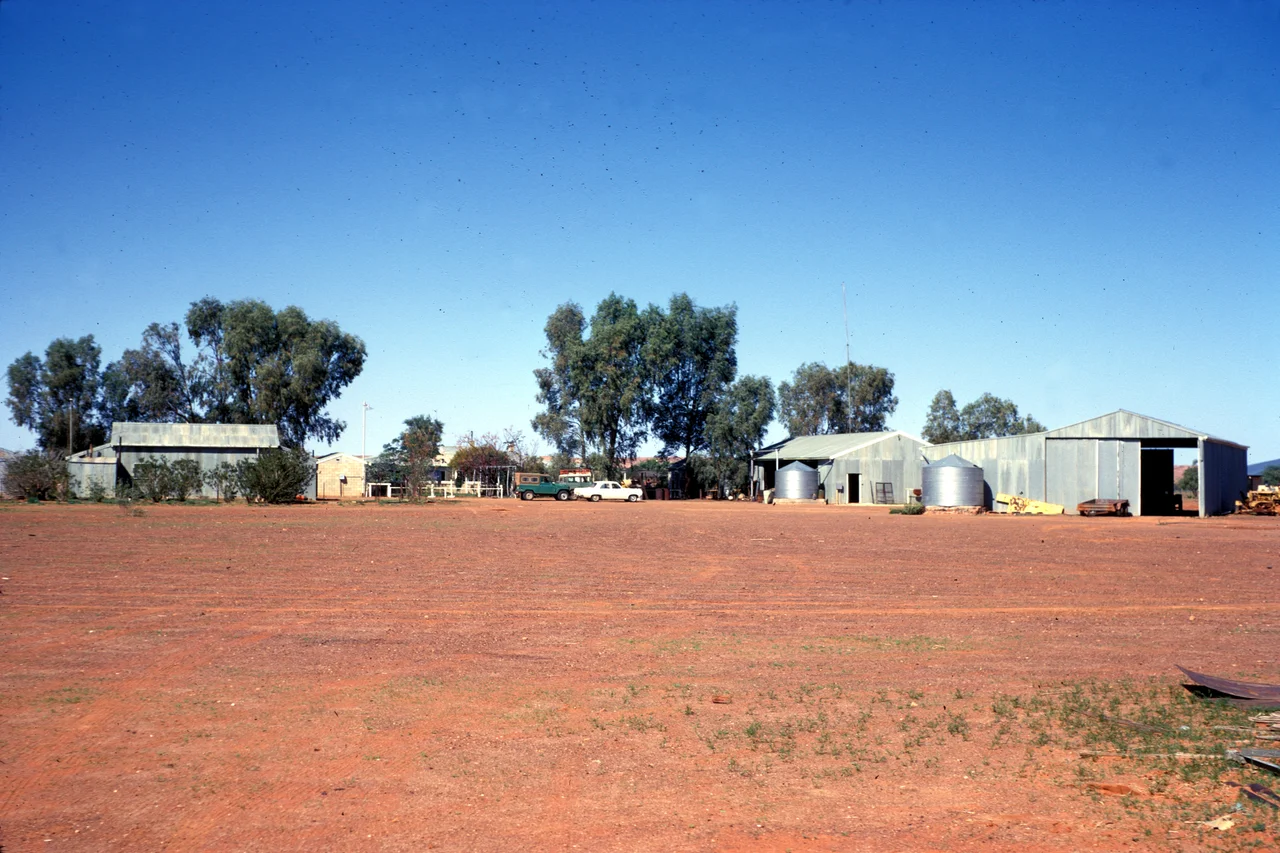

Old Andado
The boots are still by the door. Photo albums sit on the shelves, letters wait in their pigeonholes, and a landline telephone hangs on the wall as if someone might call. No one lives in the Old Andado homestead now, but step inside and the place feels paused rather than abandoned, as though its keeper has only stepped out to check the cattle. That keeper was Molly Clark, and she spent the better part of half a century making sure this lonely outpost on the rim of the Simpson Desert would never simply crumble back into the red sand.
The Easternmost Light
Andado sits where Central Australia runs out of road. The homestead is the easternmost habitation on the western side of the Simpson Desert, roughly 290 kilometres southeast of Alice Springs, in a country of tall parallel dunes and saltbush flats that flood only when the rains are generous. The ephemeral Finke River winds through part of the lease, and the swamplands between the dunes fill so rarely that their wet years become local legend. The first Andado pastoral lease was taken up by Robert MacDill in 1909. He sank bores into the dry ground, and after he married in 1922 a new homestead was built for his wife. That building still stands today, the structure now known as Old Andado.
Molly's Half-Century
Molly Clark arrived in 1955 with her husband Mac and their three sons, and the desert tested them without mercy. In 1978, Mac died of a heart attack while flying his light aircraft; nine months later his eldest son was killed in a freight train accident. Then in 1984 the federal government ordered every animal on the property destroyed to stamp out brucellosis and tuberculosis across the Territory, wiping out the herd in a stroke. Molly could have walked away. Instead, in the mid-1980s she sold the working station but held back 45 square kilometres and the old homestead, determined to keep her home standing. She ran it as a rough, welcoming tourist stop, greeting travellers who had bounced for hours across the dunes to reach her door.
A House Kept as It Was
What Molly created is something rarer than a museum. The little ramshackle homestead, with its dusty concrete floors and corrugated-iron walls, is preserved exactly as outback pastoral life was lived: spanners on the bench, history books on the shelf, the saddle shop and meathouse still standing as evidence of station work in the desert's harshest decades. Molly Clark died on 23 September 2012 in Alice Springs, and she is buried on a low hill to the east, overlooking the home she would not abandon. In 2013 a charitable trust was formed to carry on her work. Today the property is heritage-listed and kept alive by family and volunteers, just as she left it.
The Tree That Outlives Everyone
About 40 kilometres north of the old homestead grows something even older than the station's history. The Mac Clark (Acacia peuce) Conservation Reserve, gazetted in 1982 across roughly 3,000 hectares, protects a stand of around 1,000 mature waddywood trees. Acacia peuce is one of the rarest trees in the Australian arid zone, surviving in just three isolated pockets on Earth: here at Andado, and near Birdsville and Boulia in Queensland. It grows on stony, wind-scoured plain where barely 150 millimetres of rain fall in a year, reaches up to 17 metres, and can live as long as five centuries. Its timber is so hard that Aboriginal people shaped it into digging sticks and weapons. Across the 20th century many were felled for stockyards and shelters, leaving these scattered survivors marooned by the advancing desert.
From the Air
Old Andado lies at approximately 25.41°S, 135.29°E on the western edge of the Simpson Desert, in the Northern Territory just north of the South Australian border. From the air the landmark is unmistakable: long, parallel red dunes running roughly northwest to southeast, with the pale ribbon of the Finke River and isolated swamp depressions threading between them. The waddywood stand of the Mac Clark Conservation Reserve sits about 40 km north of the homestead. The nearest serviced strip is Mount Dare (to the south, in South Australia); Alice Springs Airport (ICAO YBAS) lies about 240 km to the northwest and is the regional hub. Best viewed at low to medium altitude in the clear, dry winter air; expect dust haze and strong thermals over the dunes in summer.
Nearby Stories
- Mac Clark (Acacia peuce) Conservation Reserve 34 km away
- Australian Overland Telegraph Line 36 km away
- Simpson, Northern Territory 103 km away
- Simpson Desert Bike Challenge 112 km away
- Henbury Meteorites Conservation Reserve 164 km away
- Connellan Air Disaster 193 km away
- Indigenous Australian Culture 198 km away
- Oodnadatta Track 209 km away