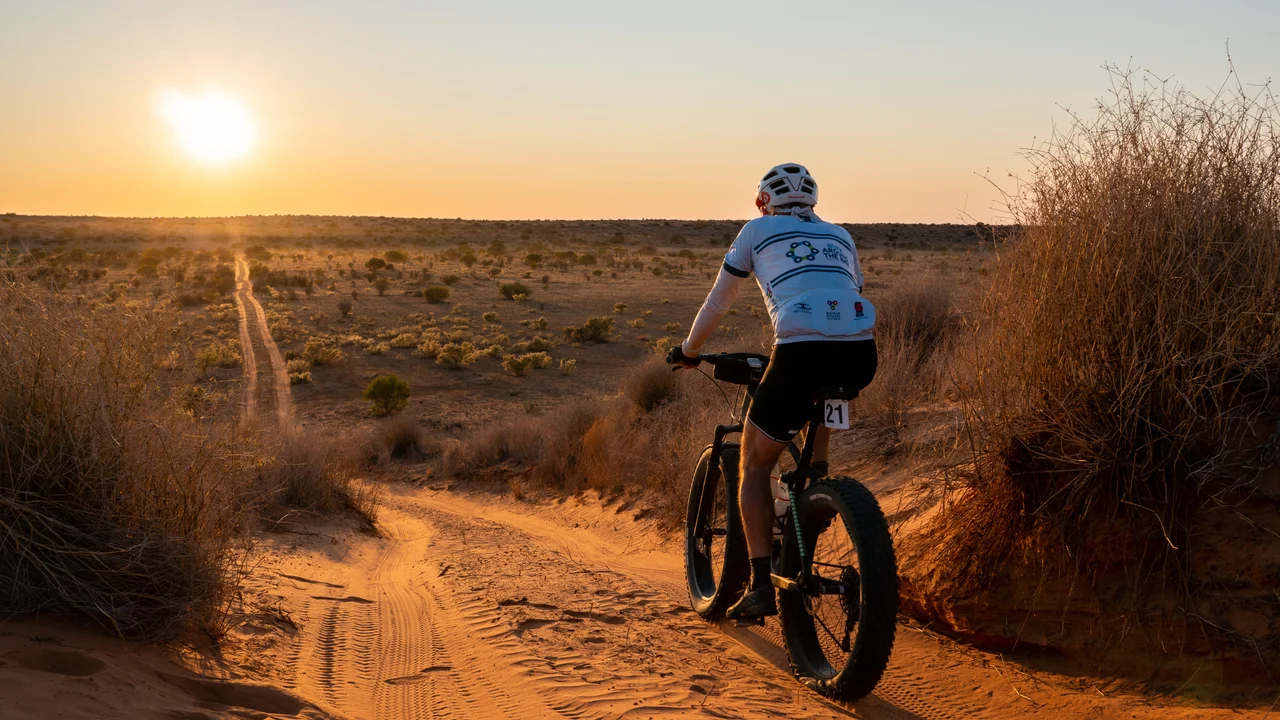

Simpson Desert Bike Challenge
There is no prize money. There is no cheering crowd at the finish, no town to stop in, not even a service station between the start line and the end. What there is, for five days, is sand. The Simpson Desert Bike Challenge sends riders grinding over hundreds of parallel red dunes, and on a hard year not one of them finishes the full course. It is widely rated among the toughest endurance events on the planet, and the people who line up for it do so not to win, but to raise money and to find out what they are made of.
Five Days, No Mercy
The format is brutally simple. Each day brings a morning stage of roughly 75 kilometres and an afternoon stage of about 45, run over five days for a total course somewhere between 500 and 600 kilometres. Riders move as a managed group, always travelling between a front convoy of support vehicles and a rear one led by a sweep vehicle. Fall behind the sweep and you are pulled from that stage and driven to camp, though you can restart the next morning. To stay ahead you must hold a minimum average speed across terrain that does everything it can to slow you down. Water stops appear at intervals, and every rider must halt and drink; at the start and end of each stage their body weight is recorded, a blunt and effective way to catch dangerous dehydration before it catches them. Beyond the water, they are on their own.
Sand, Sweat, and Fat Tyres
In the early years riders rode rigid mountain bikes with skinny tyres and spent much of the desert pushing rather than pedalling, shoving their machines up the soft faces of the dunes. The classic route ran the firmer ground of the Rig Road and the Birdsville Track. Then, after 2009, the fat bike arrived, with tyres four inches wide and more that floated over sand once thought unrideable. Suddenly riders could climb even steep dunes without dismounting, and the event transformed. Today fat bikes dominate, and organisers can route the race down harder lines like the French and WAA, where the dunes rise sharper and more often than on the old classic course.
Everyone, and Everything Can Go Wrong
The Challenge is open to all ages and abilities, and the start list reads like a slice of ordinary life: a police officer, a coffee shop owner, an IT manager, all out in the same dunes. The desert treats them equally, which is to say harshly. Every rider who completes every stage earns the coveted 100% medal, but on average only about 36 percent of starters manage it. In 2008 the desert won outright and not a single rider finished the course; in 2016, by contrast, no one was swept at all. Weather writes much of each year's story. Searing dry heat, sudden flooding, even bushfires have forced the race onto alternative ground, and in 2020 the global COVID-19 pandemic cancelled it for the first time in its history.
Riding for the Flying Doctor
The race began in 1987 and has been run ever since by a band of volunteers, formally incorporated in South Australia as the not-for-profit Desert Challenge Inc. Its founding figures, including organisers Jack and Mary Mullins in the early years and later Rod and Loz Townsend, steered it through decades and several charity partners. Since 2008 the proceeds have gone to the Royal Flying Doctor Service, the airborne medical lifeline of the outback, raised through rider fundraising, a post-race auction, and a running tally of light-hearted fines. The sums have climbed past 350,000 dollars. It is a fitting beneficiary: out here, where the nearest hospital can be hundreds of kilometres of dune away, the Flying Doctor is the difference between a bad day and a fatal one, and the riders crossing the Simpson know it better than most.
From the Air
The Simpson Desert Bike Challenge ranges across the Munga-Thirri-Simpson Desert and its surrounds, spanning the borders of the Northern Territory, South Australia and Queensland; a representative reference point sits near 25.05 degrees S, 136.74 degrees E. Courses typically start in South Australia and finish at Birdsville, Queensland, near the famous Big Red dune (Nappanerica) on the QAA Line. From the air the defining sight is the endless ranks of parallel red sand ridges; on race days a thin string of support vehicles and tents marks the moving race village. Recommended viewing altitude is 4,000 to 6,000 feet AGL to capture both the dune corridors and the convoy line. Nearest tracked airfield is Birdsville (YBDV) at the eastern edge; Alice Springs (YBAS) lies to the north-west. Conditions are extreme, with high heat, dust, and seasonal flooding that can close tracks entirely.
Nearby Stories
- Deserts of Australia 40 km away
- Mac Clark (Acacia peuce) Conservation Reserve 56 km away
- Simpson Desert 62 km away
- Old Andado 78 km away
- Colson Track 107 km away
- Poeppel Corner 117 km away
- Witjira National Park 152 km away
- Ethabuka Reserve 200 km away