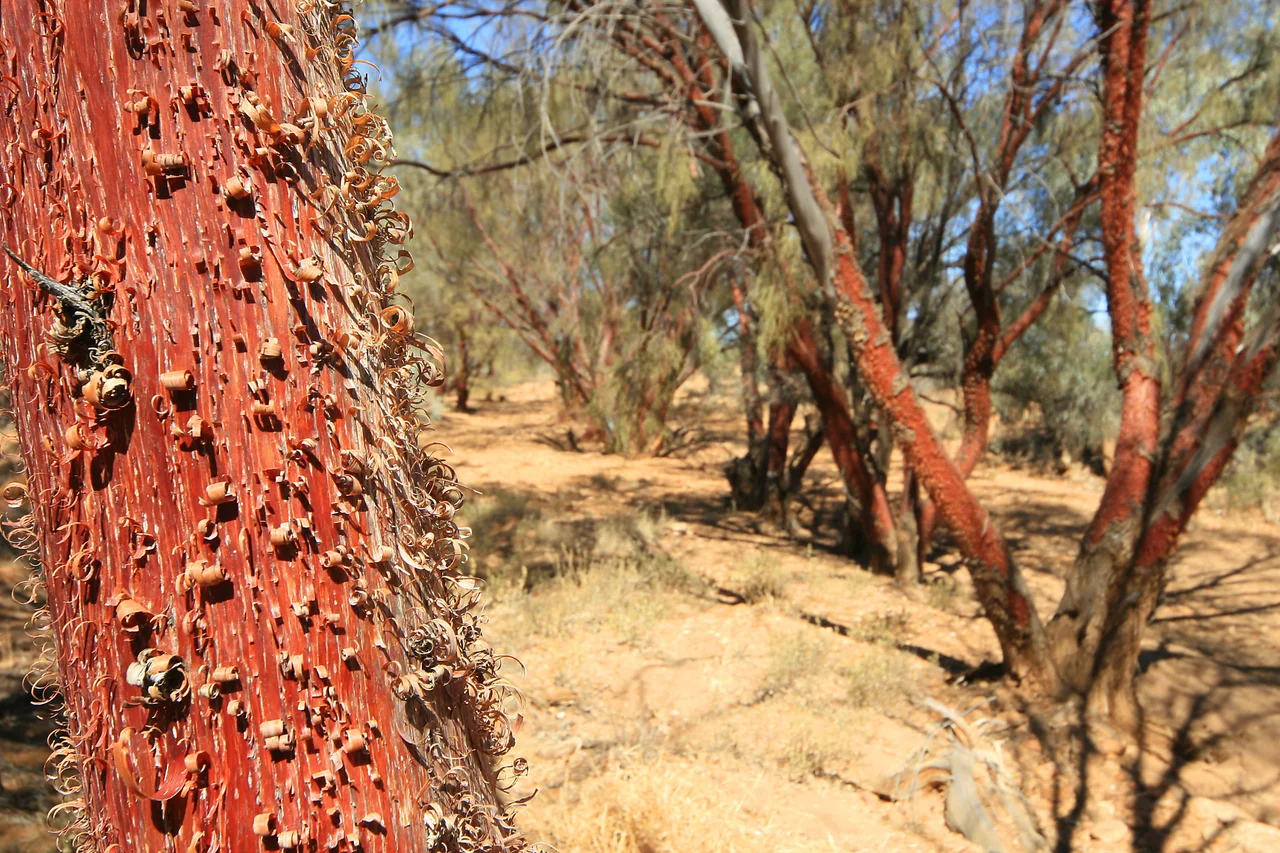

Witjira National Park
Out here the desert is supposed to be merciless, and mostly it is. Witjira National Park sprawls across nearly 7,700 square kilometres of red sand and gibber on the western edge of the Simpson Desert, almost a thousand kilometres north of Adelaide, a place where summer heat can crack stone and the horizon dissolves into nothing. And then, in the middle of all that hard country, the ground gives up water. Warm water, rising on its own through the sand from an aquifer the size of a sea. The springs of Witjira are the reason the park exists, the reason there were ever people here, and the reason the Wangkangurru and Lower Arrernte have called this Country home for longer than almost anyone has called anywhere home.
Water From the Deep
Beneath much of inland Australia lies the Great Artesian Basin, one of the largest underground freshwater stores on Earth. Where its pressure finds a fault or a weakness, it pushes to the surface and builds mound springs: low domes of mineral and reed crowned with a pool of warm water. Witjira protects the Dalhousie complex, the largest array of these springs in the country, dozens of pools scattered across the desert fringe, some of them warm enough to soak in at close to body temperature. Each spring is its own small world, fed by water that fell as rain far away and long ago and has been travelling underground ever since. In a landscape defined by absence, the springs are an almost unreasonable abundance, an oasis chain stitched across the sand.
A Refuge for the Endemic
Isolation breeds invention. Cut off from any other permanent water for an immense distance, the creatures of these springs evolved in place and exist nowhere else on the planet. Tiny fish found only here carry the spring's name: the Dalhousie goby, the Dalhousie hardyhead, the Dalhousie mogurnda, the Dalhousie catfish, each adapted to warm, mineral-rich water that would kill most fish. Several are now listed as threatened, their entire global range confined to a handful of desert pools. Snails, crustaceans and plants tell the same story of life clinging to a thin thread of water. To biologists the springs are living time capsules; to the desert they are simply the only place certain things can survive, which is much the same thing.
Custodians of Country
Long before any of this was mapped, the springs were known, named and cared for. For the Wangkangurru people of the Simpson Desert and the Lower Arrernte to the west, the waters of Witjira are deeply significant, woven into law, story and ceremony across an occupation that archaeologists trace back tens of thousands of years; this is among the densest concentrations of registered cultural sites in central Australia. The Wangkangurru relied on freshwater soaks out in the dunes, and in dry times, when those soaks failed, neighbours granted access to the eastern springs at Dalhousie. The springs were never just water. They were meeting places, lifelines and sacred ground, held in trust and shared by careful agreement, generation handing the knowledge to generation.
Shared Hands, Shared Future
That custodianship is now written into how the park is run. In 2007 Witjira became the first protected area in South Australia placed under formal joint management between its traditional owners and the state, co-managed by the Irrwanyere Aboriginal Corporation, representing the Wangkangurru and Lower Arrernte native title holders, alongside the South Australian government. The following year their native title over this Country was recognised by consent determination. The arrangement braids together two ways of knowing the land, Indigenous knowledge carried for millennia and modern conservation science, in service of the same springs. The park keeps tightening its protections: in 2021 the government moved to permanently exclude mining from the Dalhousie Springs National Heritage Area, closing the door on any future threat to the water itself.
Ruins and Reminders
Human history layers thickly here. Within the park stand the stone ruins of Dalhousie homestead, a nineteenth-century cattle station that staked itself to the same springs and lasted barely two generations before the desert took it back; the ruins are now listed on the South Australian Heritage Register. The contrast is the whole point of the place. One people read the springs as Country to be cared for indefinitely and have done so across an unimaginable span of time; another arrived, fenced the water, ran cattle, and was gone within fifty years. Witjira holds both stories side by side under the same enormous sky, the roofless homestead a short distance from pools that were old when the first stone was laid and will keep flowing long after the last wall falls.
From the Air
Witjira National Park covers the far-northern corner of South Australia, centred near 26.37°S, 135.63°E, where the Simpson Desert's parallel red dunes meet the gibber plains. From altitude, scan for the linear dune fields running northwest-southeast and the scatter of dark mound springs and isolated date palms that mark the Dalhousie complex; the dry channel of the Finke River traces the southern country. This is deeply remote airspace with no major sealed runways nearby: Oodnadatta (ICAO YOOD) lies roughly 200 km to the south, Mount Dare sits just to the north near the Northern Territory border, and Coober Pedy (YCBP) is the closest regional hub to the southwest. Expect reliably clear skies and superb long-range visibility, though afternoon heat haze and occasional dust over the dunes are best avoided by flying in the cooler morning light.
Nearby Stories
- Australian Overland Telegraph Line 30 km away
- Alberga River 43 km away
- Indigenous Australian Culture 76 km away
- Old Andado 90 km away
- Munga-Thirri–Simpson Desert Regional Reserve 140 km away
- Simpson Desert Bike Challenge 145 km away
- Oodnadatta Track 152 km away
- Mount Willoughby Indigenous Protected Area 240 km away