.jpg)
Malleco Viaduct
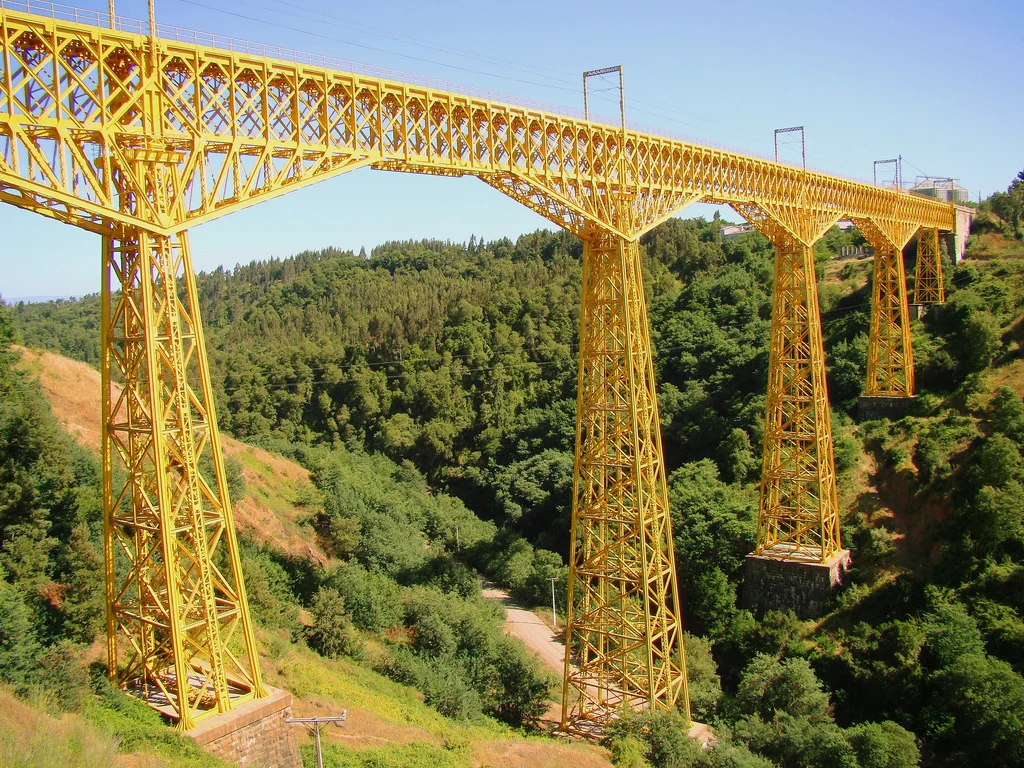
Stand beneath it and the Malleco Viaduct seems impossibly delicate - a web of iron lattice carrying the railway 102 meters above the floor of the gorge, the river a thin ribbon far below. Trains still cross it. They have crossed it since President José Manuel Balmaceda cut the ribbon on October 26, 1890, when this bridge in the wilds of Araucanía was, briefly, the tallest railway viaduct in the world. More than 130 years and countless earthquakes later, it is still standing, still working, still carrying the line that stitches northern Chile to the south.
The Bridge That Wasn't Eiffel's
A stubborn legend insists that Gustave Eiffel designed the Malleco Viaduct. He did not - though the story is not pure invention. Eiffel, fresh from his Paris tower, did submit a proposal for the crossing. Chilean authorities turned it down. The commission instead went to another French firm, Schneider et Cie of Le Creusot, working from a design credited to the Chilean engineer Victorino Aurelio Lastarria. The result was a triumph of nineteenth-century iron engineering: a span of 347.5 meters carried on slender lattice piers, the tallest reaching more than 75 meters. It is the kind of structure that makes onlookers instinctively look for a more famous name to attach to it. The truth is more interesting - this was Chile's own.
A Nation in Iron
To grasp why a railway bridge matters so much here, you have to picture Chile in 1890: a long, thin country still knitting itself together, pushing its rail network south into frontier territory only recently brought under state control. The Malleco gorge was the great obstacle on that line. Conquering it - cleanly, soaringly, with imported iron and homegrown ambition - became a statement about what the young republic could achieve. The viaduct has been called a symbol of national progress ever since, invoked by leaders across generations, including former President Ricardo Lagos. It put Chile, for a moment, at the leading edge of the engineering world.
Five Spans Across the Void
The engineering reads like a tightrope act rendered in iron. The viaduct stretches 347.5 meters across the gorge in five equal spans, each 69.5 meters long, the whole deck balanced atop four lattice piers that grow taller as the ground drops away beneath them - the loftiest rising more than 75 meters from its footing. The components were forged in France, shipped across the Atlantic and down the length of South America, then hauled into the Chilean interior and bolted together over the chasm piece by piece. There were no cranes as we know them, no steel of modern grade. There was wrought and cast iron, careful calculation, and the nerve to assemble a record-setting structure above a long drop to the river. That it came together at all, in a frontier region barely connected to the rest of the country, is its own small miracle of the age.
Still on the Line
What astonishes most is not that the Malleco Viaduct was built, but that it endures. Chile is one of the most seismically violent places on the planet, racked by some of the largest earthquakes ever recorded. The viaduct has ridden out more than a century of them, its lattice flexing where a stiffer structure might have failed. Chile declared it a national monument in 1990, on its hundredth birthday, and it appears on the country's tentative list for UNESCO World Heritage status. The Pan-American Highway now runs right alongside it, so travelers can stand at the rim and take in the full, vertiginous height. When a train crosses, the whole valley seems to hold its breath.
From the Air
The Malleco Viaduct spans the Malleco River valley just south of Collipulli in the Araucanía Region, at roughly 37.96°S, 72.44°W. From the air it is a genuine landmark: a long, pale iron lattice leaping across a green gorge, with the Pan-American Highway running beside it and the railway line approaching from north and south. Because the structure's drama is in its height above the valley floor, a lower viewing altitude of 2,500 to 5,000 feet best reveals the gorge and the bridge's slender profile. The nearest major airports are Carriel Sur International (SCIE) at Concepción to the northwest and La Araucanía International (SCQP) at Temuco to the south. The central valley here enjoys clear, settled weather through the summer months, with good visibility for spotting the viaduct against the landscape.
Nearby Stories
- 1960 Concepción Earthquakes 21 km away
- Tolhuaca National Park 22 km away
- Capitán Pastene 35 km away
- Tucapel 39 km away
- Chivilingo Hydroelectric Plant 54 km away
- La Imperial 62 km away
- Alto Biobío 69 km away
- Battle of Marihueñu 74 km away