.jpg)
Tolhuaca National Park
Before there was a single national park anywhere in South America, there was Malleco. In 1907 Chile fenced off this stretch of Andean foothill as the continent's first protected wildlife reserve, and a slice of that original ground became Tolhuaca National Park in 1935. Walk its trails today and you are walking through one of the oldest deliberately wild places on the continent, a forest the modern world agreed to leave alone before almost anywhere else did.
Where the Andes Begin to Rise
Tolhuaca sits in the western foothills of the Andes, in the commune of Curacautin in Chile's La Araucania Region. This is the gentler edge of the mountains, where the great cordillera has not yet built itself up into glaciated peaks. Coihue and beech crowd the lower slopes; the land buckles into ridges and creases that hold small lakes and a scatter of ponds. Two of them, Laguna Malleco and Laguna Verde, anchor the park, and the Malleco River begins its life here, rising from these heights before tumbling north and west toward the Chilean lowlands. Over the whole scene presides Tolhuaca volcano, a snow-flecked cone that dominates the park's vistas from almost every clearing.
The Tree That Outlives Empires
The forest's strangest resident stands among the high beeches: Araucaria araucana, the monkey puzzle, known to the Mapuche as the pewen. Its branches splay out in stiff, reptilian whorls, each scale-like leaf sharp enough to draw blood, and the whole tree is often draped in pale lichen. These are not ordinary trees. Fossils show that plants almost identical to the araucaria grew 200 million years ago, when dinosaurs moved beneath them, and individual trees can live a thousand years or more. To the Pehuenche, whose very name means "people of the pewen," the seeds were a staple food and the tree itself sacred. The araucaria is now classified as endangered, which makes a forest like Tolhuaca's all the more precious.
A Census of Wings
Every month, rangers from CONAF, Chile's forestry service, count the birds on Malleco Lake. They have done it for decades, building a patient record of who arrives, who nests, and who simply passes through. The tally reads like a field guide come alive. Andean gulls wheel over the water. Yellow-billed teal and rosy-billed pochards paddle the shallows, the pochards flashing white wing-stripes when they take flight. Overhead, the Andean condor rides the thermals, and somewhere in the trees a Magellanic woodpecker, crow-sized and crimson-crested, hammers at dead timber. It is conservation as devotion, one careful list at a time.
The Small and the Hidden
Among the beeches live creatures found almost nowhere else. The pudu, a deer barely knee-high, slips through the understory, and the monito del monte, a tiny marsupial the Mapuche called chumaihuen, survives here as a relic of an ancient southern lineage. One creature belongs to Tolhuaca alone: Alsodes igneus, a frog known to science from this park and no other place on Earth. Cougars and the small, spotted wildcat called the guina move through the same forest, mostly unseen. To protect a place is, in the end, to protect the things that can live nowhere else.
Walking the Old Forest
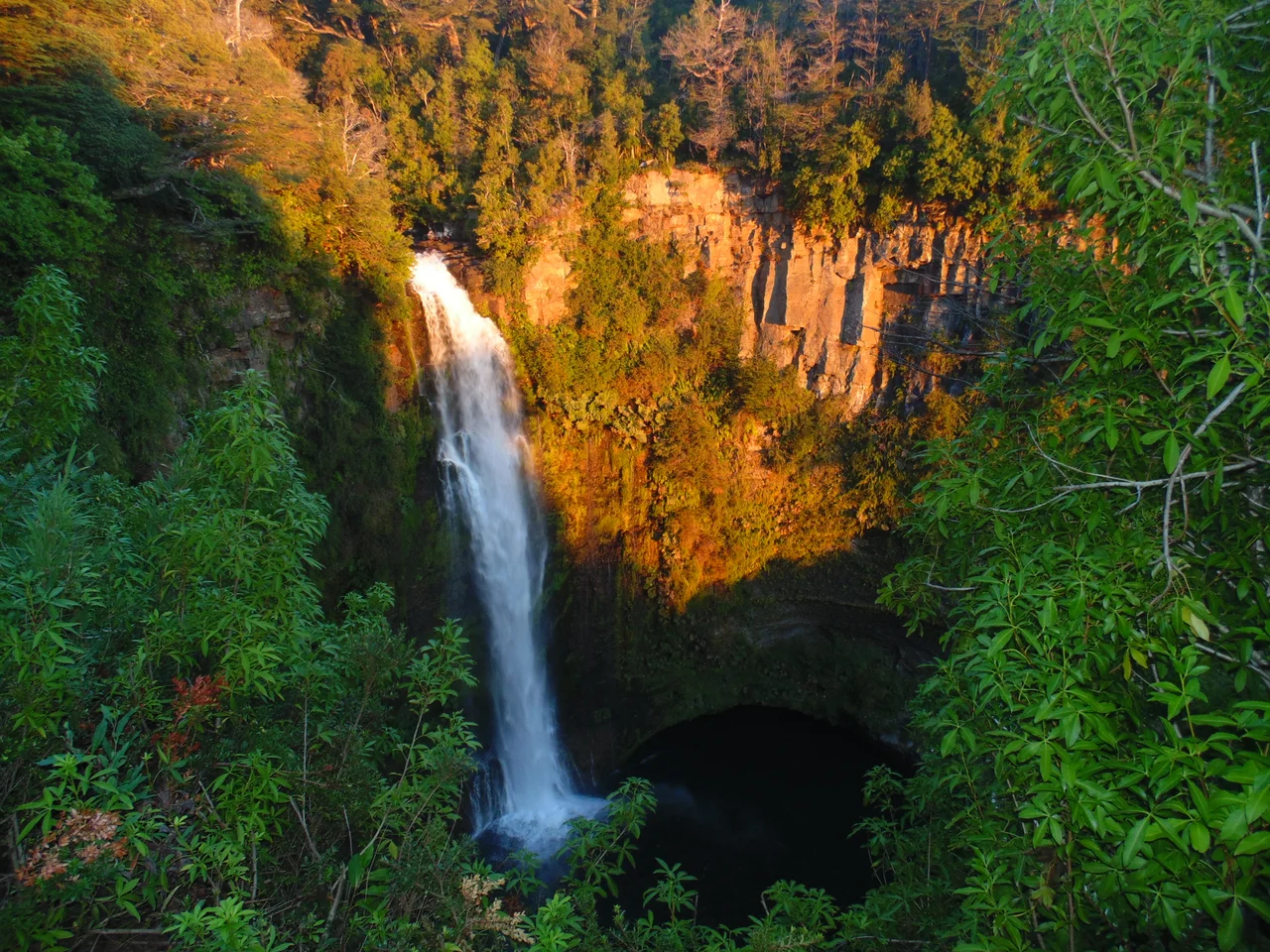
Four signposted trails thread the park: the Chilpa, the La Culebra-Lago Verde, the Lagunillas, and the Salto Malleco, which leads to a waterfall on the young Malleco River. The climate keeps visitors honest. Rain can fall in any season, and temperatures swing sharply between the warmth of day and the chill of mountain night. There is an information centre, picnic grounds, and rangers who know the forest intimately. Reaching it takes commitment, by gravel road from the town of Victoria or by the route toward the Tolhuaca hot springs, but that remoteness is exactly what has kept the forest whole for almost a century.
From the Air
Tolhuaca National Park lies at 38.20 degrees south, 71.83 degrees west, in the western Andean foothills of Chile's La Araucania Region. The park ranges from roughly 700 meters upward, and the snow-streaked cone of Tolhuaca volcano is the dominant landmark, immediately northwest of its larger neighbor Lonquimay. A viewing altitude of 7,000 to 9,000 feet frames the forested foothills, small lakes, and the volcano together; the deep green of dense beech and araucaria forest contrasts sharply with bare upper slopes. The nearest major airport is La Araucania International (ICAO: SCQP) near Temuco, about 80 km west-southwest. Mountain weather is changeable, with rain possible year-round and frequent low cloud against the foothills, so clear-air windows are best in the austral summer (December to March).
Nearby Stories
- Malleco Viaduct 1.6 km away
- Alto Biobío 21 km away
- Cerro Ñielol Natural Monument 28 km away
- Conguillío National Park 29 km away
- Capitán Pastene 50 km away
- Tragedy of Antuco 66 km away
- Tucapel 76 km away
- Vaca Muerta 104 km away