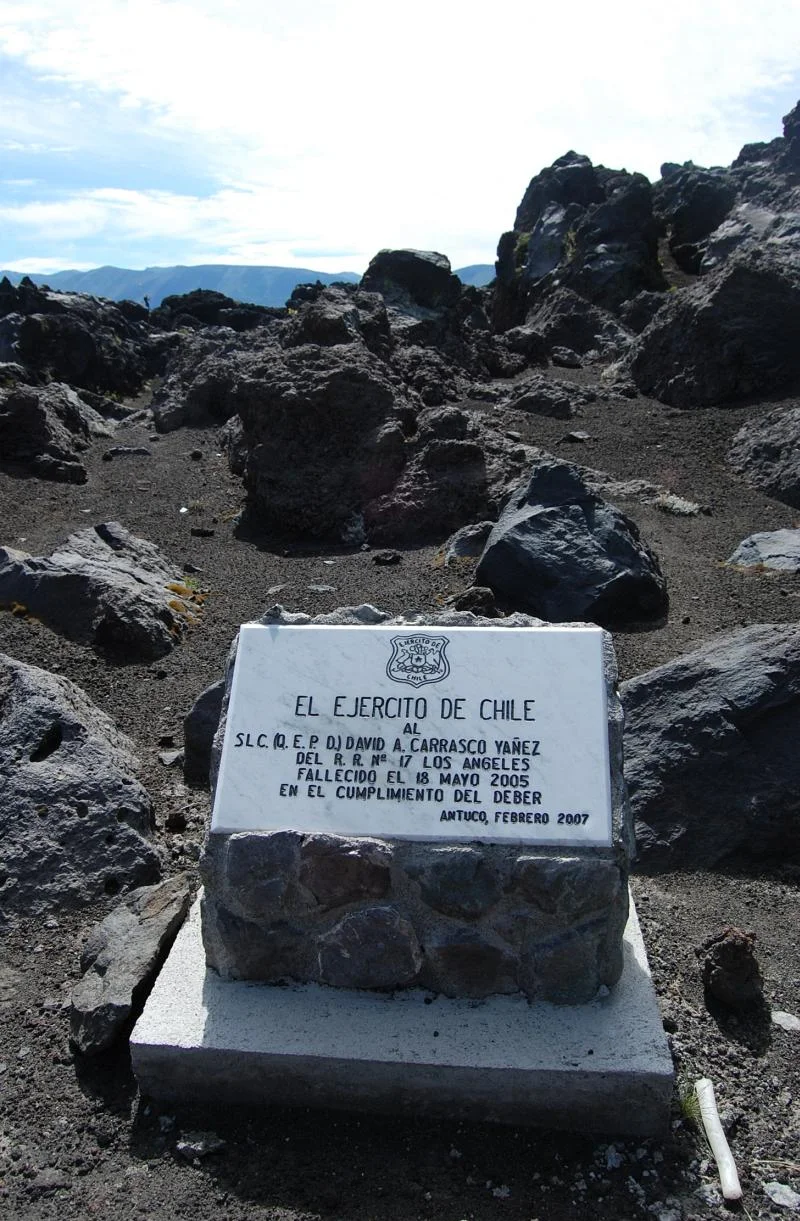

Tragedy of Antuco
They were teenagers, most of them, boys who had been soldiers for less than three months. On the morning of May 18, 2005, 474 conscripts of the Chilean Army's 17th Regiment were ordered to march twenty-eight kilometers across the flank of the Antuco volcano, into weather that their own sergeants had begged the officers to respect. The officer who gave the order stayed behind in a mountain shelter. Five hours later, on a slope above 1,400 meters, a wall of wind and snow swallowed the column. Forty-four of those young men, and one sergeant who stayed with them, never came down the mountain.
The Order
Antuco is a near-perfect volcanic cone on the edge of the Andes in the Biobío region, beautiful and, in late autumn, lethal. The conscripts who set out that May morning came mostly from Los Ángeles, ordinary teenagers fulfilling Chile's compulsory military service. Of the five companies sent onto the mountain, only one carried proper cold-weather survival gear. Non-commissioned officers, the sergeants and corporals who actually knew the ground, had asked that the exercise be canceled as the weather turned. They were overruled. Major Patricio Cereceda, who ordered the march, remained at a heated military shelter while the boys climbed into the cold. It is a detail that Chileans have never forgotten, and never forgiven.
Viento Blanco
The storm came fast. Five hours into the march, the temperature collapsed and a viento blanco, a "white wind," closed over the column, the kind of total whiteout in which a person cannot tell ground from sky. The boys were exhausted, underdressed, and lost. Many fought their way to shelter or were guided to safety by their own NCOs. Many could not. Hypothermia takes the young and fit as surely as anyone once the body's heat is gone. When the search ended, the dead numbered forty-four conscripts and one sergeant who stayed with his soldiers rather than save himself. They had names and families and futures that ended on a volcano in a training exercise that an official inquiry would later say "never should have been carried out."
A Reckoning
The Tragedy of Antuco was the Chilean military's worst peacetime loss since 1927. It detonated a national reckoning. There were public calls to abolish compulsory service altogether, and the army's culture of unquestioned obedience was suddenly on trial. Nine officers were sanctioned. Three senior men, including Major Cereceda, were forced into retirement; General Rodolfo González, commanding the relevant division, resigned as a matter of honor, taking responsibility for what his subordinates had done. Cereceda alone was convicted, sentenced to five years and sent to Punta Peuco prison, though he was paroled after serving three years and nine months. Ten soldiers were formally commended for their courage in the storm, the men who carried and dragged and refused to abandon their comrades.
What the Survivors Carry
The state eventually paid. The army offered families modest insurance and reparations and a small monthly pension, and Chile's Supreme Court later awarded the twenty-seven recognized survivors a combined 560,000 US dollars, roughly 20,600 each. No sum answers a frozen son. Every May, survivors and the families of the dead gather to remember the forty-five, to read the names aloud, to insist that these were not statistics but boys. The mountain that killed them still stands, snow-streaked and serene above the Laguna del Laja, indifferent to the grief at its foot. The lesson Chile took from Antuco was simple and hard-won: that no chain of command is worth a child's life, and that the duty to question an order can itself be an act of courage.
From the Air
The tragedy unfolded on the slopes of Antuco volcano at approximately 37.38°S, 71.34°W, in the high Andes of the Biobío region. The march crossed terrain between 1,400 and 1,700 meters; Antuco's summit reaches about 2,985 meters, a strikingly symmetrical cone rising beside the deep blue Laguna del Laja within Laguna del Laja National Park. From the air, look for the cone, the lava fields, and the reservoir lake to its west. Carriel Sur International Airport (ICAO SCIE) at Concepción lies roughly 130 km to the west-northwest; General Bernardo O'Higgins Airport (ICAO SCCH) at Chillán is the nearest field to the north. Mountain weather here changes violently and without warning, especially in autumn and winter; maintain generous terrain clearance and treat clear skies as temporary.
Nearby Stories
- Tucapel 22 km away
- Pincheira Brothers 31 km away
- Chos Malal 35 km away
- Alto Biobío 49 km away
- Chillán 64 km away
- Tolhuaca National Park 66 km away
- Espacio Lejano Station 78 km away
- Reserva Provincial La Payunia 150 km away