.jpg)
Reserva Provincial La Payunia
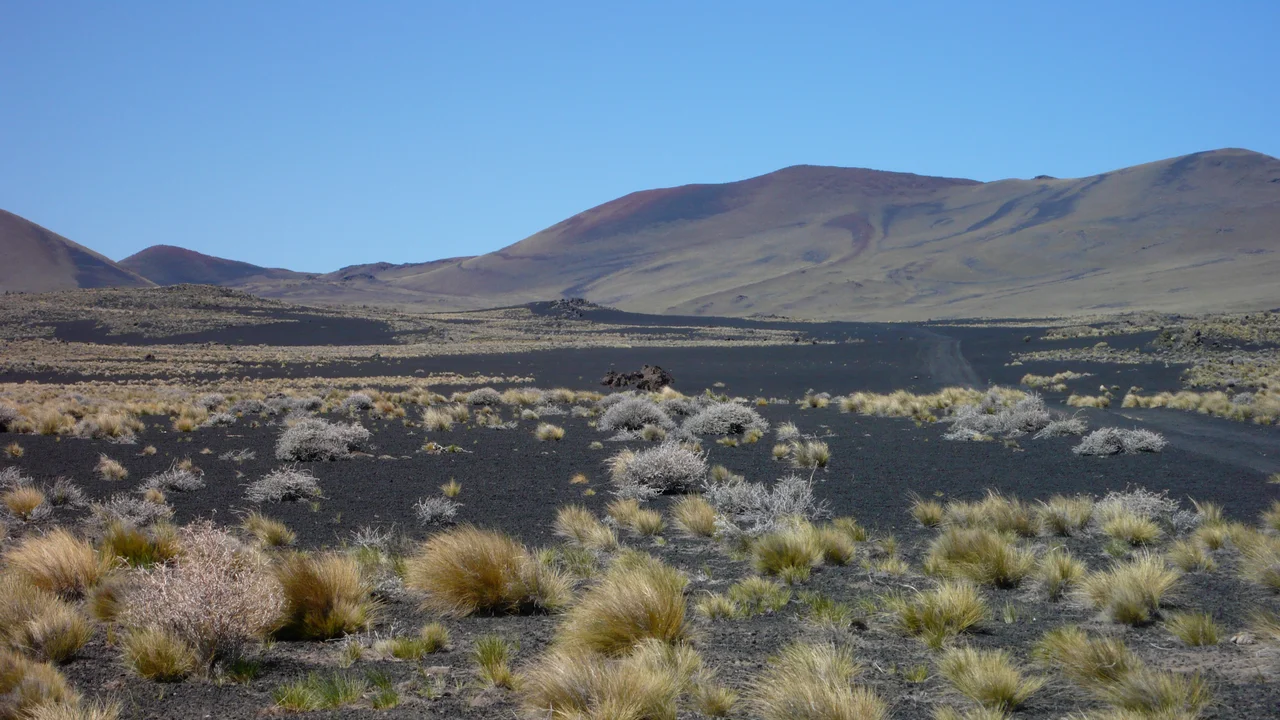
Stand anywhere in La Payunia and you are surrounded by volcanoes - not one or two on the horizon, but hundreds. This stretch of southern Mendoza Province holds more than eight hundred volcanic cones, one of the highest densities of volcanoes found anywhere on the planet, scattered across 4,500 square kilometers of Patagonian steppe roughly 160 kilometers from the town of Malargue. The ground itself records the eruptions: in places, fallen volcanic ash has stained the plains a deep black, the Pampas Negras, the Black Pampas. Argentina declared the area a provincial reserve in 1988, but the land had been writing its own history in basalt and cinder for far longer.
A Field of Fire
The reserve sits in the back-arc of the Andes, where a thinning of the Earth's crust let magma rise again and again across hundreds of thousands of years, building cone after cone instead of one towering peak. The largest are Payun Matru, Payun Liso, and Santa Maria. Payun Matru is the giant - a shield volcano rising above 3,700 meters, crowned by a caldera roughly eight kilometers wide that cradles a high lake. From this volcanic field came the Pampas Onduladas lava flow, which at well over 160 kilometers long is recognized as the longest lava flow of the entire Quaternary period - the last 2.5 million years - anywhere on Earth. The landscape is so faithfully volcanic that planetary scientists have studied these flows as stand-ins for the long lava rivers of Mars.
Black Pampas, Red Slopes
Color is the first thing the place does to you. Strombolian eruptions blanketed the plains southeast of the cones with dark lapilli, and the wind has since reworked that debris into black dunes that ripple toward the horizon. Against this darkness, oxidized cinder cones glow rust-red and ochre, so that the terrain reads almost like a painter's deliberate composition rather than an accident of geology. There are no soft transitions here. Black gives way to red, red to the pale gold of dry grass, and the whole expanse runs out toward mountains under the enormous, scouring wind that defines the Patagonian steppe. Through it the Grande River cuts its way, threading across cracked volcanic rock on its way out of the high country.
Life on the Lava
Harsh as it looks, the reserve is far from empty. More than seventy animal species have been documented across La Payunia. Andean condors ride the thermals on three-meter wings; Darwin's rhea sprints across the flats, and flamingos gather on the high lakes. Pumas hunt here, alongside South American gray foxes, the larger culpeo fox, and the pampas cat, while the burrowing plains viscacha and herds of guanaco - the largest native animal in the reserve - graze the sparse vegetation. The guanaco, a wild relative of the llama, gives the place one of its most striking sights: great bands of them moving across black volcanic ground beneath a sky full of circling condors, an Andean scene almost unchanged for millennia.
The People Who Stayed
About twenty families live within the reserve, organized as the Cooperativa Payun Matru, and they have built a livelihood out of the wildlife rather than against it. Each year they round up wild guanacos, shear them for their exceptionally fine fleece, and release them back onto the steppe - a practice monitored by the Wildlife Conservation Society, with the wool and yarn exported abroad. It is a rare model: a community earning its keep from living animals it does not own and cannot domesticate. In a place this remote and this severe, that partnership between a handful of families and a wilderness of volcanoes is its own quiet marvel, and it has helped make the case for La Payunia's growing international recognition.
From the Air
La Payunia is centered near 36.42 degrees south, 69.20 degrees west, in the Malargue Department of southern Mendoza Province, Argentina, with cone summits ranging from the plains up past 3,700 meters at Payun Matru. From the air the field is unmistakable: hundreds of dark volcanic cones and the black lapilli plains of the Pampas Negras spread across the steppe, with the broad caldera of Payun Matru as the central landmark and the Grande River threading the western edge. The nearest airport is Malargue's Comodoro D. Ricardo Salomon (ICAO SAMM, IATA LGS), about 160 km to the north; San Rafael (ICAO SAMR) lies farther north still. Expect powerful, persistent westerly winds off the Andes and the clearest air in the dry Patagonian summer.
Nearby Stories
- Witches' Cave 49 km away
- Malargüe Station 56 km away
- Chos Malal 92 km away
- Pincheira Brothers 133 km away
- Gruta del Indio 162 km away
- Espacio Lejano Station 187 km away
- Finca Los Alamos 204 km away
- FaSinPat 244 km away