
Witches' Cave
There is no light switch in the Witches' Cave, and no paved path - only a guide, a helmet lamp, and the dark. Inside the Moncol Hill, 1,830 meters up in the Andes of southern Mendoza Province, the Caverna de las Brujas runs deep into limestone laid down on the floor of a Jurassic sea. The cave got its eerie name long before tourists came, and it keeps it: kilometers of black galleries, chambers named for the Virgin and for flowers, and the constant cold drip of water that has been shaping the rock for ages. About 65 kilometers southwest of the town of Malargue, it is one of the great underground attractions of Argentina - and one you must crawl, climb, and scramble to earn.
A Sea Turned to Stone
The story of this cave begins underwater. The limestone that holds it is Jurassic sedimentary rock, formed when this part of South America lay beneath an ocean. Then the Andes rose during the Cenozoic Era, lifting that ancient sea floor thousands of meters into the sky and fracturing it along vertical cracks. Water did the rest. Acidic groundwater seeped into the fractures and slowly dissolved the rock from within, hollowing out galleries in a process geologists call solutional caving. The work accelerated at the end of the last Ice Age, when this now-arid region received far more rain than it does today. The cave, in other words, is a record of three vast changes - an ocean, a mountain range, and a wetter world - written into a single hill.
Rooms of the Virgin and the Flowers
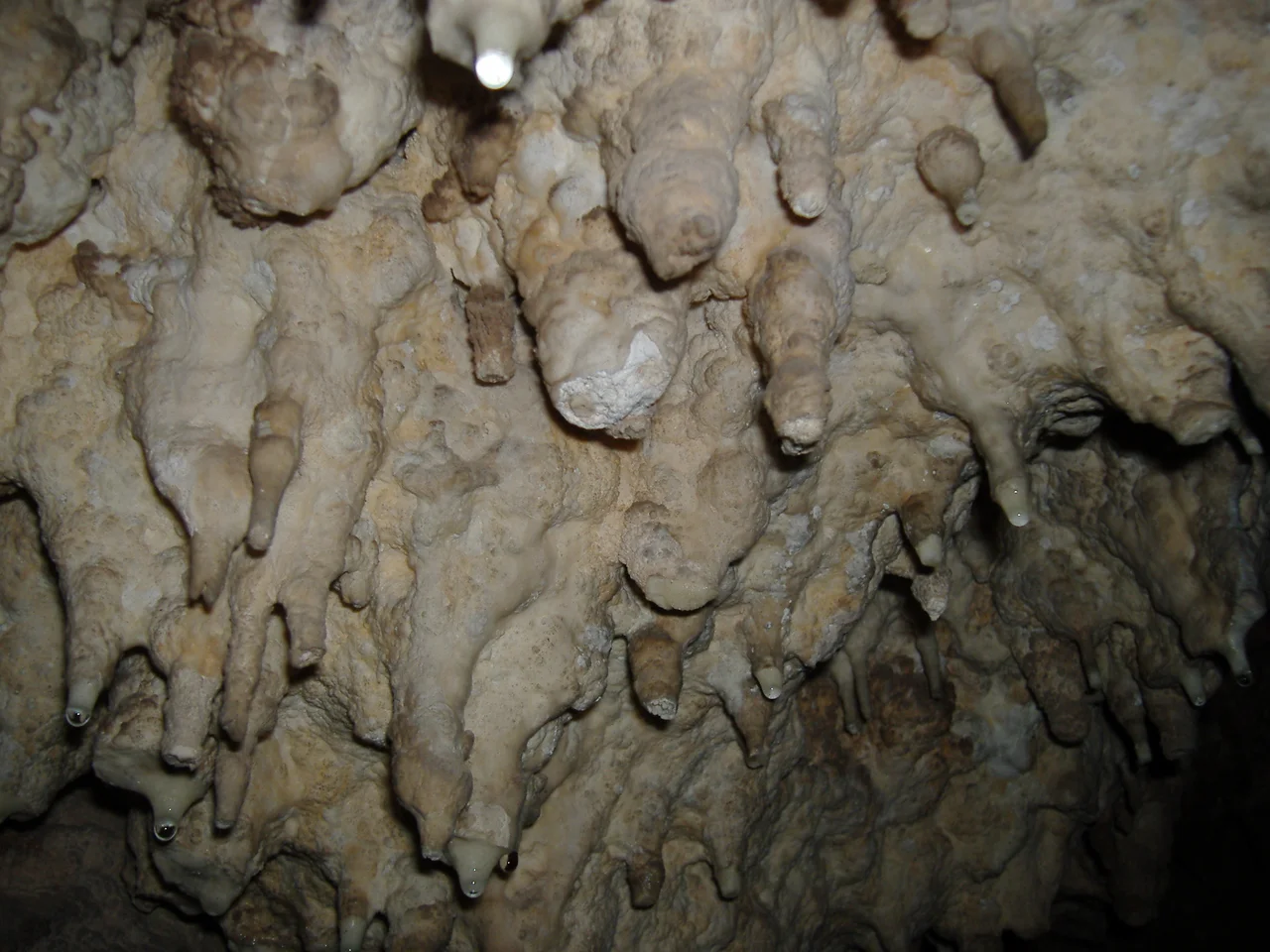
Inside, the cave is a gallery of slow sculpture. Speleothems crowd the passages - stalactites hanging like stone icicles, stalagmites rising to meet them, each grown drop by drop over uncounted centuries. Two chambers carry names that fit their strangeness: the Sala de la Virgen, the Virgin Room, and Las Flores, The Flowers, where mineral formations bloom from the walls. Deep galleries hold still pools of underground water that mirror the lamplight. It is the kind of place that makes visitors lower their voices without being told to - vaulted, silent, and utterly indifferent to the desert sun that hammers the surface a few hundred meters above.
Life Without the Sun
Something lives down here, in the permanent dark. The Witches' Cave hosts a specialized fauna adapted to a world with no solar radiation at all - spiders and springtails that have made their whole existence in the blackness, needing nothing the sun provides. These are not lost travelers but residents, generations of small creatures for whom this cave is simply the world. Nearer the entrance, where a little daylight and warmth still reach, bats and mice shelter in the galleries, coming and going across the boundary between the lit world and the dark one. They are a reminder that a cave is not a dead space but an ecosystem with its own rules, one where the usual rhythm of day and night simply does not apply and life has quietly arranged itself accordingly.
Walk Softly Underground
Explorers have mapped about six kilometers of passages, but visitors see only a fraction. Access is granted only with a guide and proper equipment, and only to the first 200 meters of galleries - and that limit is not mere caution. Those opening chambers are already damaged, their delicate formations broken and dulled by the hands of earlier visitors who could not resist touching what took millennia to grow. It is a small, sobering lesson at the threshold of one of southern Mendoza's natural wonders. A stalactite snapped off in a moment will not return in any human lifetime, and the cave's managers have drawn their line so that what remains deeper in the dark stays whole for those who come after.
From the Air
The Witches' Cave lies at 35.80 degrees south, 69.82 degrees west, within the Moncol Hill at about 1,830 meters elevation, in the Malargue Department of southern Mendoza Province, Argentina. The cave entrance itself is invisible from the air, but the surrounding country is dramatic: pale limestone ridges and the folded foothills of the Andes about 65 km southwest of Malargue, near the Bardas Blancas area off Ruta 40. The nearest airport is Malargue's Comodoro D. Ricardo Salomon (ICAO SAMM, IATA LGS), roughly 65 km to the northeast; the Andean crest and the Chilean border rise sharply to the west. Expect strong mountain winds and the clearest visibility during the dry summer months.
Nearby Stories
- Malargüe 19 km away
- Reserva Provincial La Payunia 43 km away
- Altos de Lircay National Reserve 60 km away
- Radal Siete Tazas National Park 65 km away
- Atuel Canyon 93 km away
- Pincheira Brothers 111 km away
- Gruta del Indio 138 km away
- Chos Malal 156 km away