
Malargüe
For a town this small, Malargüe keeps strange company. Physicists from a hundred institutions pass through its restaurants. A short drive out of town, an array of water tanks built to catch particles from beyond our galaxy sprawls across the plain, while farther south a 35-metre dish trades signals with spacecraft near other planets. Yet the streets stay sleepy, the taxis cost a dollar or two, and the supermarket keeps a long siesta. Malargüe sits where National Route 40 begins to fray toward the wild south, and it has quietly become one of the most scientifically interesting dots on the map of Argentina.
Place of Stone Corrals
The name comes from Mapudungun, the language of the Mapuche, and is usually read as malal-hue - roughly "place of corrals" or "place of rocky cliffs." Long before any observatory, this was open indigenous territory, home to Pehuenche, Puelche and Mapuche peoples who moved across the high country and traded along its passes. The land stayed largely beyond colonial control until the Argentine state's campaigns of the late nineteenth century. The town that grew here is now the seat of the largest and emptiest department in Mendoza Province, a place defined as much by what surrounds it - volcanoes, lava fields, salt lagoons - as by the modest grid of streets at its center.
Catching the Universe
Malargüe calls itself home to the world's largest cosmic-ray observatory, the Pierre Auger, and the claim shapes the town. The visitors' centre stands at the northern end of the city on Avenida San Martín. Drive in on ruta 40 and you pass through the edges of the array without quite realizing it: white tanks, each a sealed barrel of ultra-pure water wired with electronics and solar panels, scattered across the steppe in a vast triangular grid. They stretch for an hour's drive at highway speed. Ask at the centre and, if researchers are on site, you may find yourself talking with a physicist who flew in from Europe or the United States to study particles older than the Earth.
Volcanoes, Caves, and Flamingos
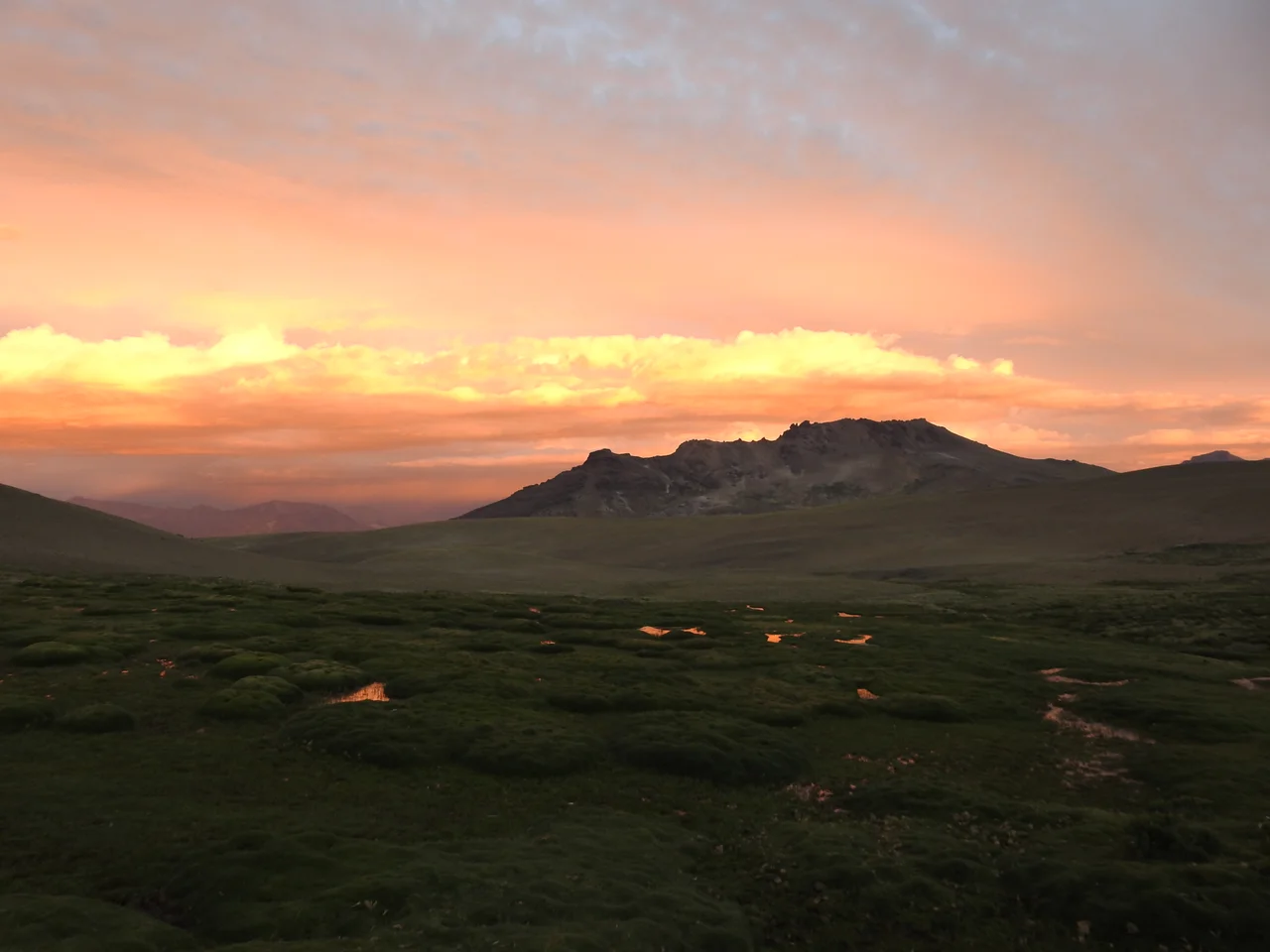
The country around Malargüe is a geologist's daydream. To the south lies La Payunia, a reserve dense with volcanic cones and black lava flows, where a careful driver can reach the base of Volcán Payún and herds of guanaco-like animals cross the track. Closer to town are the Pozos de las Ánimas, a pair of great sinkholes, and the Caverna de las Brujas - the "witches' cave" - which must be booked in advance back in town. After heavy rain the surrounding pampa floods, and shallow lagoons fill with flamingos and ibises just a few kilometres out, turning a seemingly barren plain into a birdwatcher's reward.
Gateway to the High Snow
In winter the town fills a different role. Malargüe is the nearest base for Las Leñas, one of South America's premier ski mountains, an hour or so up the road. Skiers stay here because the hotels are cheaper and many of them throw in discounted lift passes. The same valleys lead toward Cerro Sosneado - at 5,189 metres, the southernmost peak in the Americas to top 5,000 - and on toward the free, half-ruined thermal baths at El Sosneado. Whether you arrive for the snow, the science, or the volcanoes, Malargüe rewards the kind of traveler willing to drive a long way into big, quiet country and look closely at what is there.
From the Air
Malargüe lies at 35.474°S, 69.585°W in southern Mendoza Province, on the western Argentine plain at roughly 1,400 m elevation, where the flat steppe meets the rising wall of the Andes to the west. The town grid, Route 40, and the nearby Pierre Auger visitors' centre are useful landmarks; the cosmic-ray array's scattered white tanks dot the surrounding pampa. The local airport is Malargüe (ICAO SAMM); the regional hub is Mendoza (SAME), about 5-6 hours away by road. Skies are typically clear and dry, with excellent visibility toward the Andean front range.
Nearby Stories
- Malargüe Station 11 km away
- Las Leñas 11 km away
- Atuel Canyon 42 km away
- Hotel Termas el Sosneado 71 km away
- Uruguayan Air Force Flight 571 79 km away
- Gruta del Indio 88 km away
- LAN-Chile Flight 621 113 km away
- FaSinPat 365 km away