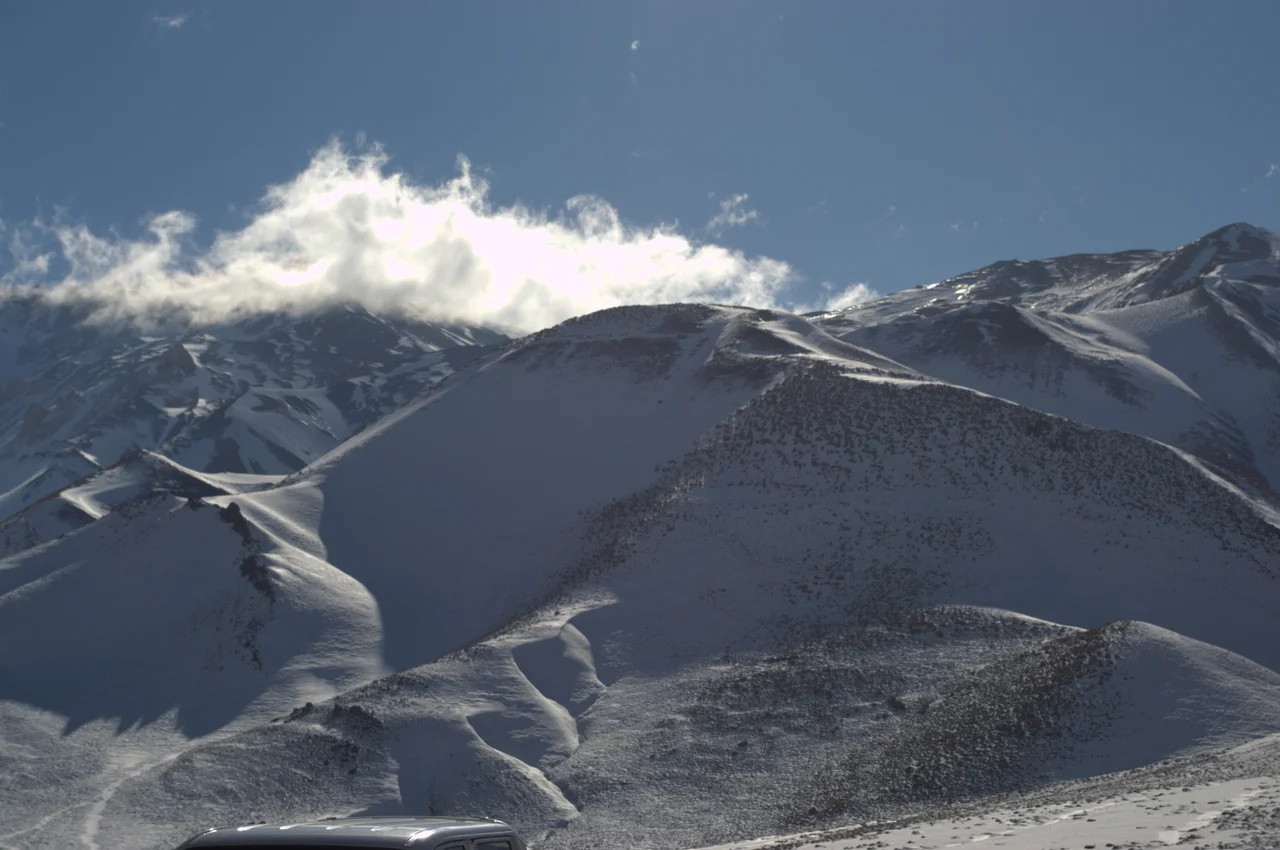

Las Leñas
Skiers will tell you they would trade every other chairlift in South America for this one. The Marte chair at Las Leñas is slow, exposed, and so often shut by wind or avalanche danger that regulars speak of the "A-Factor" - the days it simply refuses to run for no reason anyone can name. But when Marte spins, it delivers riders to a summit ringed by hundreds of chutes, couloirs and open bowls, terrain so vast and so steep that you can ski a different line every day for a week and never cross your own tracks. This is the heart of Argentine skiing, high in the Andes of Mendoza Province, where the season runs through the Southern Hemisphere winter.
A Resort Above the Trees
Las Leñas opened in July 1983, rising fast in a remote Andean valley - construction had begun only that January, and by midwinter a 300-bed hotel stood ready for guests. Everything here sits high. The base lodge rests at 2,240 metres, and the lifts climb to a summit near 3,430 metres, a vertical drop of nearly 1,190 metres. Because of the altitude, the entire mountain lies above the tree line; there is not a single wooded trail. The result is a landscape of bare white slopes and rock, open to the sky in every direction, where snow conditions and wind can change the character of the whole mountain in an afternoon.
The Master Key
Roughly a third of the marked runs at Las Leñas are rated expert, but the marked runs are not really the point. The Marte chair - its name the Spanish word for Mars - is regarded among serious skiers as the master key to freeskiing in the Andes. From its top, the off-piste possibilities run into the hundreds: steep chutes, vast bowls, and lines like the famous Eduardo's Couloir falling away at nearly 48 degrees. The terrain is so intricate that mountaineer Thomas Perren mapped and catalogued the routes, more than 200 of them, so that visitors could find their way through the maze. It has earned Las Leñas a reputation, among those who chase such things, as some of the best advanced skiing in the world.
Beauty With Consequences
That same terrain demands respect. Some of the chutes that look so inviting from the lift end abruptly at cliffs, and a wrong turn can leave a skier cliffed-out with no safe way down. The resort requires helmets, and experienced visitors hire certified guides who carry local knowledge of which line goes and which one ends in air. Avalanche danger is real on these loaded, treeless faces. The freedom of Las Leñas - the empty bowls, the untouched snow - is inseparable from its seriousness. The mountain rewards skill and punishes carelessness, and the people who love it most are the ones who treat it with the most caution.
More Than the Marte
Not everyone comes to ski the abyss. Near the village, gentle slopes by the Poma lifts give beginners and families room to learn, and runs close to the lodge stay lit for night skiing until late. A ski school teaches in several languages and runs programs for children as young as infancy. When the snow melts, between November and May, the valley reopens for mountain biking, horse riding and climbing. The nearest town is Malargüe, about 80 kilometres away, where many visitors sleep for cheaper rooms and discounted passes; the closest commercial airport is at San Rafael, a couple of hours' drive down the mountain roads.
From the Air
Las Leñas lies at 35.146°S, 70.081°W in the Andes of southwestern Mendoza Province, with a base at 2,240 m and summit terrain near 3,430 m - all of it above the tree line, so the resort reads from the air as a cluster of buildings amid bare, snow-covered alpine slopes in winter. Reached by the winding RP-222, it sits about 80 km from Malargüe. Nearest airfields: Malargüe (ICAO SAMM) and San Rafael (SAFR) for regional flights; Mendoza (SAME) is the larger hub to the north. Mountain weather shifts quickly; high winds frequently close upper lifts. The peaks of the main Andean range rise to the west toward the Chilean border.
Nearby Stories
- Hotel Termas el Sosneado 8.2 km away
- Malargüe 16 km away
- Pierre Auger Observatory 31 km away
- Radal Siete Tazas National Park 36 km away
- La Frontera (Chile) 36 km away
- Curicó 53 km away
- Witches' Cave 59 km away
- Gruta del Indio 113 km away