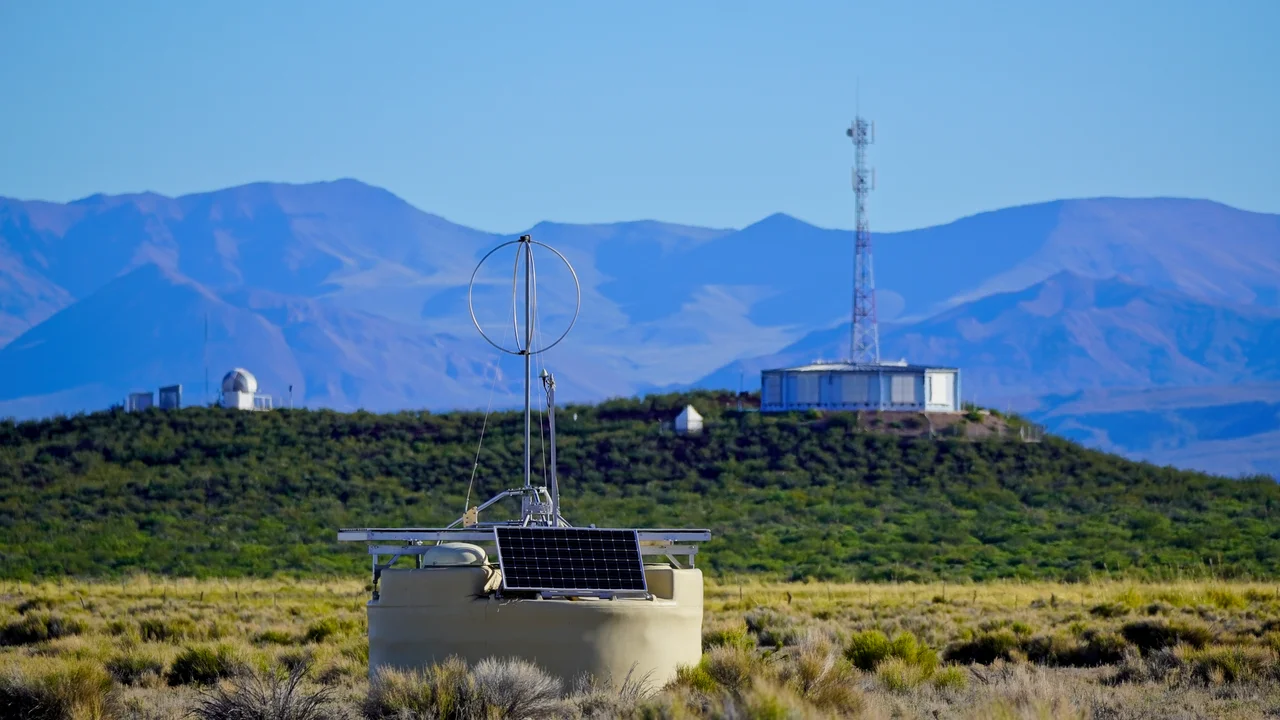

Pierre Auger Observatory
Somewhere over the Argentine pampa, perhaps tonight, a single subatomic particle will slam into the top of the atmosphere carrying as much energy as a well-thrown baseball - all of it packed into something smaller than an atom. It will never reach the ground intact. Instead it shatters the air into a cascade of billions of secondary particles, a invisible shower racing down at nearly the speed of light and spreading across kilometres of sky. To catch one of these rare visitors, scientists built a detector the size of a small country and scattered it across the plain near Malargüe. They named it for the man who first understood what was happening.
A Net the Size of Luxembourg
The numbers verge on the absurd. Cosmic rays of the highest energies strike Earth at a rate of about one particle per square kilometre per century. To gather a meaningful catch within a human lifetime, the Pierre Auger Observatory covers 3,000 square kilometres - comparable to Rhode Island, or Luxembourg. Spread across that plain stand 1,600 water-Cherenkov tanks, each a sealed barrel of ultra-pure water laid out in a triangular grid 1.5 kilometres apart. Around the edges, 24 fluorescence telescopes watch the night sky. It is, by area, the largest cosmic-ray experiment ever built, and it earns that title by sheer reach across the empty land.
Two Ways to See a Shower
What makes Auger remarkable is that it watches each air shower twice, by two completely different means. As the cascade tears through the atmosphere it excites nitrogen and emits a faint ultraviolet glow; on clear, moonless nights the fluorescence telescopes photograph that ghostly streak, like lightning traced in slow motion. Then, as the surviving particles reach the ground and pass through the water tanks, they trigger a blue flash known as Cherenkov light, picked up by photomultiplier tubes inside each barrel. By comparing the time each tank fires, physicists reconstruct the incoming particle's direction; the brightness reveals its energy. No earlier experiment had combined both techniques on the same ground, and the cross-check makes Auger's measurements unusually trustworthy.
The Man Who Read the Sky
The observatory carries the name of Pierre Victor Auger, the French physicist who in 1937 worked out that these enormous air showers all traced back to a single particle striking the atmosphere. He was building on a discovery from 1912, when Victor Hess rode a hot-air balloon to high altitude and found that mysterious radiation grew stronger the higher he climbed - proof it came from space, not the ground. Decades later, in 1992, physicists James Cronin and Alan Watson proposed an observatory grand enough to study the most extreme of these rays. Fifteen countries split the roughly fifty-million-dollar cost, construction began in 2000, and the array was officially completed in 2008. Today more than 500 scientists from nearly 100 institutions keep it running.
Hunting the Source
Where do these violent particles come from? For years that question had no clear answer. Then, in 2017, after twelve years of patient observation, the collaboration reported that the highest-energy cosmic rays do not arrive evenly from all directions - they show a faint preference, a lopsidedness in the sky that points to sources far beyond the Milky Way, in other galaxies. Which galaxies, and what cosmic engines accelerate ordinary matter to such fury, remains unsolved. An upgrade called AugerPrime is now layering new detectors over the array to sharpen the picture. Out on the Pampa Amarilla, under some of the darkest skies on the continent, the tanks keep their silent watch, waiting for the next messenger from the edge of the universe.
From the Air
The Pierre Auger Observatory is centered near 35.207°S, 69.316°W on the Pampa Amarilla west of Malargüe, Mendoza Province, on high steppe around 1,300-1,500 m elevation with the Andes rising to the west. From the air the array itself is nearly invisible - its 1,600 tanks are small and widely scattered - but the fluorescence-detector buildings on low rises mark its edges, and the central campus sits in Malargüe town. Nearest airfield is Malargüe (ICAO SAMM); Mendoza (SAME) is the regional gateway. The same dark, dry, cloudless nights that make the site ideal for detecting faint air showers also offer superb visibility for high-altitude transit.
Nearby Stories
- Las Leñas 15 km away
- Hotel Termas el Sosneado 25 km away
- Malargüe Station 30 km away
- Atuel Canyon 31 km away
- Gruta del Indio 72 km away
- Uruguayan Air Force Flight 571 81 km away
- Altos de Lircay National Reserve 89 km away
- FaSinPat 384 km away