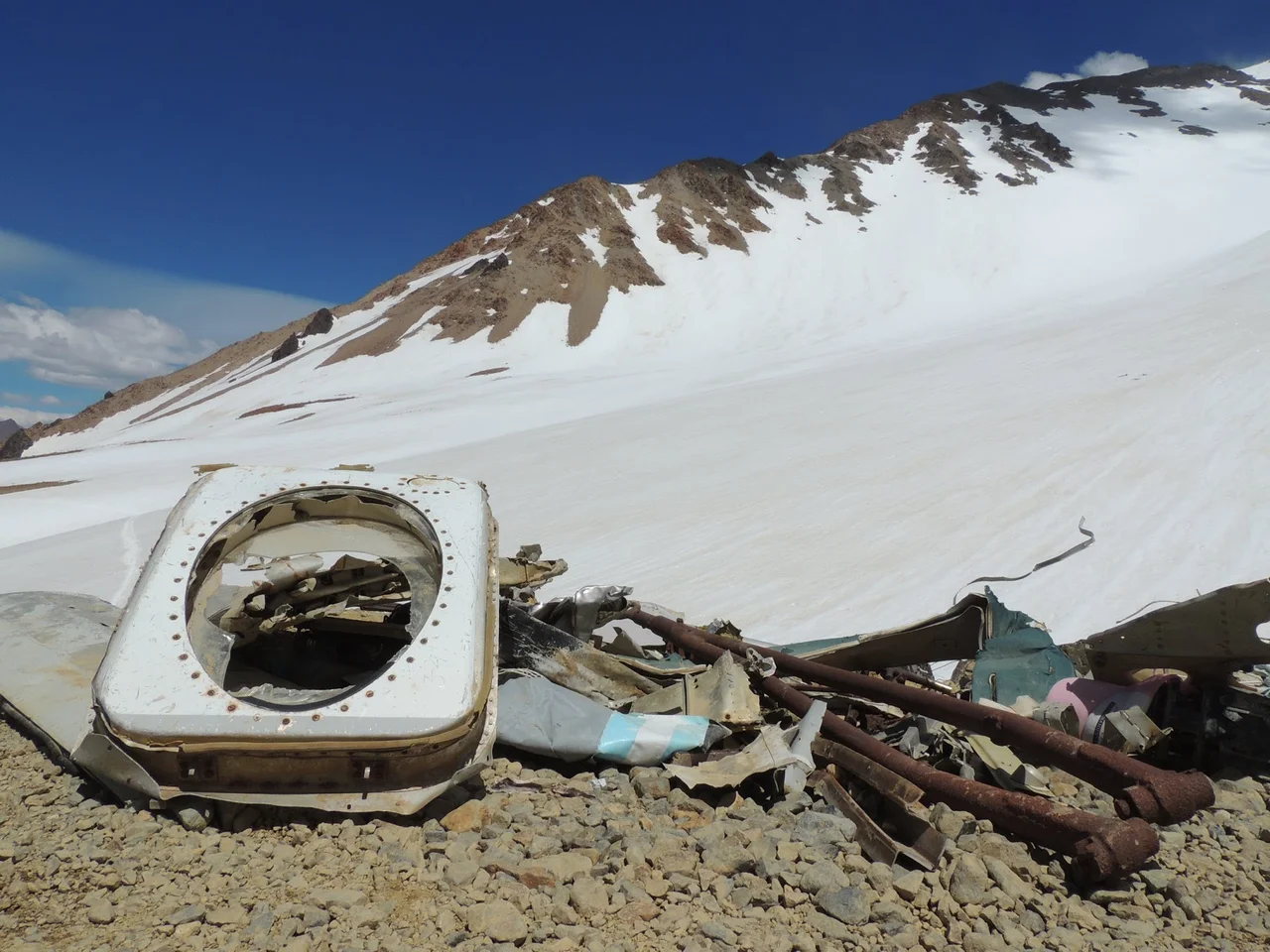

Uruguayan Air Force Flight 571
Forty-five people boarded the chartered Fairchild in Montevideo on a Friday the thirteenth, most of them young, most of them laughing. They were a rugby club called the Old Christians, flying to Santiago for a match, and they had brought along friends and family to make a weekend of it. None of them could have known that twenty-nine would not come home, or that the survivors would spend seventy-two days on a frozen mountainside writing one of the most extraordinary chapters in the history of human endurance. This place, a nameless slope near the Chilean border, would come to be called the Valle de las Lágrimas: the Valley of Tears.
A Wrong Turn in the Clouds
The Andes are not a single ridge but a vast, crumpled wall, and in October the storms hide the peaks behind cloud. The co-pilot believed the aircraft had passed Curicó, the waypoint where it should have turned north toward Santiago, and began his descent. He was wrong by dozens of miles. As the plane dropped, the clouds parted to reveal black rock dead ahead. The pilots pulled up, but the Fairchild clipped a ridge, lost both wings and its tail, and slid down the eastern face of the mountains before stopping on the snow at roughly 3,500 metres. Twelve people died in the impact or fell from the broken fuselage. The survivors found themselves alone, injured, and unimaginably high, with the temperature falling and the light beginning to fade.
The Mathematics of Staying Alive
There was almost nothing to eat. A little chocolate, some wine, scattered snacks rationed into crumbs that lasted only days. The search planes that crossed overhead could not see a white fuselage against white snow, and after eight days the searching stopped. The survivors heard this on a small transistor radio. It was then that they confronted the decision that would haunt and define them: to live, they would have to eat the bodies of their friends who had died. They did not arrive at it lightly or alone. They made a pact among themselves, a promise that if any of them died, the others could use his body so that the group might survive. Several later compared it to a sacrament, an act of love rather than horror. It is not a thing to sensationalize. It was a choice made by grieving young men who wanted, more than anything, to see their families again.
The Avalanche and the Long Dark
On the sixteenth night, an avalanche poured down the slope and buried the fuselage where everyone slept. Eight more people died, smothered in the snow inside the shelter that was supposed to protect them. Those who dug free now faced the depths of the southern winter at altitude, days of whiteout and cold so total it became its own kind of presence. They melted snow for water using sheets of metal in the sun. They tended the injured. They told stories of home and of the meals they would eat when they returned. What did not happen is as remarkable as what did: there was no descent into every-man-for-himself savagery. The strong cared for the weak. Decades later, survivors would note that their story is the photographic negative of fiction like Lord of the Flies. Under the worst pressure imaginable, these young men became more human, not less.
Two Boys and a River
By December, two of the survivors, Nando Parrado and Roberto Canessa, understood that no one was coming. They sewed insulation into a crude sleeping bag and set out west on foot, climbing a peak that nearly killed them, then descending for ten brutal days into a green valley they had begun to think was a hallucination. Across a river they spotted a Chilean arriero, a mountain herdsman named Sergio Catalán. They could not be heard over the water, so they threw a note weighted with a stone. Catalán read it, gestured that he understood, tossed them bread, and rode ten hours to fetch help. On 22 and 23 December, helicopters lifted the last fourteen survivors off the mountain. Years later, when Catalán needed a hip replacement he could not afford, the men he had saved, one of them now a doctor, paid for the surgery. They never forgot the stranger who chose to believe two ragged ghosts.
What the Mountain Keeps
The survivors buried their dead at the crash site in a common grave and set the wreckage alight, though the snow-covered bottom of the fuselage remained when Eduardo Strauch returned in 1995. In 2006, families raised a simple black monument to those who lived and died there. Today the Valle de las Lágrimas draws trekkers who ride and climb for days to reach it, drawn by a story that refuses to be reduced to its grimmest detail. Books by Parrado and others, and J. A. Bayona's 2023 film Society of the Snow, have carried it around the world. The survivors have spent half a century insisting on a single message: that what saved them was not strength alone but the bonds they forged, the care they gave one another in the place they named for tears.
From the Air
The Valle de las Lágrimas crash site lies near 34.77°S, 70.29°W, high in the Andes on the Argentina-Chile border near El Sosneado, at roughly 3,500 metres (11,500 ft) elevation. The terrain is severe: glaciated peaks, deep snow much of the year, and rapidly changing mountain weather that historically hid the wreckage. Overflight is only advisable in clear, stable conditions and well above ridge level. The nearest serviced fields are in Argentina's Mendoza Province: Malargüe (SAMM, elevation 4,683 ft) to the southeast, San Rafael (SAMR, elevation 2,470 ft) to the east, and Mendoza El Plumerillo (SAME, elevation 2,310 ft) to the north. Treat all Andean crossings with respect for altitude, turbulence, and limited visibility.
Nearby Stories
- Las Leñas 19 km away
- Rancagua 33 km away
- La Frontera (Chile) 34 km away
- Pierre Auger Observatory 37 km away
- El Teniente 45 km away
- Curicó 52 km away
- Malargüe 84 km away
- Uco Valley 103 km away