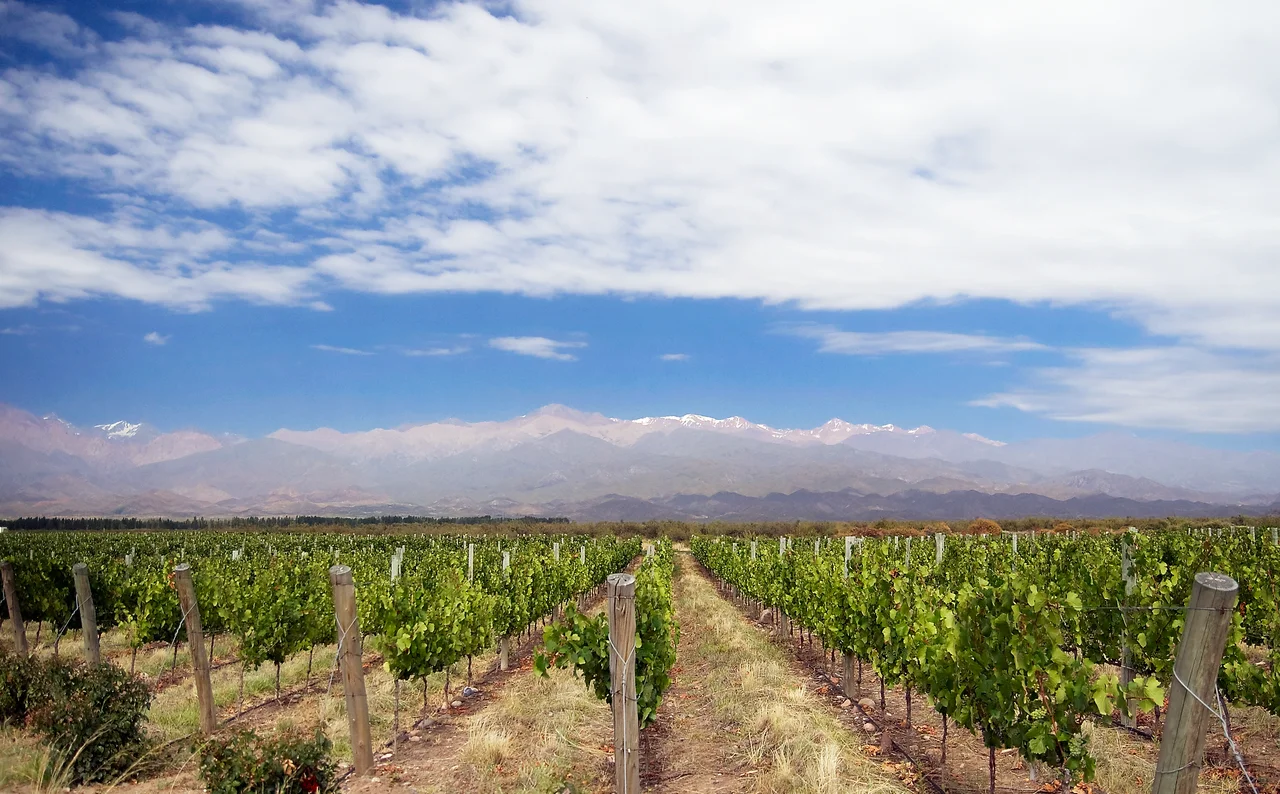

Uco Valley
Stand among the vines in the Valle de Uco and you feel the altitude before you taste it. The air is thin and bright, the sun fierce by day, the nights startlingly cold. This is high-desert farming on the edge of what a grapevine can survive - rows of Malbec planted between 900 and 1,500 meters above sea level, with experimental plots in the Gualtallary district climbing toward 1,600 meters and beyond. Roughly 100 kilometers south of the city of Mendoza, spread across the departments of Tupungato, Tunuyan, and San Carlos along the Tunuyan River, the Uco Valley has become the address every Argentine winemaker covets.
Water From the Mountains, Light From the Sky
Almost no rain falls here. What makes the valley green is meltwater from the Andes, channeled into vineyards through irrigation networks fed by the snows on the peaks to the west. The growing season is long and generous, with more than 250 sunny days a year, so the fruit ripens slowly and fully. Yet the secret ingredient is the daily temperature swing. Intense mountain sun drives ripening through the afternoon; then, after sundown, cold air slides down off the cordillera and the temperature plunges. That cool night air lets the grapes hold onto their acidity and aroma even as their sugars climb - the chemistry behind wines that are deep in color, intense in scent, and layered in flavor.
Why Altitude Tastes Different
Malbec is an old French grape that found its truest home far from France, and the Uco Valley shows why. At these elevations the wines turn out markedly different from Malbec grown in the warmer, lower zones of Mendoza. Instead of heavy, jammy dark fruit, high-altitude Uco Malbec leans toward vivid violet and red-fruit aromas, brighter natural acidity, finer-grained tannins, and a distinct mineral edge drawn from the valley's stony, alluvial and calcareous soils. The same grape, lifted a thousand meters into thinner air and stronger sunlight, simply becomes a different wine - more lifted, more nervy, more alive.
The Ground Itself
Much of what ends up in the glass is decided underfoot. The Tunuyan River and its mountain tributaries have spent millennia washing rock and gravel down from the Andes, building the alluvial fans that the vineyards are planted on. The soils are poor, stony, and free-draining - exactly the kind of lean ground that makes a vine struggle and, in struggling, concentrate its fruit. In the higher reaches around Gualtallary, growers prize pockets of calcareous, limestone-rich soil that lend the wines their stony, almost saline minerality. The strong ultraviolet light at altitude thickens grape skins as well, deepening color and tannin. Climate gets the credit, but the geology is the quiet partner.
A Valley on the Wine Route
Tradition planted Semillon and Malbec here first, alongside smaller quantities of Bonarda and Barbera, and Malbec remains the valley's signature. In recent decades growers have added Cabernet Sauvignon, Cabernet Franc, Sauvignon Blanc, and Chardonnay, drawn by the same cool, high-altitude conditions. Today the Uco Valley anchors the Argentina Wine Route, and visitors come not just for the cellars but for the setting itself - long gravel drives lined with poplars, low modern wineries built to frame the view, and always the wall of the Andes filling the western sky. Few wine regions on Earth offer a backdrop like this: vineyards spread across a desert bench with snow-capped peaks rising directly behind them, the same mountains that feed the rivers and chill the nights that make the wine.
From the Air
The Uco Valley lies at approximately 33.62 degrees south, 69.13 degrees west, on the desert benchlands southwest of Mendoza city in western Argentina. Vineyards sit at 900 to 1,500 meters elevation, set against the Principal Cordillera of the Andes immediately to the west, where peaks exceed 6,000 meters. From the air the valley reads as an irrigated green-and-tan patchwork along the Tunuyan River, sharply bounded by arid foothills. The nearest airport is Mendoza's El Plumerillo / Governor Francisco Gabrielli (ICAO: SAME), roughly 100 km to the northeast; Santiago's Arturo Merino Benitez (ICAO: SCEL) lies west across the high Andes in Chile. Skies are clear most of the year; afternoon winds and rapid mountain weather changes are the main hazards near the cordillera.
Nearby Stories
- 1947 BSAA Avro Lancastrian Star Dust accident 14 km away
- Bodega Catena Zapata 30 km away
- Cajón del Maipo 69 km away
- 1945 El Teniente Mining Accident 71 km away
- San Rafael, Mendoza 80 km away
- Finca Los Alamos 112 km away
- Tragedy of Alpatacal 120 km away
- Sierra de las Quijadas National Park 168 km away