
1945 El Teniente Mining Accident
The fire that killed them never reached them. On the morning of June 19, 1945, nearly a thousand men were working underground in the El Teniente copper mine, high in the Chilean Andes, when a blaze broke out in a warehouse on the surface near the shaft the miners called Teniente C. It found oil drums and burned hard. The danger was not the flame but the smoke, which the mine drew down its own throat and pushed through kilometers of tunnels. When it cleared, 355 men were dead and 747 more were injured. In Chile the catastrophe has a name worn smooth by grief - la Tragedia del Humo, the Smoke Tragedy - and it remains the deadliest accident in the history of metal mining anywhere on Earth.
The Morning Shift
These were working men of the Andes, most of them living in Sewell, the company town clinging to the mountainside above the mine at over 2,000 meters. They had ridden down into the rock to do the ordinary, exhausting labor that made Chilean copper move through the world. When the smoke came, the men nearest the shaft got out. The rest did what trapped miners are trained to do - they retreated into security corridors and to the bottoms of the shafts, waiting for air and rescue. But the ventilation failed to clear the poison, and the emergency exits were poorly marked, so that escape routes which might have saved lives instead led men in circles. Carbon monoxide is silent and merciful in the worst way: it takes consciousness before it takes life. Most of the dead simply slipped under and did not wake.
Three Days in the Rock
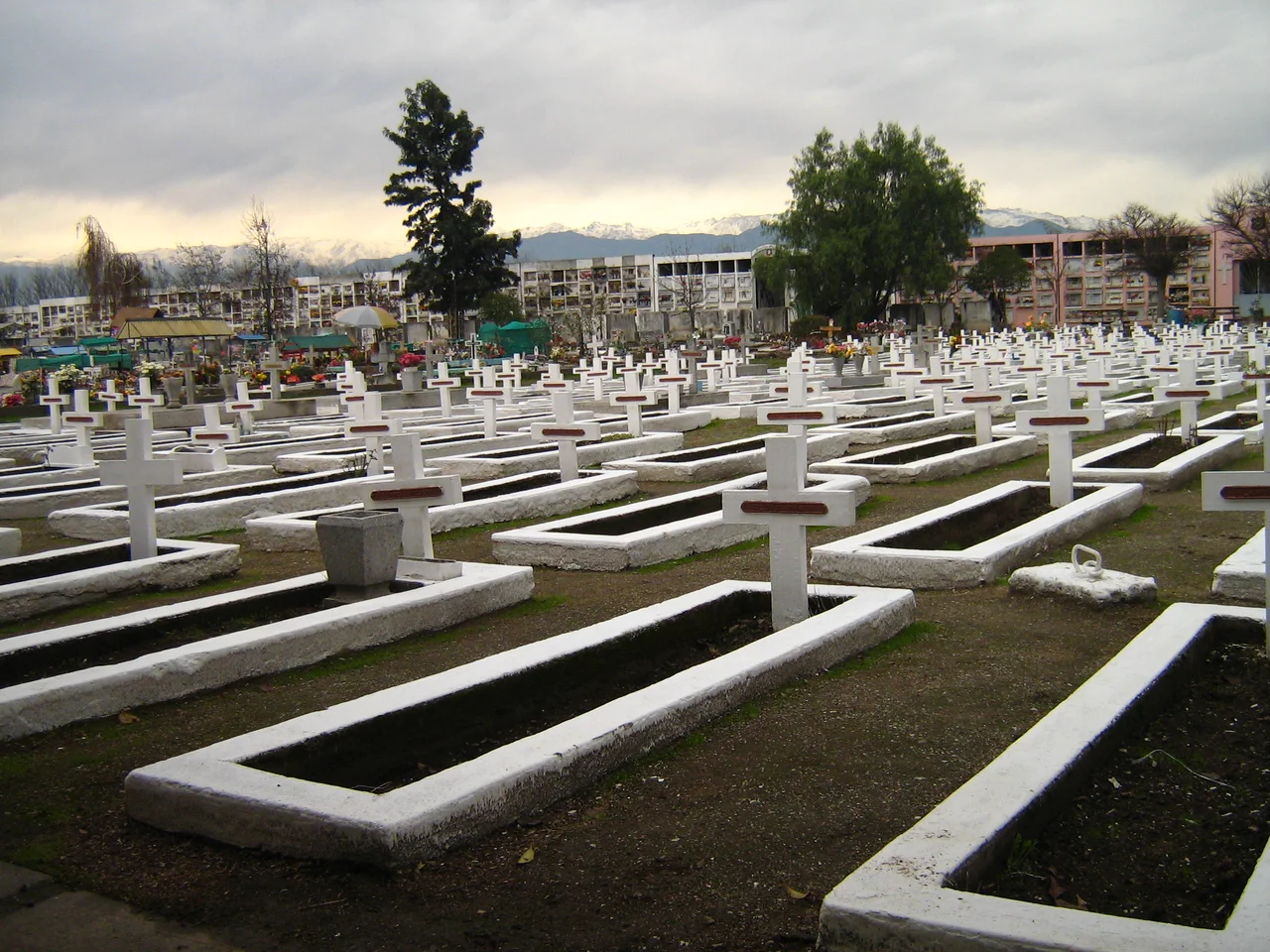
The surface fire was under control by that evening, but the tunnels stayed deadly, and rescuers could not enter until noon the following day. For three days they pushed into the mountain, and for three days they kept finding men already gone. There was no cemetery at Sewell - the town was too steep, too high, too purpose-built for the living - so the bodies were carried down to Rancagua, in the valley, and buried there beneath gravestones cut to a single matching design. That uniform row of markers is its own kind of testimony: not 355 separate tragedies, the stones seem to say, but one tragedy suffered 355 times over.
The Widows' Community
Chile stopped to grieve. The government declared three days of national mourning; schools and businesses closed, and flags flew at half-mast across the country. A mass was held for the miners at Sewell on June 20, the camp filling with the families of men who would not climb back up the stairs. The American company that owned the mine compensated the families and built housing for those it had left behind - a settlement that came to be known, plainly and painfully, as Las Viudas, the Widows' Community. Behind that name were real women and children, suddenly without husbands and fathers, learning to keep a household going in a place built entirely around a job their men no longer held.
What the Dead Changed
Disasters sometimes buy reforms that ordinary advocacy cannot, and this one did. In the aftermath, Chile adopted occupational-safety systems already standard in the United States and Europe. The Congress passed legislation curbing the company's independence and a Work Accident Law to protect laborers, and the government created a Department of Mining Safety built around closer communication with the men underground. The change was real enough that El Teniente went on to win an international mine-safety award for fourteen consecutive years. None of it returned a single father to Las Viudas. But every Chilean miner who came home safe in the decades that followed owed something to the 355 who did not.
From the Air
The disaster site lies at El Teniente, 34.09 degrees south, 70.35 degrees west, in the Andes of Chile's O'Higgins Region at roughly 2,300 meters elevation. From the air, the mine and the ruins of Sewell sit in steep, folded mountain terrain about 60 km east of the city of Rancagua, where the victims are buried. The nearest regional airport is Rancagua's De la Independencia (ICAO SCRG); Santiago's Comodoro Arturo Merino Benitez International (ICAO SCEL) lies about 100 km to the northwest. This is high, sharp country - approach with altitude to spare and expect strong terrain-driven winds. Clearest viewing comes in the dry Andean summer; winter brings the heavy snow that has always defined life at the mine.
Nearby Stories
- Attempted Assassination of Augusto Pinochet 18 km away
- La Frontera (Chile) 45 km away
- 1947 BSAA Avro Lancastrian Star Dust accident 46 km away
- Uruguayan Air Force Flight 571 57 km away
- Casa de Isla Negra 71 km away
- Santa Cruz, Chile 76 km away
- Uco Valley 88 km away
- Pierre Auger Observatory 119 km away