
1947 BSAA Avro Lancastrian Star Dust accident
At 5:41 in the afternoon on 2 August 1947, a radio operator named Dennis Harmer tapped out a calm message in Morse code: the airliner Star Dust would reach Santiago in four minutes. Then came one last word, repeated twice for clarity - STENDEC. The control tower asked him to confirm it. He sent it again, exactly the same. Those seven letters were the final trace of the aircraft and the eleven people aboard. Star Dust never arrived, and for fifty-three years no one knew where it had gone.
The People on Board
Eleven lives were folded into that aircraft. The captain, Reginald Cook, had flown bombers through the Second World War and wore the Distinguished Service Order and Distinguished Flying Cross; his crew were RAF veterans too, men who had survived a war only to disappear on a peacetime crossing. Iris Evans, the flight attendant, had served as a chief petty officer in the Women's Royal Naval Service. The six passengers were ordinary travelers with ordinary errands: a British diplomatic courier carrying official papers, businessmen, a representative for the tire-maker Dunlop. One woman, Marta Limpert, was said to be bringing home the ashes of her late husband. They were not adventurers chasing a dangerous summit. They were people on the last leg of a long flight from London, expecting dinner in Santiago.
An Invisible River of Wind
To reach Chile, Star Dust had to climb above 24,000 feet and thread the highest wall of the Andes in thick winter cloud, with no sight of the ground below. The crew navigated by dead reckoning - time, speed, and heading - and they were confident they had cleared the peaks. They were wrong. The aircraft had flown into the jet stream, a band of high-altitude wind that in 1947 was barely understood. Blowing hard from the west, it became a fierce headwind, slowing the plane's progress over the ground while the crew believed they were racing ahead. Thinking the mountains were behind them, they began their descent into a sky that was still full of mountain.
The Glacier Closes Over
Star Dust struck a near-vertical snowfield high on the Tupungato Glacier at almost cruising speed, its landing gear still tucked away - a plane flying confidently into terrain it could not see. The impact triggered an avalanche that buried the wreckage in seconds. Within days the compacted snow had hardened into ice, and the airliner became part of the glacier itself. Air Vice Marshal Don Bennett, who led British South American Airways, personally directed a five-day search and found nothing. The mountain had swallowed the evidence so completely that whispers of sabotage and stranger things filled the silence. The plain truth was colder: the dead lay frozen inside a moving river of ice.
What the Ice Gave Back
Glaciers do not keep what they take forever. Between 1998 and 2000, Argentine climbers near Tupungato began finding pieces of Star Dust emerging far down the mountain - a wheel, an engine, fragments of the past delivered by decades of glacial creep. Investigators could finally reconstruct what had happened, and clear Captain Cook's name of any blame. As for STENDEC, the explanations never stop coming. It is an anagram of DESCENT; perhaps a hypoxic, oxygen-starved operator garbled the word. Perhaps it was an abbreviation no one recorded. The most haunting answer may be that there is no answer - just seven letters tapped out above the clouds, moments before a young man and ten others slipped beyond reach.
From the Air
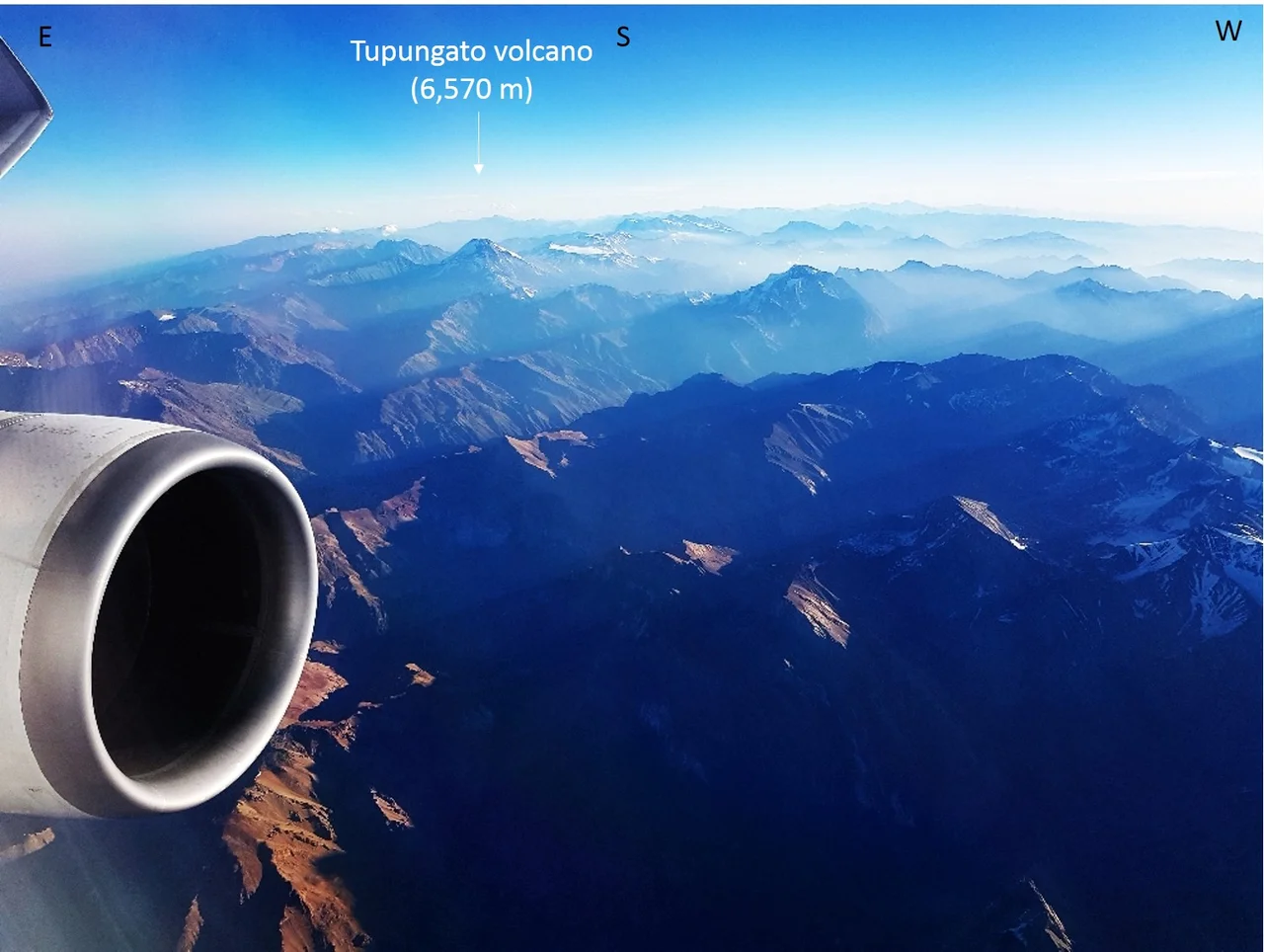
The crash site lies on Mount Tupungato at approximately 33.37 degrees south, 69.76 degrees west, near the Argentina-Chile border in the high Principal Cordillera of the Andes, at elevations above 5,000 meters. This is severe high-mountain terrain dominated by the 6,570-meter Tupungato volcano and, to the north, 6,961-meter Aconcagua - the highest peak in the Americas. Star Dust was crossing roughly the same route flown today between Buenos Aires and Santiago. The nearest airports are Santiago's Arturo Merino Benitez (ICAO: SCEL) about 80 km to the west and Mendoza's El Plumerillo / Governor Francisco Gabrielli (ICAO: SAME) to the northeast. Glaciated peaks, sudden cloud, and powerful jet-stream winds make this some of the most demanding airspace on the continent; clear-weather viewing from safe cruising altitude is essential.
Nearby Stories
- Farellones 4.5 km away
- Cajón del Maipo 7.4 km away
- Uco Valley 13 km away
- Puente del Inca 27 km away
- Battle of Chacabuco 35 km away
- Bodega Catena Zapata 35 km away
- General San Martín Park 40 km away
- Attempted Assassination of Augusto Pinochet 64 km away