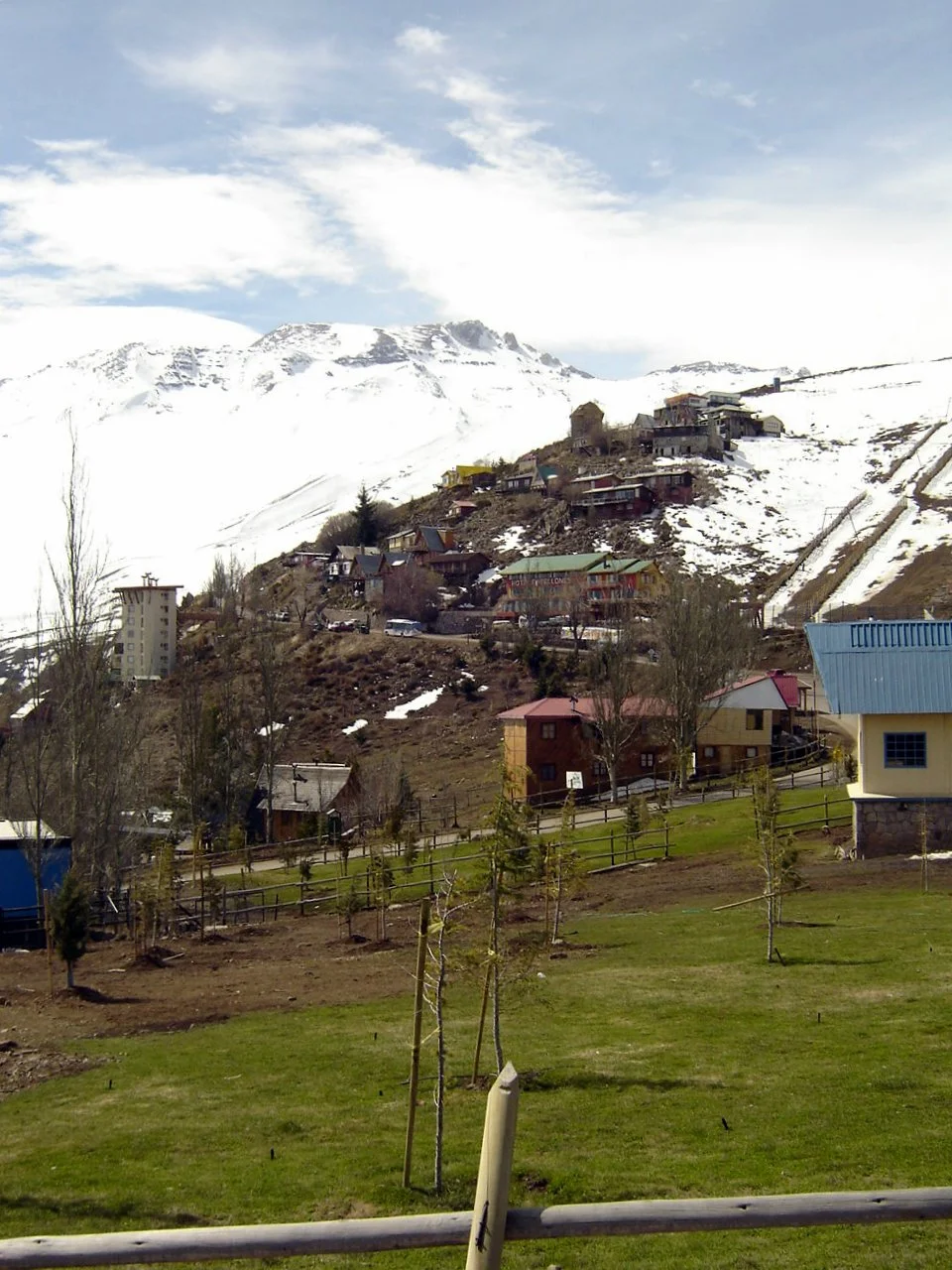

Farellones
The road up is the first thing anyone remembers about Farellones. From the edge of Santiago it claws into the Andes through more than forty hairpin turns, so tight and so steep that on busy winter days traffic is allowed to climb only in the morning and descend only in the afternoon, lest two streams of cars meet on a switchback. At the top, just over 2,300 meters up, sits a cluster of about two hundred wooden cabins - Chile's oldest ski village, and the gateway to the largest ski terrain in the Southern Hemisphere.
Skis from the North
Skiing reached Chile in the early 1930s, arriving with gear shipped from Switzerland and Norway: wooden planks, leather boots greased to keep out the wet, and crude bindings that stayed clamped to the foot even in a fall, which made every tumble an adventure. The sport found its home on these slopes. In 1937 the landowner Von Kiesling carved his property into plots to seed a village, and Antonio Padrós soon opened one of its first hotels, the Posada de Farellones, a building of wood and stone in an Alpine style. The place gained a certain glamour - the English Duchess of Kent once visited for a formal luncheon. When the first ski lift went up in the 1950s, the boldest skiers ended their run by leaping clean over the hotel's roof.
The Roof of the Americas
Farellones itself keeps only a handful of runs, but it is the doorway to far more. Its cable car climbs to El Colorado, five kilometers up the mountain of the same name, and the two are usually counted as a single area of sixty-two runs - eleven for beginners, dozens more rising in difficulty to a dozen reserved for experts. The terrain tops out above 3,300 meters, drops more than 900 meters of vertical, and gathers around five meters of snow in an average year. Push higher up the same valley and the village connects to La Parva and Valle Nevado, which together form the broadest stretch of skiable mountain in South America. On a clear winter morning the white bowls seem to fold endlessly into the cordillera.
The Child on the Summit
Long before skis, these mountains were sacred ground. Herdsmen drove livestock through the high passes, and treasure-seekers combed the slopes for the stone forts and ruins the Inca left behind. On February 1, 1954, three wranglers climbing nearby Cerro El Plomo made an extraordinary find near the 5,400-meter summit: the frozen, almost perfectly preserved body of an Inca child, roughly eight years old. The Boy of El Plomo had died more than five centuries earlier in a capacocha ceremony, the Inca rite in which a chosen child was carried on a months-long pilgrimage to a mountaintop shrine. It was the first frozen high-altitude Inca sacrifice ever recovered, and it transformed what the world understood about the practice. The child rests today in Santiago's National Museum of Natural History, his story a sober counterpoint to the lift lines below.
One Road, Many Dangers
The mountains that draw skiers can turn lethal without warning. In July 2016 the Swedish extreme skier Matilda Rapaport was caught in an avalanche while filming nearby; she died days later in a Santiago hospital, a reminder of how thin the margin is at altitude. The single access road remains Farellones' lifeline and its bottleneck, demanding snow chains in winter and patience always. Yet that isolation is part of the appeal. Below the village stretches the Yerba Loca Nature Sanctuary, a protected valley of high coniferous forest threaded with trails, one of which climbs to the hanging glaciers of Cerro La Paloma. From the cabins, Santiago's smog and noise feel impossibly distant, and the Andes close in on every side.
From the Air
Farellones lies at roughly 33.351 degrees south, 70.314 degrees west, in the Andes about 36 km northeast of Santiago at an elevation near 2,340 meters. From the air the cluster of wooden cabins and the pale scars of ski runs stand out against the high gray-and-white ridges; the snowfields of El Colorado, La Parva, and Valle Nevado spread up-valley to the northeast, and the 5,424-meter pyramid of Cerro El Plomo dominates the skyline. The nearest major airport is Arturo Merino Benítez International (ICAO: SCEL), about 50 km west near Santiago. Mountain weather is fast-changing; clear, calm winter mornings offer the safest and most spectacular views, while afternoon cloud can swallow the peaks quickly.
Nearby Stories
- Attempted Assassination of Augusto Pinochet 1.7 km away
- La Campana National Park 19 km away
- Battle of Chacabuco 19 km away
- 1947 BSAA Avro Lancastrian Star Dust accident 20 km away
- Puente del Inca 25 km away
- Viña del Mar International Song Festival 59 km away
- Uco Valley 77 km away
- Santa Cruz, Chile 122 km away