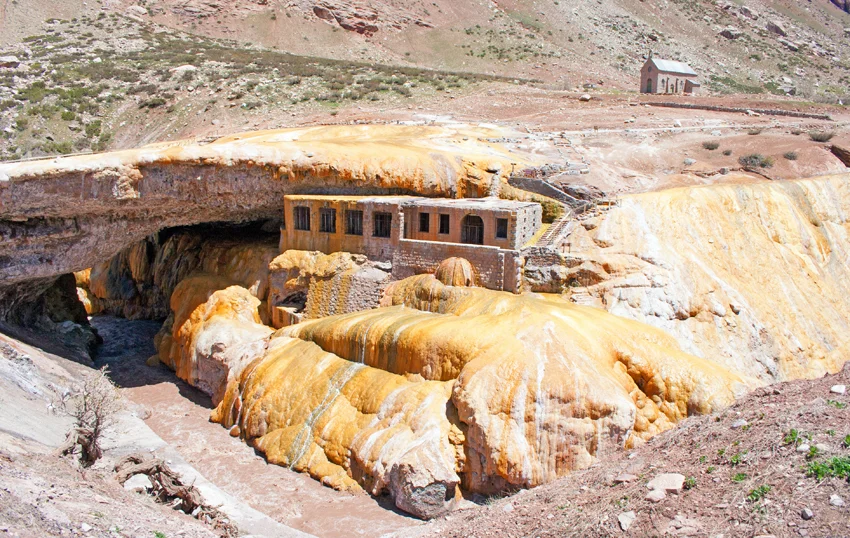

Puente del Inca
The bridge looks less built than melted. Slung across the gorge of the Las Cuevas River, the span of Puente del Inca drips with mineral crust the color of egg yolk and old rust, as if someone poured candle wax over the canyon and let it harden. No engineer designed it. Hot springs and glaciers did, over thousands of years, cementing avalanche debris and the remains of an old ice bridge into solid stone with water rich in iron, sulfur, and calcium. The Inca knew this crossing long before Europeans arrived, and gave it the name it still carries: the Bridge of the Inca.
How a River Builds a Bridge
The arch is the product of patience measured in millennia. During the last ice age, glaciers ground down the valley; as the climate warmed, the retreating ice left huge banks of rubble. Thermal springs, surfacing at temperatures between roughly 34 and 38 degrees Celsius, seeped through that debris and slowly cemented it, the dissolved minerals hardening grain by grain into the span you see today, about 28 meters across. Those same minerals paint it. Iron lays down the reds and oranges, sulfur the vivid yellows, calcium carbonate the pale crusts that drape like frozen drips. The whole formation glows against the gray rock around it, a splash of color in a stark valley. The arch shows its age and has been studied closely for stability, but it still carries its own weight.
Darwin Stops to Sketch
In March 1835, a young naturalist on a long journey through South America paused here and reached for his notebook. Charles Darwin, then early in the work that would reshape biology, examined the bridge and drew it, noting the great stalactites of mineral hanging beneath the span. He was on his way across the Andes, reading the rocks for clues about how mountains rise and how the Earth changes over deep time. Puente del Inca was exactly the kind of puzzle that fascinated him: a structure that looked man-made or even mythical but was, in fact, the slow handiwork of water and chemistry. His visit threaded this remote arch into the story of one of science's most consequential minds.
The Spa That Time Abandoned
In the early twentieth century, the springs drew the ailing and the hopeful. A grand thermal resort rose beside the river, complete with a monastery, where visitors came to soak in the warm mineral water and treat their illnesses. They arrived by train: the Transandine Railway, completed in 1910, ran a station right here, one of the last on the Argentine side before the line plunged into a long tunnel beneath the mountains toward Chile. The resort is gone now, and the railway is silent. But the abandoned station still stands, repurposed by a group of climbers from Rosario into the Museo del Andinista, a small mountaineering museum that opens in summer and keeps the valley's stories alive.
Gateway to the Roof of the Americas
Puente del Inca is not only a curiosity in its own right. It is a threshold. The village sits between the two main trailheads for Aconcagua, the highest mountain in the Western Hemisphere, and at 2,740 meters it serves as the first staging post for climbers heading toward the 6,961-meter summit. Its weather is itself a rarity. Tucked deep in the Andean rain shadow, far from any ocean, Puente del Inca holds onto a continental climate so unusual that it is almost unheard of elsewhere in South America, with dry summers and genuinely snowbound winters. Travelers pass through on the way to higher and harder places. The bridge waits below, glowing, indifferent, older than any of them.
From the Air
Puente del Inca lies at 32.83°S, 69.91°W, at roughly 2,740 meters in Argentina's Mendoza Province, hard against the main Andean highway and rail corridor to Chile. From the air, look for the deep gash of the Las Cuevas River valley and the distinctive yellow-and-orange mineral staining around the bridge and old spa ruins. Aconcagua's massif rises immediately to the northwest and is the dominant terrain reference. A survey altitude of 12,000 to 14,000 feet clears nearby ridges while keeping the valley and the peak in view. The nearest airport of consequence is Mendoza's El Plumerillo (SAME), about 150 km east; Santiago's Comodoro Arturo Merino Benítez (SCEL) lies west across the border. Mountain weather shifts fast here, with strong winds funneling through the pass and limited visibility in winter.
Nearby Stories
- Farellones 34 km away
- Bodega Catena Zapata 34 km away
- 1947 BSAA Avro Lancastrian Star Dust accident 36 km away
- General San Martín Park 38 km away
- Battle of Chacabuco 42 km away
- 1965 La Ligua earthquake 75 km away
- El Leoncito National Park 89 km away
- San Juan, Argentina 129 km away