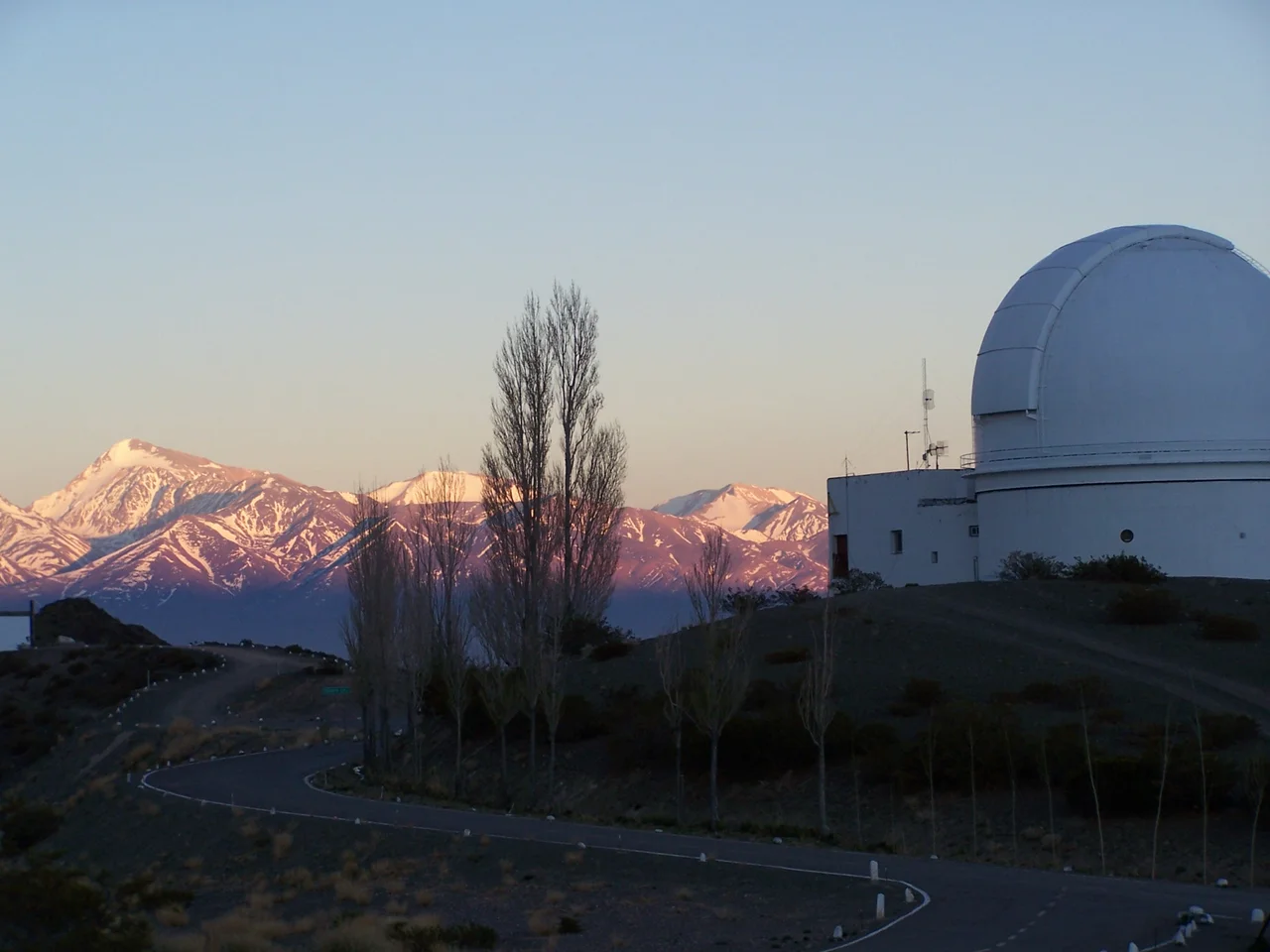

El Leoncito National Park
Roughly three hundred nights a year, the sky over El Leoncito goes utterly black, and the Milky Way arrives in a density that city dwellers never see. That darkness is the whole reason this remote corner of San Juan province became famous. High in the Argentine Andes, screened from light and cloud by sheer distance and dry air, El Leoncito protects nearly 90,000 hectares of steppe and Puna, an Inca road, and a sky so consistently clear that astronomers built their largest telescopes here to read the heavens.
Where the Stars Come Down
El Leoncito is brutally dry, taking in only about 200 millimeters of rain a year, and that aridity is its gift. Clear, cloudless nights on roughly 300 evenings a year make it one of the finest windows onto the cosmos anywhere on the planet. The park sits high in the Andean highlands, where summer days can climb to 35 degrees Celsius and winter nights plunge to minus 10, and where the thin, stable air holds the stars steady rather than letting them shimmer. Bring a jacket if you come to look; the mountaintops turn bitterly cold after dark. The reward is a sky most people will never otherwise witness, undimmed by the glow of any town.
Two Eyes on the Universe
Two observatories share the park, and both welcome visitors to look through their instruments. The larger, the El Leoncito Astronomical Complex known as CASLEO, was established in 1983 as a joint venture of Argentina's national research council and three universities. Inside its white dome stands the Jorge Sahade telescope, a 2.15-meter reflector built by the firm Boller and Chivens, installed in 1984 and running regular observations since 1987. It remains the largest optical telescope in Argentina. The second, the smaller CESCO complex, also opens its domes to night-time visitors who arrive after dark. Reservations help, and schedules shift with the seasons and the moon. There is something fitting about a national park whose star attraction is, quite literally, the stars, where the protected resource is not a waterfall or a peak but the darkness itself.
Sailing on Dry Land
Below the observatories spreads the Pampa El Leoncito, a vast, bone-flat plain that was once the bed of an ancient lake, roughly 12 kilometers long and 5 wide, sitting near 1,900 meters above sea level. Today it is a radiantly white expanse where almost nothing grows and the wind blows hard and steady across the open ground, gusts after midafternoon climbing toward 80 kilometers an hour. That combination makes it one of the world's great spots for land sailing, called carrovelismo here, the sport of skimming across the flats in a light, three-wheeled cart rigged with a sail. The afternoon wind does the work, and the cart can travel far faster than the air that pushes it; the best pilots clock speeds past 100 and even 120 kilometers an hour on the smooth, hard surface. The prime season runs from October into late February, when the winds are strongest. From a distance the sails look like tiny bright triangles racing across a frozen white sea.
Life at the Edge of Possibility
For all its harshness, the park holds tenacious life. Guanacos, pumas, and foxes range the highlands, and the rare lesser rhea, a smaller cousin of the great flightless bird, picks across the steppe. In the park's small streams swims a catfish found nowhere else, isolated, biologists believe, when its streams stopped reaching the San Juan River, leaving its ancestors stranded to adapt to ever-harsher conditions. There is even a thread of human history running through it: a stretch of the old Inca road system crosses the park, a reminder that people moved through these heights long before telescopes or sail-carts arrived. Entry is free, the nearest town is little Barreal some 35 kilometers off, and the silence is total.
From the Air
El Leoncito National Park lies at 31.80 degrees south, 69.37 degrees west, high in the Andean foothills of western San Juan province. From the air the defining feature is the Pampa El Leoncito, a strikingly bright white former lakebed flanked by dark, arid mountain ranges; the white domes of the CASLEO and CESCO observatories sit on higher ground nearby. The terrain is rugged and high, so maintain ample altitude. The nearest town is Barreal, about 35 km north; the nearest city with airline service is San Juan, roughly 245 km away, served by Domingo Faustino Sarmiento Airport (ICAO SANU). Skies are clear on the great majority of nights and days alike, ideal for visual reference, though daytime winds across the pampa can be strong. Best viewing of the white plain and surrounding ranges is from 4,000 to 7,000 feet AGL.
Nearby Stories
- San Juan, Argentina 41 km away
- Uspallata 65 km away
- Aconcagua 74 km away
- Mendoza 99 km away
- Las Chinchillas National Reserve 109 km away
- Pisco Elqui 158 km away
- Villa San Agustín 165 km away
- Cerro Tololo Inter-American Observatory 195 km away