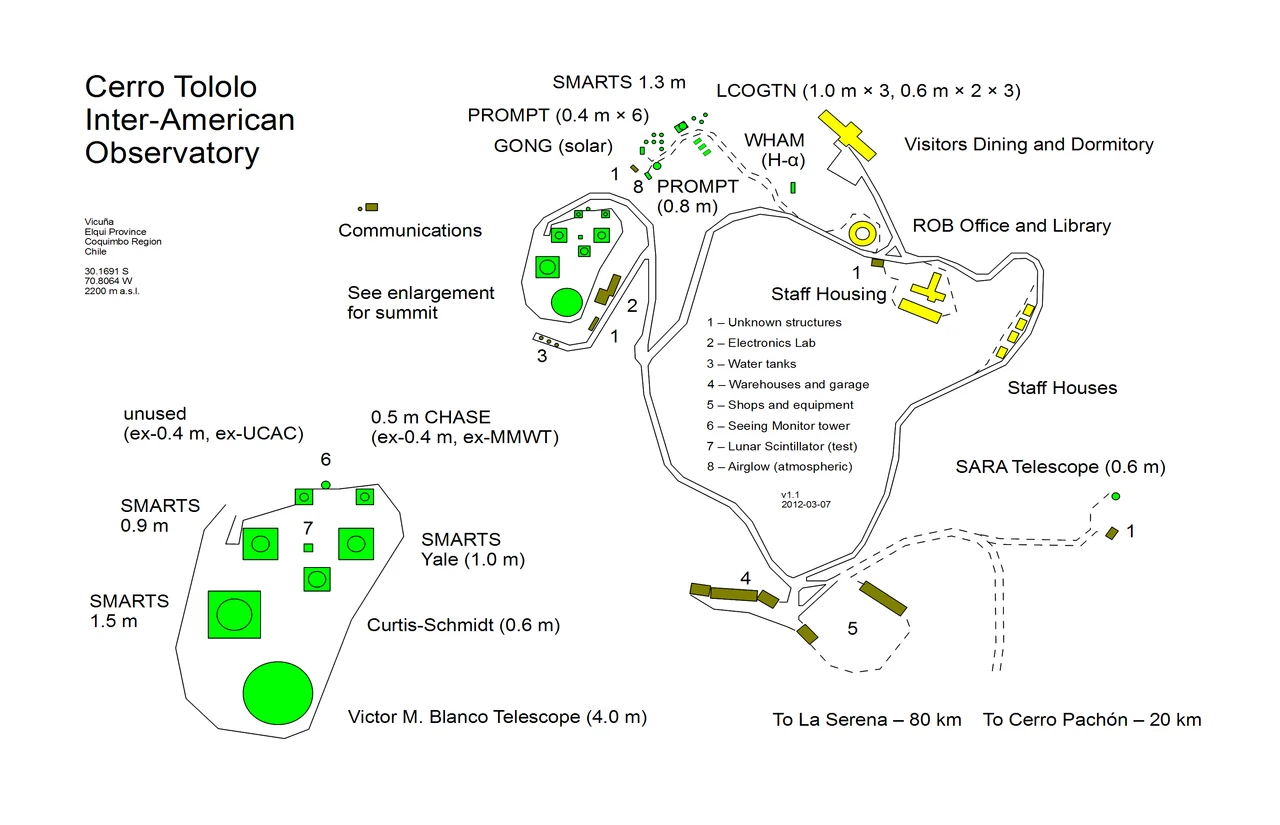

Cerro Tololo Inter-American Observatory
In the late 1950s an astronomer named Jürgen Stock climbed the mountains east of La Serena on muleback, hauling a small telescope and an interferometer up slope after slope, measuring the steadiness of the air and the clarity of the light. He was hunting for the darkest, stillest sky in the southern hemisphere. On 23 November 1962 the search ended on a 2,200-meter summit called Cerro Tololo, and the observatory that took its name has been mapping the southern stars ever since.
The Edge of the Abyss
Cerro Tololo sits roughly 80 kilometers east of La Serena, where the coastal haze falls away and the Andes climb into some of the driest air on the planet. Construction began in 1963 with Stock as the first director, and the first regular observations came in 1965. The conditions are extraordinary: hundreds of cloudless nights a year, thin dry atmosphere, and almost no light pollution for hundreds of kilometers. What looks from below like an ordinary brown ridge is, after dark, one of the finest windows onto the universe that Earth provides.
The Great Eye of Blanco
The mountain's flagship is the Víctor M. Blanco Telescope, a four-meter giant whose mirror weighs some 34,000 pounds. Assembled on the summit in 1974, it was named in 1995 for Víctor Manuel Blanco, the Puerto Rican astronomer who directed the observatory for nearly two decades. In 2012 it gained a new heart: the Dark Energy Camera, a 570-megapixel instrument that captured its first light on 12 September that year. With it, the Dark Energy Survey charted some 5,000 square degrees of sky — roughly one-eighth of the entire celestial sphere — chasing the invisible force that is pushing the cosmos apart.
Discoveries in the Dark
Great instruments find strange things. In 1985, working from sky photographs taken on Tololo, support technician Arturo Gomez spotted a peculiar object that turned out to be a young star wrapped in a disk of dust — forever after known as Gomez's Hamburger, for its layered shape. Decades later, on a December morning in 2013, a research assistant at the University of Chile named Luis González caught a supernova in a galaxy 370 million light years away. It was the first discovery by a robotic Chilean telescope on the mountain, confirmed by astronomer José Maza, proof that the country had grown its own generation of star-hunters.
A Cluster of Summits
Tololo no longer works alone. About ten kilometers to the southeast rises Cerro Pachón, home to the 4.1-meter Southern Astrophysical Research Telescope and, more recently, to the giant survey observatory that will scan the entire visible sky night after night. Smaller robotic telescopes from networks around the world dot these ridges, all of them drawn by the same gift: the clarity that Jürgen Stock measured on muleback more than sixty years ago. This corner of the Andes has become, quietly, one of the astronomical capitals of the world.
From the Air
The observatory crowns Cerro Tololo at 30.170°S, 70.807°W, at roughly 2,200 meters (about 7,200 feet) in the Andean foothills of the Coquimbo Region. The nearest airport is La Florida (ICAO: SCSE, IATA: LSC) at La Serena, about 80 km west, field elevation near 481 feet. From the air the white telescope domes stand out sharply on a bare brown summit, with Cerro Pachón and its observatories about 10 km to the southeast. The exceptional dryness that makes this sky famous also makes for excellent daytime visibility; respect the high terrain, as surrounding peaks exceed 4,000 meters.
Nearby Stories
- Bosque de Fray Jorge National Park 41 km away
- Dominga 67 km away
- Pascua Lama 69 km away
- Punta de Choros 71 km away
- Pingüino de Humboldt National Reserve 101 km away
- Las Chinchillas National Reserve 125 km away
- San Guillermo National Park 158 km away
- El Leoncito National Park 179 km away