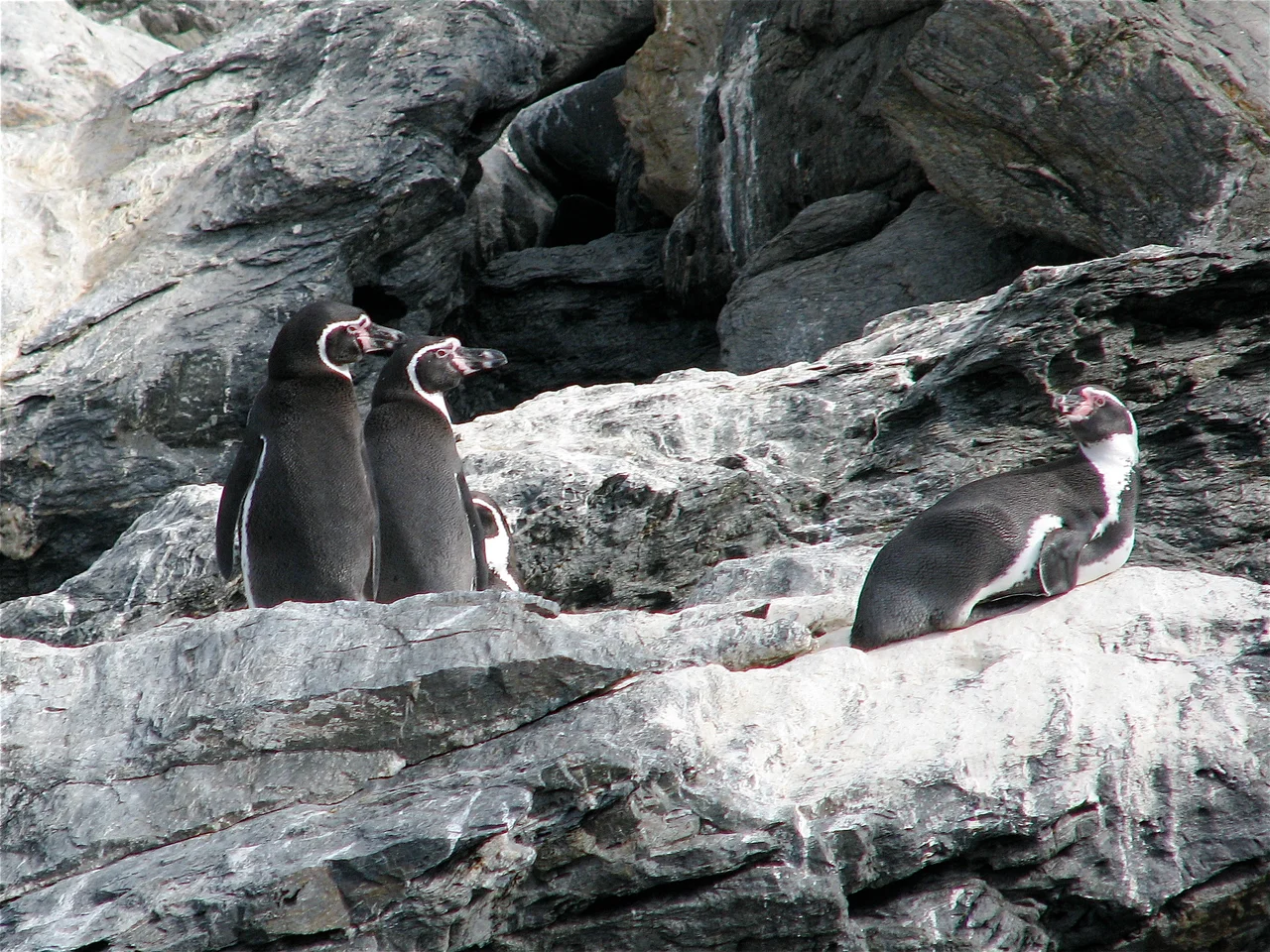

Pingüino de Humboldt National Reserve
Eighty percent of the world's Humboldt penguins live in Chile, and a remarkable share of them nest on three small islands tucked against this stretch of desert coast. Drift past in a fisherman's boat on a clear morning and the air fills with sound before you see anything: the bark of sea lions hauled out on the rocks, the squabble of cormorants, the occasional gust as a penguin porpoises across the swell. Behind it all stands the Atacama, the driest place on the planet. The contrast is the whole story. Where the desert meets the cold, nutrient-rich Humboldt Current, life arrives in staggering abundance.
Where the Desert Drinks the Sea
The reserve sits about 100 kilometers north of La Serena, spread across three islands: Chañaral in the Atacama Region, and Damas and Choros in Coquimbo. Together they cover roughly 860 hectares of guano-streaked rock and sparse scrub. Almost no rain falls here. The islands stay alive on the ocean instead. The Humboldt Current sweeps cold water up from the south, carrying nutrients that feed plankton, then sardines and anchovies, then everything that eats them. Penguins dig their nesting burrows into old guano deposits and rocky crevices, returning each year between September and February to breed. The water that sustains them is bracingly cold, which is why Damas Island's pale, Caribbean-looking beaches come with a catch: wade in, and the chill of the current cuts straight through the illusion.
A Census of the Living
The Humboldt penguin gives the reserve its name, but it shares these waters with an astonishing roster of neighbors. Bottlenose dolphins work the channels and are seen most days. Sea lions lounge year-round in noisy colonies. Chungungos, the small marine otters of the Pacific coast, slip among the kelp. Overhead wheel albatrosses and cormorants. And out past the islands, the giants pass through: blue whales, the largest animals that have ever lived, alongside fin, humpback, and sperm whales drawn to the same rich feeding grounds. Chañaral de Aceituno, the village nearest the northern island, has become one of Chile's best places to watch them. To stand on a small boat as a blue whale surfaces nearby is to feel the scale of the ocean rearrange itself around you.
Bringing the Island Back
Conservation here is not a static act of fencing nature off. It is active repair. For years, invasive rabbits introduced to Choros Island had stripped its vegetation, degrading the burrows and habitat that ground-nesting birds depend on. In 2013, Chile's national forest service, CONAF, working with the group Island Conservation, removed the rabbits entirely. The recovery was quick and measurable. By 2014, fields of native Alstroemeria flowers were returning, and Peruvian diving petrels were again seeking out burrows. In 2018, the partners declared the eradication a success. It is a small, hopeful example of a hard truth: sometimes saving a place means undoing what people brought to it.
A Fragile Stronghold
Protected since January 1990 and managed by CONAF, the reserve is a stronghold for a species in trouble. The Humboldt penguin is listed as Endangered, with perhaps 23,800 mature birds left in the wild and roughly 13,000 breeding pairs in Chile. Their numbers are falling. Overfishing of the sardines and anchovies they rely on, warming seas, and entanglement in fishing nets all press against them, and recent surveys on nearby islands have recorded alarming breeding failures. The reserve matters precisely because so much of the species depends on so few places. These islands are not a curiosity. They are a last line, and what happens in the waters around them decides whether the penguins endure.
From the Air
The Pingüino de Humboldt National Reserve lies at roughly 29.25°S, 71.54°W, where three small islands sit just off the Chilean coast a few kilometers offshore. From the air the islands read as distinct rocky landmasses ringed by surf and pale beaches, set against the stark ochre of the Atacama coastline behind them. The nearest airport is La Florida Airport (ICAO: SCSE, IATA: LSC) at La Serena, about 100 km to the south. Copiapó's Desierto de Atacama Airport (ICAO: SCAT) lies farther north. A viewing altitude of 4,000 to 7,000 feet offers a clear look at the island cluster and the coastal villages of Punta de Choros and Chañaral de Aceituno. Skies here are famously clear and dry, with excellent year-round visibility; coastal morning low cloud (camanchaca) can occasionally veil the shoreline before burning off.
Nearby Stories
- La Silla Observatory 27 km away
- La Serena 50 km away
- Vicuña 62 km away
- Llanos de Challe National Park 93 km away
- Desert Bloom 152 km away
- Constitución, Chile 646 km away
- Santa Olga 688 km away
- 1687 Peru Earthquake 1583 km away