.jpg)
Vicuña
On 7 April 1889, in a modest house in this small Andean town, a girl named Lucila Godoy Alcayaga was born. The world would come to know her by a name she invented: Gabriela Mistral. Half a century later she became the first Latin American writer to win the Nobel Prize in Literature. Vicuña, the largest town in the Elqui Valley, has never stopped being her town — its plaza of ancient trees still holds sculptures raised in her honor.
Daughter of the Valley
Mistral grew up just up the valley in the village of Montegrande, taught in a one-room school by her older sister Emelina. The poems she would later write — fierce, tender, grief-struck, devoted to children and the dispossessed — carry the dry light and hard hills of this place in their bones. When the Swedish Academy honored her in 1945, it praised lyric poetry that had made her name a symbol, in its words, of the idealistic aspirations of the entire Latin American world. Before she died she left what she owned to the valley's children. The town that raised her keeps her memory the way you keep a family story.
The Floor of the Valley
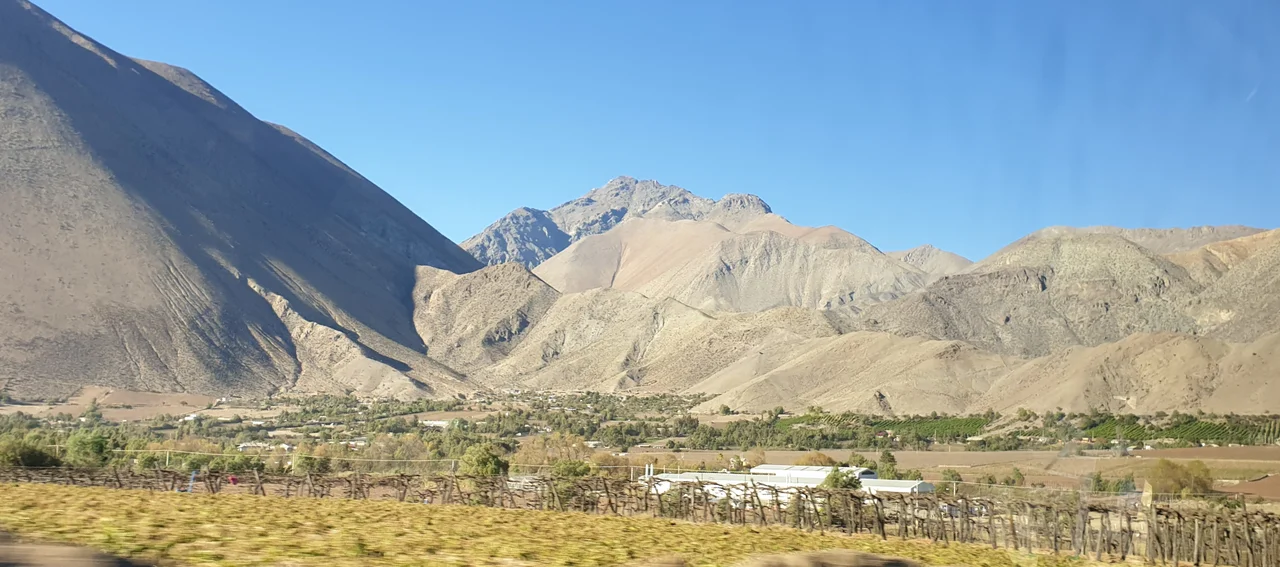
Vicuña sits on a green valley floor hemmed by mountains, several of whose peaks climb past 4,000 meters. The plains here grow exceptional grapes, along with other fruits and vegetables, and the great pisco cooperative CAPEL runs its main distillery in the zone. A short way out of town, the Route of the Grappa links the pisqueras — the family distilleries with names like Capel, Mistral, and Tres Erres — where the valley's sun is turned into Chile's national spirit. The town itself, walkable end to end, is built largely of buildings dating to around 1900, a low and unhurried place beneath a very large sky.
Three Hundred Clear Nights
What truly sets Vicuña apart happens after dark. The valley enjoys roughly 300 totally clear nights a year, and the result is a sky so dense with stars it can disorient a first-time visitor. The great professional observatories cluster on the surrounding summits, including Cerro Tololo, which offers daytime tours. But the valley also pioneered astrotourism for everyone: in November 1998 the Municipality of Vicuña opened the Mamalluca Observatory just northwest of town, the first tourist observatory in Chile, built around a telescope donated by Cerro Tololo. On a clear night, the Milky Way arches overhead like a road.
From the Air
Vicuña lies at 30.017°S, 70.700°W, on the floor of the Elqui Valley about 60 km inland from the coast. The nearest airport is La Florida (ICAO: SCSE, IATA: LSC) at La Serena, field elevation near 481 feet; Route 41-CH runs from La Serena up the valley through Vicuña toward the Agua Negra pass into Argentina. From the air, look for the bright green ribbon of irrigated vineyards threading between bare 4,000-meter ridges, with the Puclaro reservoir downstream toward La Serena. Daytime visibility is exceptional thanks to the dryness that also gives the valley its famous night skies.
Nearby Stories
- Carmen de Andacollo 25 km away
- Dominga 51 km away
- Pascua Lama 52 km away
- Punta de Choros 52 km away
- Bosque de Fray Jorge National Park 56 km away
- Pingüino de Humboldt National Reserve 82 km away
- San Guillermo National Park 145 km away
- El Leoncito National Park 196 km away