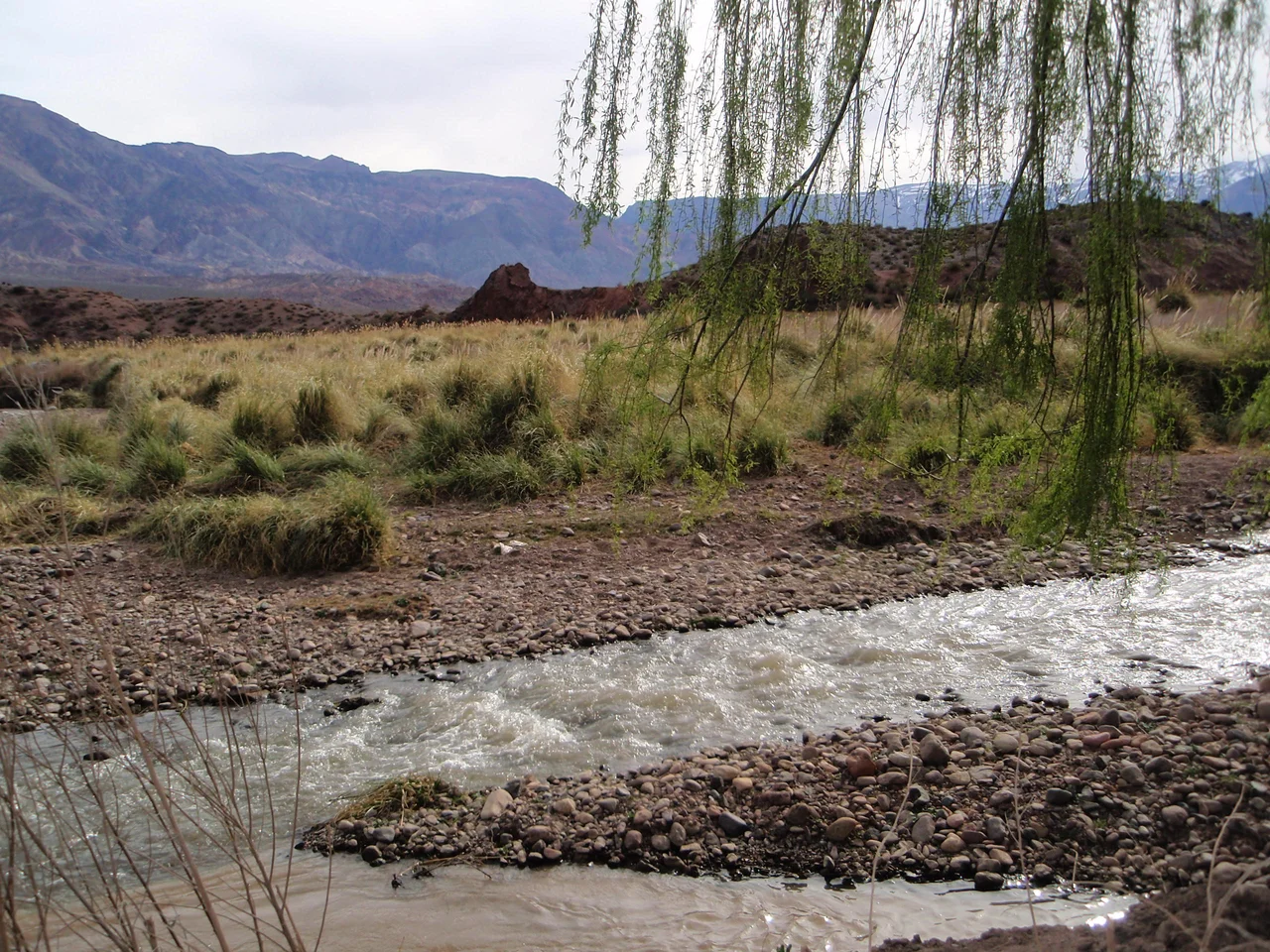

Uspallata
In 1997, a film crew turned this quiet Argentine valley into the Himalayas. For nearly three months, Uspallata stood in for Tibet in the movie Seven Years in Tibet, its population swelling by half as roughly 700 cast and crew descended with hundreds of vehicles and built a miniature Lhasa on the desert floor. The original plan had been to film in India, but politics intervened, and producers went hunting for a landscape that could pass for the roof of the world. They found it here, in a broad valley ringed by snow-streaked peaks, 100 kilometers west of Mendoza, where the air is thin and the mountains crowd the horizon.
A Stand-In for the Roof of the World
It is easy to see why the location scouts stopped here. Uspallata sits in a high desert basin where the Andes pile up on every side, bare and immense, the light hard and clear. The valley offered something the Himalayas could not: the mountains looked the part, and the town had roads, beds, and the infrastructure a major production needs. Brad Pitt and a small army of filmmakers moved in, recreated Tibetan streets and monasteries, and shot the long caravan sequences across the surrounding heights. Then they left, and the town went quiet again, as if the whole thing had been a strange and vivid dream. The valley returned to what it had always been: a waypoint on the road between two countries.
The Egg-Shaped Kilns
Just over a kilometer from town stand the Bóvedas, a cluster of curious dome-shaped kilns that look like enormous adobe eggs half-buried in the earth. They date to the early seventeenth century, built to smelt the gold, silver, copper, and zinc dug from nearby mines. Look closely at the brickwork and history surfaces in an unexpected place: some of the refractory bricks are stamped "Rufford Stourbridge," the mark of a firm from the English West Midlands, a small fingerprint of Britain's industrial reach pressed into the Andean dirt. A little museum beside the kilns explains how they worked, and how, in time, these same furnaces would be turned to a far weightier purpose.
Where an Army Crossed the Mountains
Uspallata's valley earned a place in the founding story of two nations. In January 1817, General José de San Martín launched his Army of the Andes from Mendoza on one of history's great military gambles: a crossing of the cordillera to liberate Chile from Spanish rule. He split his force, and the column that funneled through the Uspallata Pass was led by Juan Gregorio de Las Heras. The kilns nearby had a role too, repurposed to help arm the independence cause. Picture the scene: thousands of soldiers, mules, and cannon threading up into the high passes in summer, gambling that they could cross 4,000-meter ground before the weather turned. Within weeks, they had descended into Chile and changed the map of South America.
The Road to the Border
Leaving Uspallata westward, the highway climbs into the most dramatic country in the region. The peaks here form the foreground to Aconcagua, the highest mountain outside Asia at nearly 7,000 meters, and the road grants sudden, breathtaking glimpses of it between the ridges. Farther on, the route passes the ochre-stained natural arch of Puente del Inca, built by mineral springs over millennia. The valley itself is austere. With barely 156 millimeters of rain a year, Uspallata holds a cold desert climate of pleasant days, cold nights, and the real possibility of winter snow. It is a place that rewards the passing traveler with scale and silence, then watches them continue on toward the border.
From the Air
Uspallata lies at 32.57°S, 69.32°W, in a high desert valley roughly 1,900 meters above sea level, about 100 km west of Mendoza along the main Andean route to Chile. From the air, identify the broad open basin set among bare, snow-streaked ranges, with the thin line of National Route 7 running through it toward the western passes. Aconcagua's massif rises to the northwest. The town is served by the small Uspallata Airport; the nearest major field is Mendoza's El Plumerillo (SAME) to the east, with Santiago's Comodoro Arturo Merino Benítez (SCEL) across the border to the west. A survey altitude of 9,000 to 11,000 feet gives a clear view of the valley and its surrounding peaks. Expect strong afternoon winds, dry air, and rapidly deteriorating conditions toward the higher passes.
Nearby Stories
- General San Martín Park 3.9 km away
- Aconcagua 7 km away
- National Route 40 (Argentina) 32 km away
- Cerro El Plomo 47 km away
- Mendoza 58 km away
- El Leoncito National Park 61 km away
- San Juan, Argentina 96 km away
- Las Chinchillas National Reserve 141 km away