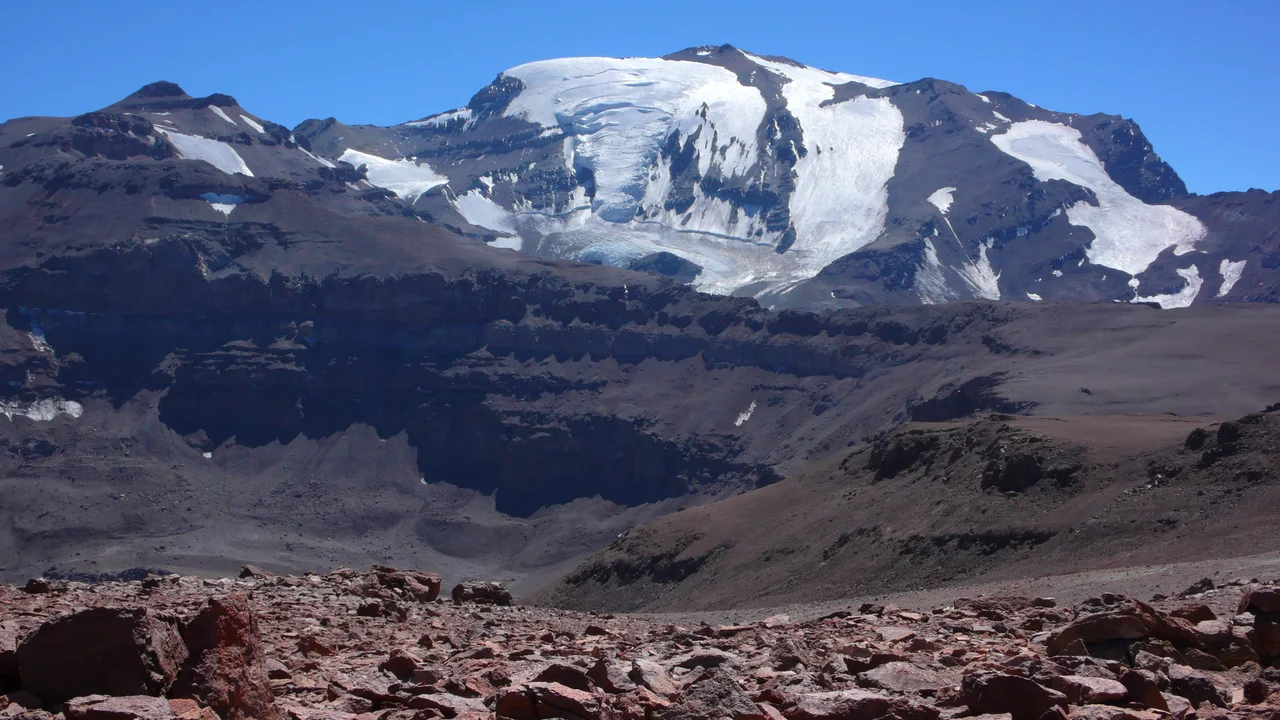

Cerro El Plomo
On a clear day, Santiago's six million residents look up at Cerro El Plomo without always knowing its name. At 5,444 meters - just over 17,860 feet - it is the highest peak visible from the city, a wall of rock and snow standing guard above the smog and the streets. For most of the year it is simply scenery. But near its frozen summit, the mountain held something for nearly five hundred years: a boy of perhaps eight or nine, dressed in fine red wool, his hair braided into more than two hundred plaits, sitting in the ice exactly as he had been left by the Inca.
A Mountain the Inca Climbed
The Inca Empire reached deep into central Chile in the fifteenth century, and to its people the high peaks were sacred - dwellings of mountain spirits, the apus, that demanded reverence. The Inca climbed Cerro El Plomo periodically, hauling themselves and their offerings above 5,000 meters into air so thin and cold it punishes every step. That they could build shrines at such altitude, by hand and on foot, is staggering even to modern climbers with oxygen and synthetic gear. The first recorded European ascent did not come until 1896, when Gustav Brandt and Rudolph Lucke reached the top - centuries after Andean people had already made the summit a place of ritual.
The Child of El Plomo
In 1954, three Chilean arrieros - muleteers named Guillermo Chacón Carrasco, Jaime Ríos Abarca, and Luis Gerardo Ríos Barrueto - searching the mountain came upon a grave near the summit and found the boy. He had been the subject of a capacocha, an Inca rite the Quechua called qhapaq hucha, in which a child of high status was sent into the mountains as a sacred offering. This was not casual cruelty by the standards of those who performed it. The child was chosen for his perfection, honored, dressed in finery, and believed to be carried into the company of the gods - a belief his family and community held with deep seriousness. To modern eyes the practice is wrenching, and it should be: this was a young child who lost his life. Both things are true at once, and his story deserves to be told holding the weight of both.
What the Ice Preserved
The cold had kept him almost perfectly. His internal organs were intact, the tissue beneath his skin still soft. His face was painted with red and ochre stripes, and his hair had been carefully styled into over two hundred small braids - a level of preservation that let researchers see not just a body but a person, prepared with evident care. Brought to the attention of Grete Mostny at Chile's National Museum of Natural History, the find became the first major discovery of a high-altitude Inca sacrifice frozen in the Andes, decades before the more famous mummies of higher peaks. He remains in the museum's care to this day. Since 1982 a replica has stood in the public galleries, the original kept frozen in storage so that what the mountain protected for five centuries is not undone by being seen.
The Mountain Keeps Its Dead
The boy is not the only one El Plomo has held. On July 16, 1932, a Pan American-Grace Airways Ford Trimotor named San José, flying from Santiago to Mendoza, was caught in a savage snowstorm and crashed into the mountain, killing all nine aboard. Buried in ice and snow, the wreck was not found until March 1934 - nearly two years later. The mountain that takes life is also the one that hands it back, slowly and on its own terms. Today climbers attempt El Plomo mostly between November and March, when the approach from the Piedra Numerada base camp clears of snow and the weather steadies. They climb for the summit and the view back over Santiago. The mountain, as it always has, keeps the rest.
From the Air
Cerro El Plomo rises in the Andes northeast of Santiago, near 33.23 degrees south, 70.21 degrees west, summiting at 5,444 meters (17,861 feet). It is the dominant snow peak on Santiago's eastern skyline and an unmistakable terrain landmark, often partially occluded from the city by the lower Cerro Leonera. Pilots must treat it as serious high terrain: maintain safe altitude well clear of the summit, and expect rapidly building mountain weather, strong winds, and turbulence near the ridgelines, especially in the afternoon. The nearest major field is Santiago's Arturo Merino Benitez International Airport (ICAO: SCEL), about 30 nautical miles to the west-southwest. Clearest conditions are typically in summer mornings (December to March); winter brings heavy snow and frequent cloud cover on the peak.
Nearby Stories
- Battle of Chacabuco 6.3 km away
- Huaca de Chena 8.9 km away
- Museum of Memory and Human Rights 14 km away
- Cajón del Maipo 21 km away
- Paso Internacional Los Libertadores 25 km away
- Uco Valley 44 km away
- Uspallata 60 km away
- Bodega Catena Zapata 66 km away