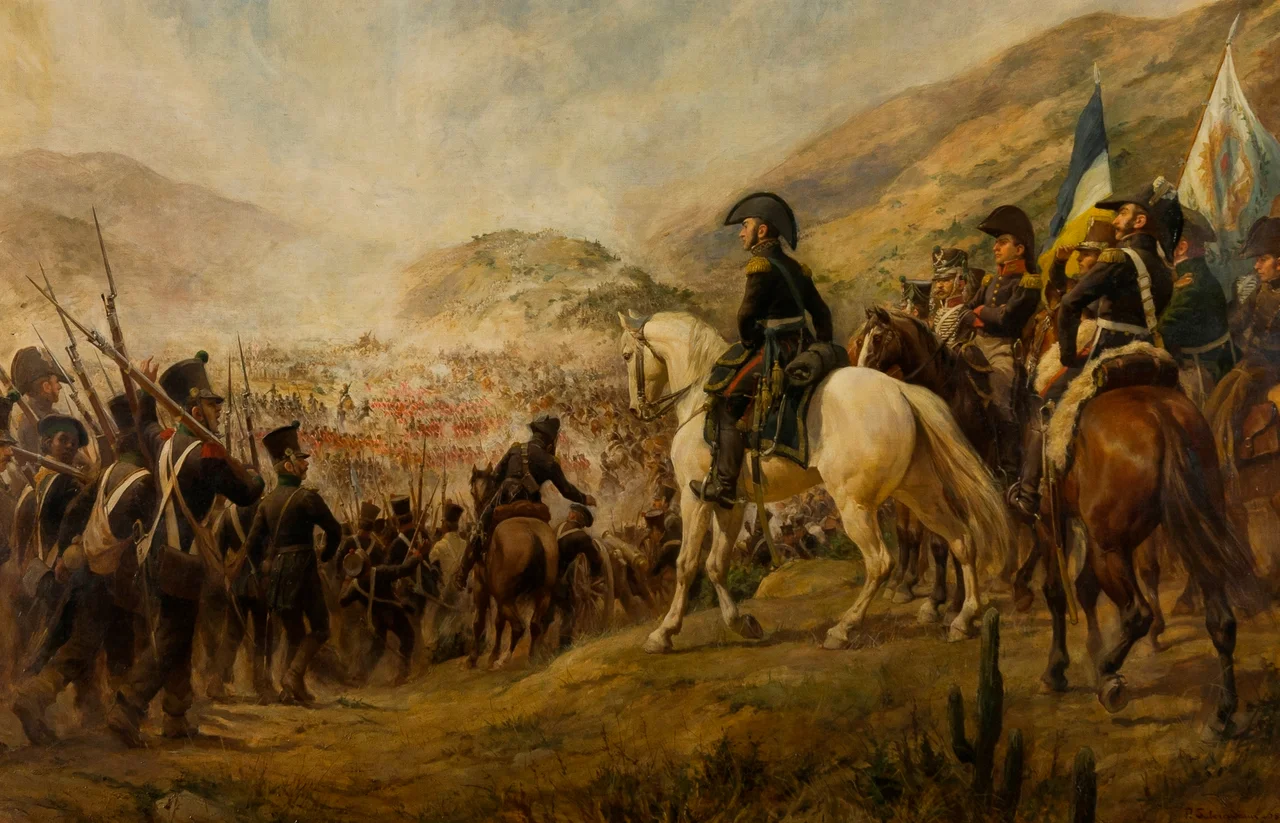

Battle of Chacabuco
To attack Chile, José de San Martín first had to climb out of his own century. In January 1817 he marched roughly 5,000 men, more than a thousand horses, and twenty-two cannons straight up into the Andes - some of the highest mountains on Earth - in a crossing that took about three weeks and killed soldiers and animals by the hundreds as the cold and thin air thinned his ranks. By the time the survivors stumbled down the western slopes into Chile, they had already paid a terrible price. The battle that justified it would be over by the afternoon of February 12.
The Idea Before the Army
San Martín had spent years thinking past the obvious. After helping establish a popularly elected congress in Argentina, he concluded that Spanish power in South America could not be broken piecemeal - it had to be driven out entirely, and the first step was Chile. So he built an army for the purpose, recruiting and equipping the Army of the Andes over less than two years. His masterstroke was deception. Through false rumors and feints, he convinced the royalists to scatter their defenses against invasions that never came, so that when his columns finally descended the cordillera, the passes were unguarded. Waiting for him in Chile was Bernardo O'Higgins, the Chilean patriot who commanded his own force and who would fight this battle on the soil of his homeland.
Pride on the Royalist Side
The Spanish governor in Santiago dithered. His field commander, Brigadier Rafael Maroto, first proposed abandoning the capital and retreating south to regroup - a plan the war council adopted on February 8, only for the governor to reverse it the next morning and order a stand at Chacabuco, a valley just north of Santiago. The night before the battle, an officer named Antonio de Quintanilla quietly argued that the royalists should pull back toward the hills of Colina rather than fight where they stood. Maroto overheard him from the next room. Whether from pride or stubbornness, he refused to listen; in his famously hoarse voice he called for an attendant and issued a general order threatening death to anyone who so much as spoke of retreat. His task was simply to delay the patriots until reinforcements arrived from Santiago. San Martín, knowing this, decided to strike while he still held the advantage in numbers.
A Plan, and a Man Who Could Not Wait
San Martín's design was elegant: split his roughly 3,600 troops into two columns and send them down separate roads on either side of the high ground, the right under Miguel Estanislao Soler, the left under O'Higgins. Soler would swing wide to cut off the royalist rear while O'Higgins pressed the front, trapping the enemy between two fires. It did not unfold cleanly. Soler's men found themselves on a narrow path that took far longer to descend than anyone expected. O'Higgins, by most accounts overcome at the sight of his own country, abandoned the timing and charged with his 1,500 men before the trap was set. What happened next is still argued over. O'Higgins insisted the royalists had stopped retreating and turned on him, and that ordering his men back up the narrow track would have seen them picked off one by one.
The Turning of the Morning
Seeing O'Higgins exposed, San Martín ordered Soler to throw his weight against the royalist flank, relieving the pressure. The firefight ground on into the afternoon until Soler seized a key Spanish artillery position and the momentum swung. The royalists formed a defensive square around the Chacabuco ranch; O'Higgins drove at its center while Soler closed off any escape. The fighting ended in hand-to-hand combat around the ranch buildings. When it was over, five hundred royalist soldiers were dead and six hundred taken prisoner. The Army of the Andes lost only twelve men in the fighting itself, with roughly 120 more gravely wounded. The patriots reentered Santiago. Offered the role of Supreme Director, San Martín declined it and saw the title go to O'Higgins, opening the era Chileans call the Patria Nueva. Chacabuco did not end the war - that came the following year at Maipú - but it cracked the empire's grip and pointed the whole continent toward independence.
From the Air
The battlefield lies in the Chacabuco valley north of Santiago, near 32.99 degrees south, 70.68 degrees west, where the central valley meets the southern foothills of the Andes. From a viewing altitude of 6,000 to 9,000 feet, the snowcapped Andean wall to the east, the Aconcagua valley to the north, and the sprawl of greater Santiago to the south frame the scene; the historic crossing route San Martín used runs up into the high cordillera beyond. The nearest major field is Santiago's Arturo Merino Benitez International Airport (ICAO: SCEL), roughly 25 nautical miles south. Mountain weather can build quickly over the cordillera in the afternoon; mornings generally offer the steadiest air and clearest views of the peaks.
Nearby Stories
- Cerro El Plomo 9.4 km away
- Viña del Mar 19 km away
- Battle of Papudo 23 km away
- Paso Internacional Los Libertadores 25 km away
- Santiago General Cemetery 28 km away
- Aconcagua 29 km away
- Casa de Isla Negra 38 km away
- 1965 La Ligua earthquake 39 km away