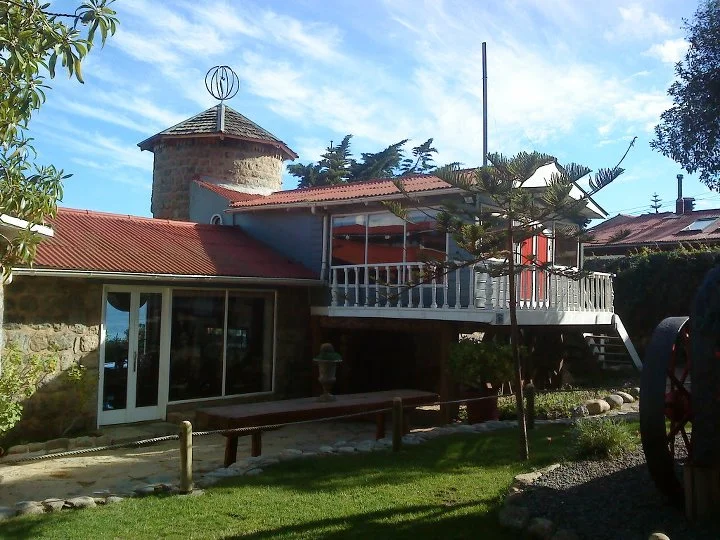

Casa de Isla Negra
There is no island at Isla Negra. The name belongs to a dark hump of rock offshore, and the rest is windswept coast about 96 kilometers west of Santiago - which makes it the perfect address for a poet who spent his life turning ordinary things into something larger. Pablo Neruda found this place on a visit, wanted it immediately, and talked his publisher into an advance so he could buy it. What he built here was less a home than a confession: a low, narrow house designed to feel like a ship that never leaves shore, where the Nobel laureate could write while the Pacific hammered the rocks below his windows.
A House That Wants to Be a Boat
Step inside and the disguise is total. The ceilings press low, the wooden floors creak like a deck underway, and the passages narrow as though squeezed by a hull. Neruda was a hoarder of beautiful things, and he packed the house with the obsessions of a man in love with the ocean: ship figureheads salvaged from old vessels, ships sealed inside bottles, maps, colored glass, and a shell collection so vast it filled a room he christened Bajo el Mar - 'Under the Sea.' Nothing here is incidental. Each object was chosen, placed, and worked into the poems he wrote at a desk that looked out on the water he could not stop describing.
The Sea as Co-Author
Neruda did not visit the coast so much as collaborate with it. Isla Negra became his favorite of his three Chilean houses, the place he returned to with his third wife, Matilde Urrutia, and the place where the landscape pressed itself directly into his work. The region's winter storms - the kind that send spray over the rocks and rattle every window in the house - gave him 'Oda a la Tormenta,' his Ode to the Storm. He had imagined the property at first as a gathering place for writers, and later dedicated it to Carlos George-Nascimento, the publisher whose advance had made it possible. The arrangement says something about the man: even his real estate came wrapped in gratitude and turned into a gift.
The Long Way Home
Neruda won the Nobel Prize in Literature in 1971. Two years later, in September 1973, he was dying of cancer when a military coup tore Chile apart and overthrew his friend, President Salvador Allende. Soldiers searched the Isla Negra house. Neruda died twelve days after the coup, his country and his health collapsing together, and he was buried far from here, in Santiago's General Cemetery. It took the return of democracy to bring him back. In 1992 his remains, and those of Matilde, were moved at last to the ground he loved most. Today husband and wife lie together beside the house, within sound of the surf he wrote into a hundred poems.
What the Pilgrims Find
The house is a museum now, kept by the Pablo Neruda Foundation, and visitors arrive from all over the world to walk the ship that never sailed. They come for the figureheads and the bottled vessels, but mostly they come for the feeling - the sense that the man only just stepped out and the sea is still dictating. Standing where his desk faces the water, you understand why he chose this exact rock above all others. The Pacific does most of the talking. Neruda simply wrote it down, and then arranged to stay forever within earshot.
From the Air
Casa de Isla Negra sits on the central Chilean coast at 33.44 degrees south, 71.68 degrees west, in the commune of El Quisco, roughly 45 km south of Valparaíso. From the air, look for the dark offshore rock formation that gave the place its name, set against a coastline of small resort towns and pale beaches. The house itself is modest from above - the draw is the dramatic meeting of the Pacific and the Coast Range. Santiago's Comodoro Arturo Merino Benítez International (SCEL) lies about 100 km northeast; the small coastal strips serving the Valparaíso region are nearer. Best viewed at low altitude on a clear afternoon, when the long Pacific light rakes across the headlands Neruda watched from his windows.
Nearby Stories
- Great Fire of Valparaíso 17 km away
- Battle of Maipú 23 km away
- Paine Memorial 29 km away
- Battle of Chacabuco 40 km away
- Pichilemu 82 km away
- Constitución, Chile 179 km away
- Santa Olga 219 km away
- 1687 Peru Earthquake 2039 km away