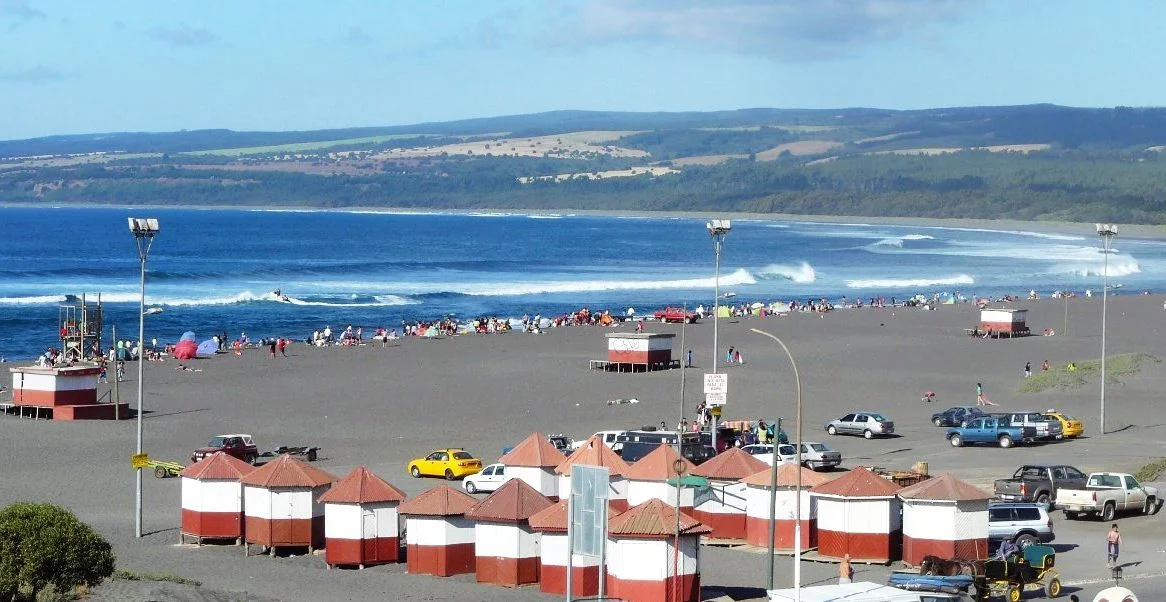

Pichilemu
The wave breaks left, peeling for hundreds of meters along a rocky point crowned by two sea stacks called Los Morros. At Punta de Lobos, just south of Pichilemu, the Pacific can throw up swells that tower ten meters high, and the best surfers in the world come to ride them. But long before anyone paddled out here, this stretch of dark Chilean sand belonged to a different fantasy: a Gilded Age industrialist who dreamed of building a French resort town on the edge of the Southern Ocean.
Little Forest
The name comes from Mapudungun, the language of the Mapuche: pichi, meaning little, and lemu, meaning forest. Before the Spanish arrived, this coast belonged to the Promaucaes, hunter-gatherers and fishermen whose shell middens still lie buried near Punta de Lobos and the lagoons to the south. In January 1541 the conquistador Pedro de Valdivia granted the surrounding lands as part of an encomienda, and centuries of quiet rural life followed: leather, jerky, and tallow shipped north to Santiago and Valparaíso. For a long time, Pichilemu was simply a small port that never quite became one.
The Resort That Almost Was
Then came Agustín Ross Edwards. A politician and businessman of one of Chile's wealthiest families, Ross wanted to turn Pichilemu into an elegant seaside escape for the country's upper class, a Chilean answer to the spa towns of Europe. Between 1904 and 1906 he built a grand casino modeled on a French château, its silhouette echoing the palaces of Paris. When it opened in January 1906, it was claimed to be the first casino in Chile. Ross laid out parks and terraces, planted palms, and imported furniture and building materials from France and England. He never managed to build the working port he envisioned, and he died in Viña del Mar in 1926. His heirs donated the parks, the avenues, and the casino to the town, on the condition they remain forever open to the public.
Where the Waves Come In
Surfing arrived in the early 1970s and never left. Pichilemu's expansive dark-sand beaches face directly into the swells of the South Pacific, and the waves grow through the southern fall and winter into walls that can reach fifteen meters in the biggest storms. Punta de Lobos, a powerful left-hand point break six kilometers south of town, became the crown jewel, hosting big-wave events that draw international athletes and the crowds who come to watch them. The reef has been recognized as a World Surfing Reserve, a designation meant to protect both the wave and the coast around it. On any given morning, the lineup fills with surfers; on the headland, photographers wait for the next set.
When the Ground Moved
This coast is also restless. Pichilemu sits near its own geological fault, threaded between the town and Vichuquén to the north. On February 27, 2010, one of the largest earthquakes ever recorded struck central Chile, and the tsunami that followed tore through Pichilemu's shoreline. Two weeks later, on March 11, a pair of intraplate quakes — magnitude 7.0 and 6.9 — struck just northwest of town within minutes of each other, killed one person, and rattled nerves already frayed. The town rebuilt, as Chilean coastal towns have learned to do. Today the old casino stands restored as a cultural center and public library, its galleries filled where roulette wheels once spun, and the waves keep rolling in beneath the palms Agustín Ross planted more than a century ago.
From the Air
Pichilemu sits on the Pacific coast at roughly 34.39°S, 72.00°W, in the westernmost reach of Chile's O'Higgins Region. From the air, look for the town's grid hugging a curving bay, with the twin sea stacks of Punta de Lobos jutting from the headland six kilometers to the south and the salt lagoons of Cáhuil glinting inland. The Coastal Range rises behind the town toward 2,000 meters. The nearest major airport is Santiago's Comodoro Arturo Merino Benítez International (SCEL), about 110 nautical miles northeast; regional fields lie inland around San Fernando and Curicó. A viewing altitude of 2,500-5,000 feet AGL best frames the meeting of dark beach, white surf, and forested coastal hills. Afternoons here are often windy with coastal fog, so morning offers the clearest air.
Nearby Stories
- Santa Cruz, Chile 0.5 km away
- Lolol 25 km away
- La Frontera (Chile) 47 km away
- Pukara of La Compañía 63 km away
- Casa de Isla Negra 76 km away
- Chanco, Chile 123 km away
- Cobquecura 199 km away
- 1687 Peru Earthquake 2129 km away