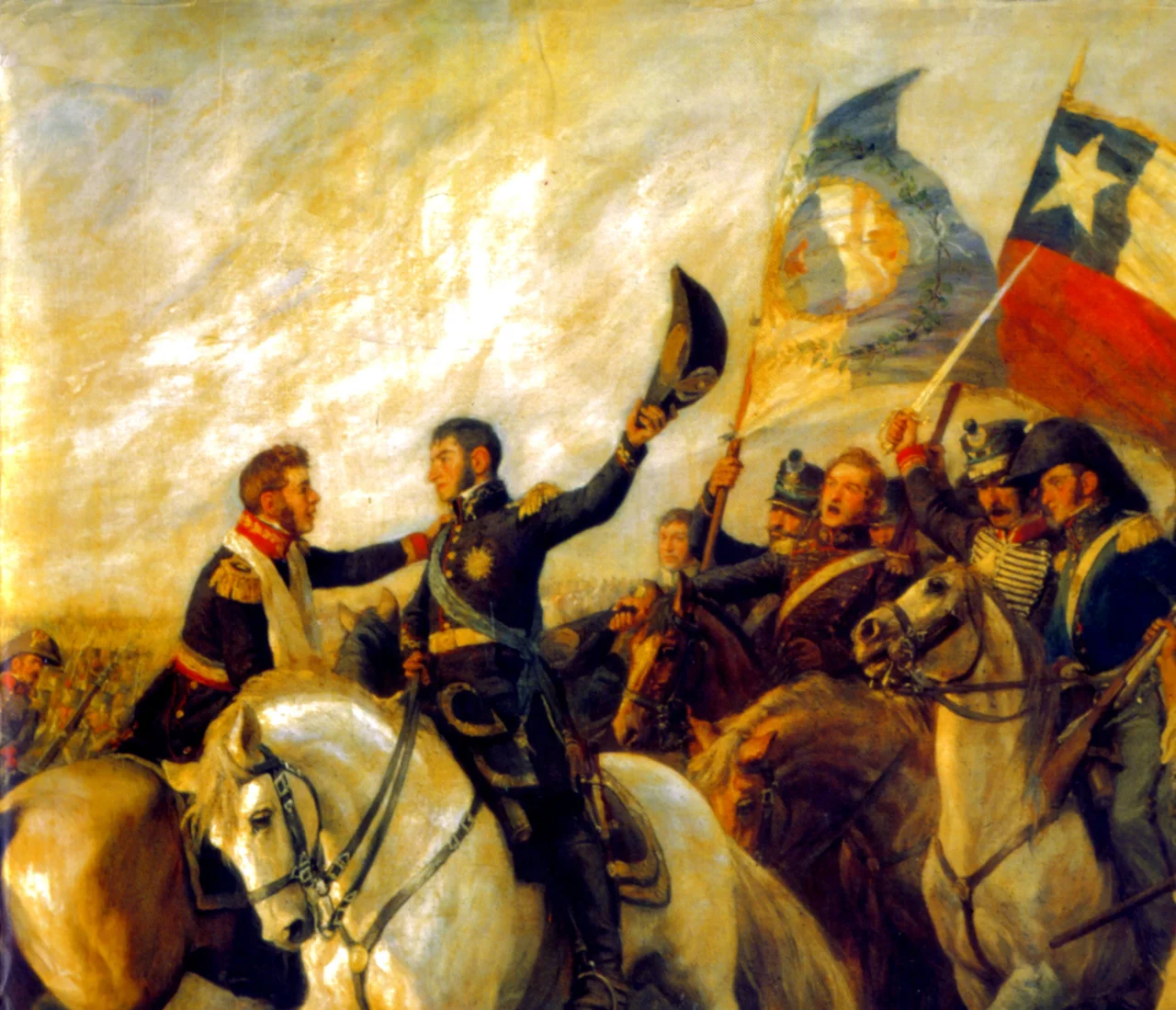

Battle of Maipú
Two weeks before the battle, the cause looked lost. The Spanish had surprised and scattered the patriot army by night at Cancha Rayada, and Santiago braced for the royalists to march in and snuff out Chile's young independence. Instead, something remarkable happened: in less than two days, José de San Martín rebuilt his shattered force almost from scratch. On 5 April 1818, on a low ridge of farmland near the village of Maipú, just south of the capital, that resurrected army turned to face General Mariano Osorio's Spaniards one final time. By evening the question of whether Chile would be free had been answered, and not quietly.
The Army That Refused to Die
San Martín was Argentine, and he had already done the impossible once - leading an army over the high passes of the Andes the year before to liberate Santiago at the Battle of Chacabuco. Cancha Rayada should have undone all of it. Yet the drive for independence never wavered. Within two days the patriots had reformed into three infantry divisions, some 5,000 soldiers in all. Inside Santiago, the Chilean leader Bernardo O'Higgins worked feverishly to make it possible, gathering up rifles and sabres handed out to civilians after the defeat, confiscating weapons from merchants to rearm the troops, rushing supplies down from Los Andes, and pulling fighters from the countryside into a training camp at Ochagavía. When Osorio realized he had not finished his enemy, a final reckoning near the capital became inevitable.
The Afternoon on the Ridge
The guns opened around 11:30 in the morning, and for half an hour the two artilleries hammered each other to no effect. Then San Martín sent his infantry forward in columns, holding their fire as they advanced. The fighting swung hard in the center, where Osorio's reinforced Ordóñez division charged and forced the patriot line to give ground - until San Martín fed in three fresh battalions that split the Spanish Burgos battalion and shattered the Arequipa. On the wings, the grenadiers held off the royalist cavalry and the Cazadores under Ramón Freire scattered the horsemen on the eastern flank. Colonel Santiago Bueras died leading a charge that day. As his lines buckled, Osorio fled the field, abandoning his men to General Ordóñez, who gathered the survivors for a last stand.
The Cost and the Consequence
The end came at the farmhouses of Lo Espejo, where the cornered royalists made their final stand. The Coquimbo battalion threw itself recklessly at the position and was cut down; then San Martín's cannons pounded the buildings until Ordóñez's men, with O'Higgins's militias closing in, had no choice but to surrender. The arithmetic of that single afternoon was brutal. Roughly 1,500 Spanish soldiers lay dead and 2,289 were taken prisoner; on the patriot side, around 800 men were killed and 1,000 wounded - thousands of lives spent in a few hours on a stretch of farmland. But the result was total. Maipú ended major Spanish operations in Chile for good and freed the combined Chilean and Argentine forces to carry the war up the Pacific coast, toward the eventual liberation of Peru.
An Embrace Remembered
What Chile chose to commemorate, in the end, was not the killing but a moment of joy. When the fighting was done, O'Higgins and San Martín met on the field and embraced - the Chilean and the Argentine, the two halves of a shared liberation. The 'Abrazo de Maipú,' the Hug of Maipú, became one of the most cherished images in both nations, painted, retold, and even honored with an Antarctic refuge named for it. Every 5 April the victory is marked in Maipú with a civil-military parade, and a month of festivities each April closes with a living-history reenactment on the ground where it happened. The plain that decided a country still gathers crowds two centuries later, to remember the day the impossible held.
From the Air
The battlefield lies in what is now the Maipú commune on the southwestern edge of metropolitan Santiago, near 33.50 degrees south, 70.77 degrees west, on the flat ground between the Maipo River and the city. From the air today it is fully urbanized - the open farmland of 1818 has long since filled in - but the site is anchored by the Templo Votivo de Maipú, the large modern basilica built to honor the victory, which makes an unmistakable landmark. Santiago's Comodoro Arturo Merino Benítez International (SCEL) is about 20 km north. The snowcapped wall of the Andes rises to the east, the same range San Martín's army crossed to reach this plain. Clear winter days offer the most dramatic backdrop of mountains behind the city.
Nearby Stories
- Paine Memorial 14 km away
- Viña del Mar International Song Festival 28 km away
- Battle of Chacabuco 29 km away
- Cerro El Plomo 30 km away
- Casa de Isla Negra 30 km away
- Paso Internacional Los Libertadores 49 km away
- Pichilemu 92 km away
- Uruguayan Air Force Flight 571 113 km away