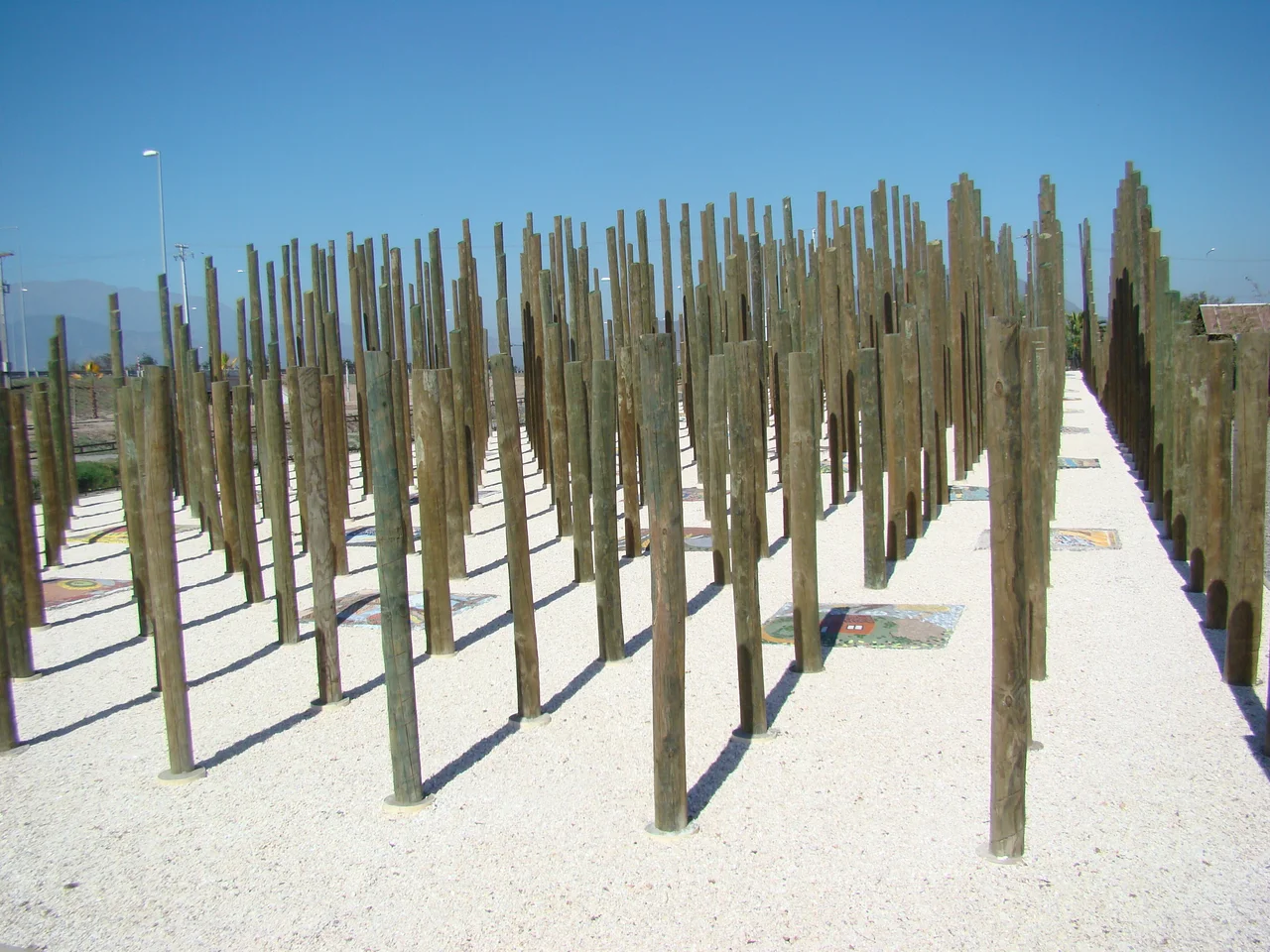

Paine Memorial
Count the poles and you will find one thousand, except you will not. Seventy are missing. In their place sit seventy hand-made mosaics, each assembled from the things one person loved - a soccer crest, a guitar, the tools of a trade. This is the Paine Memorial, built in a small farming town twenty miles south of Santiago, and its arithmetic is the whole story. The standing poles represent the survivors, the children and grandchildren who were left behind. The empty spaces represent the people the dictatorship took and never gave back. To walk among them is to read a subtraction that the families of Paine have lived with for half a century.
A Town That Lost the Most
Paine is not a famous place. It grew vegetables and fruit for the capital, a community of small farmers and farmworkers whose lives turned on harvests and weather. Then came the coup of September 1973, and the campaign of repression that followed it. According to the 1991 Rettig Report, prepared by Chile's National Commission for Truth and Reconciliation, Paine suffered more disappearances and executions per capita than any other settlement in the country. Around seventy people from this one rural district were abducted or unlawfully arrested and killed. They were not generals or guerrillas. They were neighbors - men known by the rows they tended and the cooperatives they had joined during the land reforms of the preceding decade. In a town this small, seventy is not a statistic. It is a face in every direction.
The Years of Silence
In December 1973, bodies of local people were found at Cuesta de Chada, a lonely valley nearby. The women who discovered them said nothing at first, afraid of what speaking might cost. When they finally went to the police in March 1974 to ask for the remains, they were refused. Most families were never allowed to recover their dead; only some were given death certificates. Grief had nowhere to go. Children grew up inside a silence enforced by fear, told in a hundred small ways that asking questions was dangerous and that perhaps the missing must have done something to deserve it. That last cruelty - the insinuation of guilt onto the vanished - was its own wound, and it festered for years in a community taught not to mourn out loud.
Six Who Marched
The silence broke slowly, and it broke from below. In 1989, six people walked through Paine in protest of the abductions. Six. By the end, the march had grown to forty, the marchers holding their ground as police tried to herd them onto the sidewalks. It was a small act of enormous courage in a place that had learned the price of visibility. The following year, remains began to be handed over and excavations were arranged to find more. In 2000, families formed AFDD-Paine - the Association of Relatives of the Detained-Disappeared and Executed of Paine - to speak the names aloud and to insist that the country remember. For eight years they pressed government ministries until, in 2008, the memorial finally rose from the ground they had farmed.
A Living Forest
The memorial is meant to be lived in, not merely visited. The third generation - grandchildren of the people who were killed - now works alongside the survivors to keep the story present, and the families dream of turning the site into a permanent cultural center rather than running it, as they do now, from a temporary trailer. In 2024, President Gabriel Boric stood among the poles, a sitting head of state acknowledging what the state had once denied. The timber forest is a quiet thing. It does not shout. But stand in it long enough and the empty spaces begin to feel like the most occupied places of all - held open, deliberately, so that no one forgets who belongs in them.
From the Air
The Paine Memorial sits at 33.81 degrees south, 70.71 degrees west, on the flat agricultural plain about 32 km (20 miles) south of central Santiago, where the Maipo valley spreads toward the Andean foothills. From the air, look for the rectangular grid of farm parcels around the town of Paine, with the snow-streaked Andes rising sharply to the east. The nearest major airport is Santiago's Comodoro Arturo Merino Benitez International (ICAO SCEL), roughly 50 km to the northwest; the regional field at Rancagua (ICAO SCRG) lies to the south. Best viewing is on the clear, dry days common in the central Chilean autumn and winter, when haze over the basin lifts and the valley floor reads cleanly against the mountains.
Nearby Stories
- Votive Temple of Maipú 9.8 km away
- Rancagua 12 km away
- Casa de Isla Negra 33 km away
- Cerro El Plomo 39 km away
- Pichilemu 67 km away
- 1947 BSAA Avro Lancastrian Star Dust accident 73 km away
- Uruguayan Air Force Flight 571 74 km away
- Great Fire of Valparaíso 87 km away