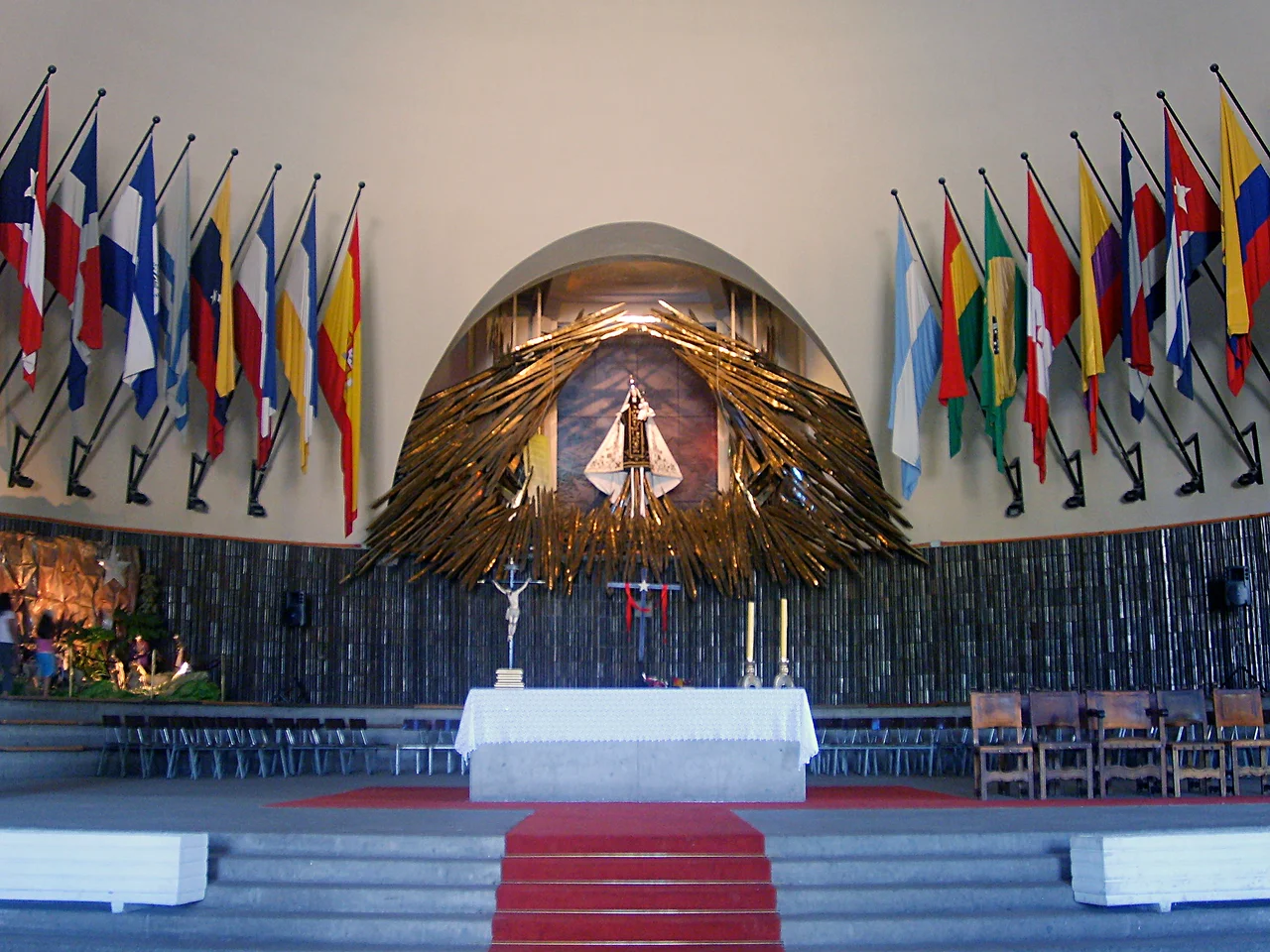

Votive Temple of Maipú
On the plains southwest of Santiago, a vast concrete tower climbs nearly three hundred feet into the sky, and beneath it lie the ruins of a far humbler chapel. The two structures, separated by a century and a half, both trace back to a single vow. In 1818, on a field that would decide whether Chile became a free nation, Bernardo O'Higgins promised the Virgin Mary that if his army prevailed, he would build her a temple here. His army won. The promise took 156 years to fulfill in its final form, but stand at its base today and you are standing on the ground where Chilean independence was secured.
A Vow on the Battlefield
The Battle of Maipú, fought in April 1818, broke the back of Spanish power in Chile and effectively assured the young republic's independence. O'Higgins, the nation's founding leader, had pledged before the fighting to raise a sanctuary to Our Lady of Mount Carmel in thanksgiving for victory. The word votive comes from exactly this: a vow, a promise made and owed. He moved quickly to honor it. By a decree of May 7, 1818, construction was ordered, and on November 15 the first stone of the Chapel of Victory was laid and blessed on the battlefield itself. The temple was, from its first stone, less a building than a debt of gratitude made solid.
A Promise Deferred
Honoring the vow proved far harder than making it. The original chapel took sixty-four years of stop-and-start construction, hobbled repeatedly by lack of money, before it was solemnly inaugurated. Then the great Valparaiso earthquake of 1906 ruined it. The dream of a proper sanctuary persisted; in 1942 a Marian congress in Santiago agreed unanimously to build something grand on the site, and in 1948 the Archbishop of Santiago commissioned a new design from the architect Juan Martinez Gutierrez. Even then progress stalled for want of funds, and not everyone approved. Some Catholic groups argued the money would be better spent on the poor of the archdiocese than on a monument. The present temple was finally inaugurated on October 24, 1974, more than a century and a half after O'Higgins first made his promise.
The Queen of Chile
At the heart of the basilica stands a wooden image of Our Lady of Mount Carmel with a history older than the building around it. The sculpture was brought to Chile in 1785 by Martin de Lecuna for his private oratory, and passed down through his family until a descendant donated it to the Archbishop of Santiago in 1945. The figure carries an extraordinary national weight. In 1923, Pope Pius XI had declared the Virgin of Carmen the patroness of Chile, and on April 3, 1987, Pope John Paul II personally crowned this image as Queen and Patroness of the nation during his apostolic visit. On that same visit he raised the temple to the rank of minor basilica. For Chilean Catholics, this is not merely a famous statue. It is the protector their country pledged itself to on a battlefield.
A View from the Belfry
The architecture had grander ambitions at first. Early plans imagined a great mausoleum for the heroes of Chilean independence, a national pantheon on the model of the one in Paris. The Church rejected the idea, preferring a place devoted purely to worship and to the care of pilgrims. What was built instead reaches dramatically upward. Just below the roof of the central belfry, sixty-three meters up, an observation deck opened in 2012 on the twenty-fifth anniversary of John Paul II's visit. Reached by lift or a climb of 323 steps, it offers panoramas across southwest Santiago and looks down on the ruins of the old Chapel of Victory in the plaza below. At its center sits a compass rose pointing toward Marian sanctuaries around the world.
Where Two Stories Meet
Beneath the main sanctuary, the Museo del Carmen holds liturgical objects and artifacts drawn from the site's long history, the physical residue of two centuries of devotion and delay. What makes Maipu compelling is the layering of it: a battlefield and a basilica, a soldier's vow and a pope's crown, a ruined chapel and a tower of concrete, all stacked on the same patch of ground. The temple was declared a national historical monument in 1984. It remains a working shrine, drawing pilgrims to the place where, as Chileans tell it, both a nation and a promise were kept.
From the Air
The basilica stands in the commune of Maipu, southwest of central Santiago, at 33.51°S, 70.77°W. Its sheer scale makes it a striking landmark from the air: a slab-like tower roughly 91 meters tall rising from the flat plain of the Santiago basin, well clear of the surrounding low-rise sprawl. The Andes wall the basin to the east; the city core lies to the northeast. Santiago sits near 520 meters elevation and is prone to winter smog that softens visibility; clearer air follows rain or wind. A viewing altitude of 3,500 to 5,500 feet AGL frames the temple and the open ground around it well. Nearest airport is Comodoro Arturo Merino Benitez International (SCEL), about 8 nautical miles to the north-northwest.
Nearby Stories
- Paine Memorial 14 km away
- Viña del Mar International Song Festival 28 km away
- Battle of Chacabuco 29 km away
- Cerro El Plomo 30 km away
- Casa de Isla Negra 30 km away
- Paso Internacional Los Libertadores 49 km away
- Pichilemu 92 km away
- Uruguayan Air Force Flight 571 113 km away