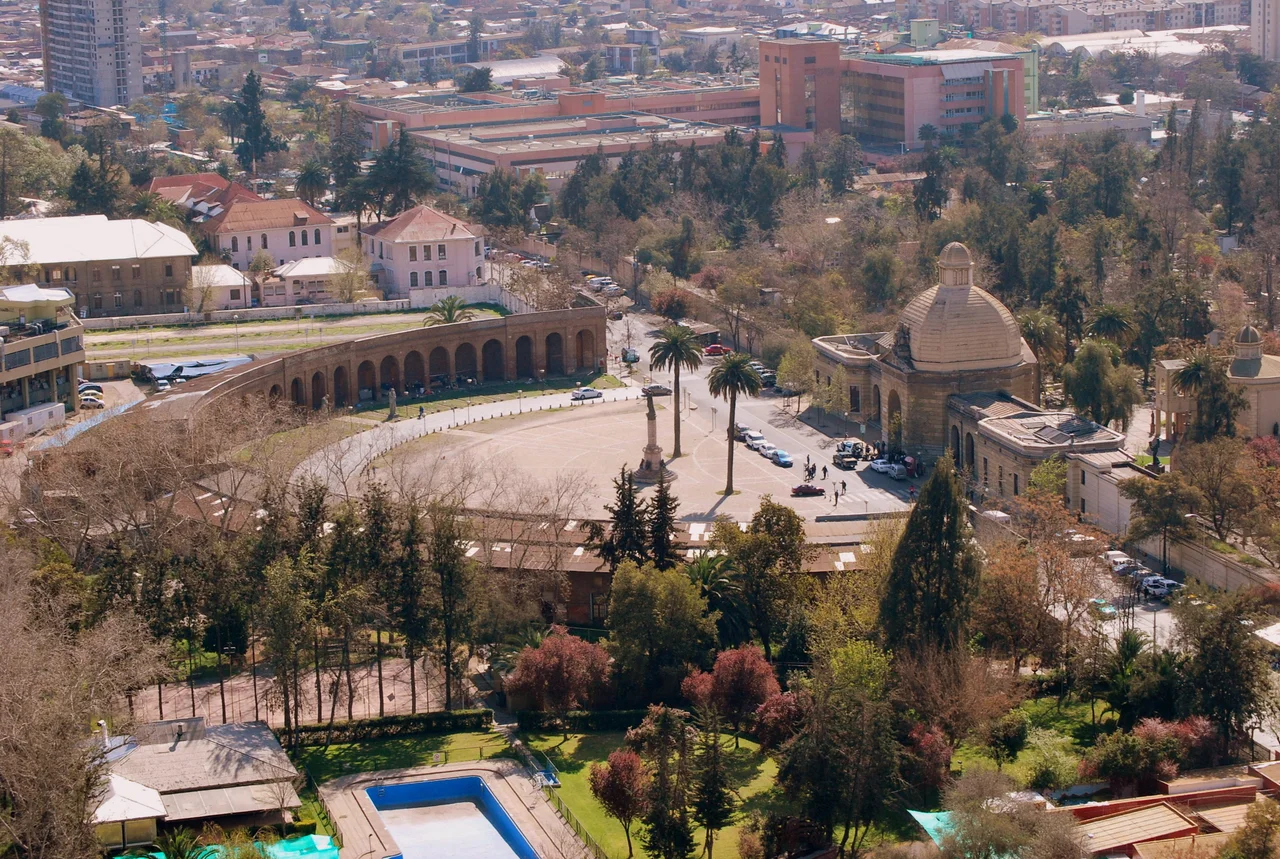

Santiago General Cemetery
Roughly two million people are buried here, which makes the Cementerio General de Santiago less a graveyard than a city of the dead, complete with avenues, plazas, and addresses. Palms throw long shadows over marble mausoleums that imitate Greek temples and Egyptian tombs. Families picnic among the monuments on Sundays. And somewhere along these lanes lies almost the entire story of modern Chile, from the presidents who governed it to the citizens its government tried to erase.
A Republic in Marble
Bernardo O'Higgins, the soldier who led Chile to independence, set this ground aside in 1821, just three years after the new nation declared itself. He gave it more than eighty hectares along the old bed of the Mapocho River, below the rocky shoulder of Cerro Blanco. Over two centuries it filled with the names that define the country. At least four former presidents rest here, among them Arturo Alessandri, Eduardo Frei Montalva, and Patricio Aylwin, the man who guided Chile back to democracy. The folk singer Violeta Parra lies nearby, as do generals and senators whose monuments range from sober granite slabs to ornate marble chapels. The grand entrance, crowned by a dome, frames the view down La Paz Avenue like the climax of a stage set. In 2010 the historic core was declared a national monument, formal recognition that this was a place worth protecting.
The Long Walk Home
On September 11, 1973, a military coup ended Salvador Allende's socialist government, and Allende died inside the burning presidential palace. The dictatorship buried him quietly and far away, in a plot at Viña del Mar under another family's name, as if hoping the country would forget. It did not. When democracy returned, Chile brought him back. In 1990 his remains were carried in solemn procession through the streets of Santiago and laid in a place of honor here, in the cemetery O'Higgins had founded. The grave became, almost instantly, one of the most visited in the country, a destination for those who wanted to mourn not only a man but the republic he represented.
The Wall of Names
Near the entrance stands a long wall of pale stone, and carved into it are roughly three thousand names. This is the Memorial to the Detained, Disappeared, and Politically Executed, a record of the people killed or vanished after the 1973 coup. The left wing lists the disappeared, those whose bodies were never returned to their families. The right names the executed. At the center, alone, is cut the name of Salvador Allende. Not far away lies Patio 29, a field of plain crosses where the regime buried the unidentified dead in secret. After democracy returned, forensic teams worked through the graves and by 2006 had exhumed more than 125 sets of remains. The identification process proved painstaking and imperfect — many early identifications were later revised through DNA testing — but each confirmed name ended one family's decades of not knowing.
The Singer Who Would Not Stop
Among the graves is that of Víctor Jara, the folk singer and theater director whose songs became anthems of Allende's Chile. In the first days after the coup, soldiers detained him at the Estadio Chile in central Santiago. His captors smashed his hands, then mockingly told him to play. He answered by singing "Venceremos" - "We Will Win" - to the other prisoners before they shot him; his body was found riddled with bullets. Decades later, Chilean courts convicted retired officers of his murder. His wife, the dancer Joan Jara, who spent her life seeking justice for him, was buried beside him after her death in 2023. Their shared grave draws a steady stream of visitors who leave flowers, notes, and sometimes a few quiet bars of his music.
From the Air
The Santiago General Cemetery lies at roughly 33.415 degrees south, 70.649 degrees west, in the Recoleta district just north of central Santiago and immediately below the dark hump of Cerro Blanco - a useful landmark from the air. The sprawling grid of pale mausoleums and tree-lined avenues stands out clearly against the surrounding dense urban fabric. The primary airport is Arturo Merino Benítez International (ICAO: SCEL), about 15 km northwest in Pudahuel. Santiago sits in a basin ringed by the Andes, so clear morning light before the afternoon smog builds offers the best visibility over the city.
Nearby Stories
- Paine Memorial 21 km away
- 1947 BSAA Avro Lancastrian Star Dust accident 23 km away
- Battle of Chacabuco 31 km away
- La Campana National Park 36 km away
- Puente del Inca 44 km away
- Casa de Isla Negra 62 km away
- Santa Cruz, Chile 103 km away
- Pierre Auger Observatory 172 km away