_001.jpg)
La Campana National Park
On 16 August 1834, a young naturalist set out before dawn to climb a mountain in the coastal hills of central Chile. Charles Darwin was twenty-five, ashore from HMS Beagle, and he would later call the day among the most memorable of the entire voyage. From the summit of Cerro La Campana he looked out over the whole sweep of country, the Andes to the east, the Pacific to the west, and wrote of feeling as though he could see all of Chile at once. On the way up he noticed the palms, strange and massive, and described how the local people drew from them a sap that tasted like honey. Nearly two centuries later that mountain and those palms are protected together inside La Campana National Park.
Darwin's Mountain
The Beagle had reached Valparaíso in July 1834, and Darwin used the stop to range inland. In mid-August he rode out to the Hacienda de San Isidro at the foot of the mountain, and on the morning of the sixteenth, with a guide and fresh horses, he made the ascent of Cerro La Campana, which rises to 1,880 meters. The summit gave him one of the grand panoramas of his life, and he filled his notebook with observations of the geology and the plants. The mountain still draws climbers up the same slopes Darwin traced, a steep day's hike rewarded by the view that moved a future revolutionary in science. A trail and a commemorative plaque mark his path, and standing where he stood, you understand why he reached for superlatives.
The Honey Palm
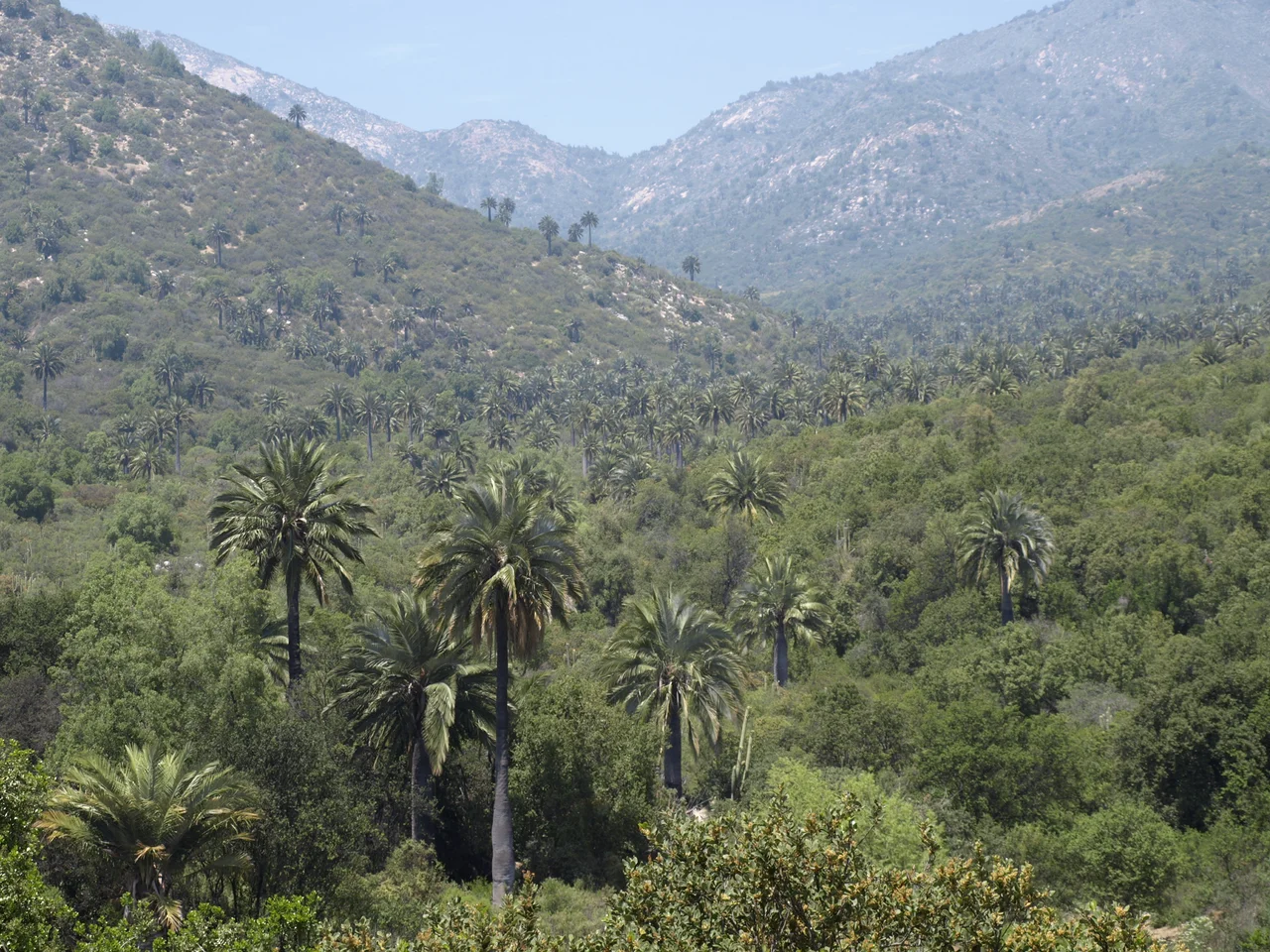
The tree Darwin admired was Jubaea chilensis, the Chilean wine palm, and it is a botanical marvel. It carries the thickest trunk of any palm on Earth, a smooth gray column that can reach one and a half to two meters across and rise some eighteen to twenty-five meters, and it is among the most southerly-growing palms in the world and the most cold-hardy of all feather palms. It is also extraordinarily patient. The tree can take a decade or two simply to form a trunk, may not produce seed until it is around sixty years old, and can live for several centuries. The historical name hints at its undoing: settlers felled the palms to tap their sweet sap, boiling it down into a syrup and a palm wine, and the species that once spread widely across central Chile was cut back to a handful of groves. La Campana guards one of the greatest survivors.
The Ocoa Forest
The heart of the palm story lies in the park's Ocoa Valley, where the Palmar de Ocoa holds the largest concentration of Chilean wine palms left in the world. La Campana spreads across roughly eighty square kilometers of the Chilean matorral, the Mediterranean-climate scrubland that clothes this stretch of the coastal range, and its three sectors, Granizo, Cajón Grande, and the palm-rich Palmas de Ocoa, each open a different door into the landscape. Among the palms grow a cast of distinctly Chilean plants: the spiny Puya chilensis with its towering flower spikes, the columnar cactus Echinopsis chiloensis, and native trees like boldo, peumo, and litre. The park was established in October 1967 and has been administered by Chile's forestry agency, CONAF, since 1974. In 1984 UNESCO folded it, with the neighboring Lago Peñuelas reserve, into a Biosphere Reserve.
A Window Into Old Chile
What makes La Campana matter is that it preserves a version of central Chile that has nearly vanished everywhere else. The vineyards, suburbs, and farms of the densely settled coast have erased most of the original matorral and almost all of the old palm forests. Here, behind the park boundary, the slow-growing palms still rise above the scrub as they did when Darwin rode through, some of them old enough to have been standing on that August morning in 1834. The mountain offers the same enormous view; the valley offers the same impossible trees. Visiting is less a hike than a kind of time travel, a chance to see the landscape that helped shape one of the most consequential minds in the history of science, still living and still rooted in the Chilean soil.
From the Air
La Campana National Park lies at 32.92°S, 71.15°W in the Chilean Coast Range of the Valparaíso Region, northwest of Santiago and inland from the coast at Valparaíso and Viña del Mar. From the air the landmark is Cerro La Campana itself, a distinct peak rising to 1,880 meters above the surrounding matorral hills, with the green Ocoa Valley and its palm groves to the north of the summit. A viewing altitude of 5,000 to 8,000 feet shows the peak, the valley, and the park's setting between the coast and the distant Andes. Nearest airfields are Santiago's Arturo Merino Benítez International (SCEL) to the southeast and the regional strip at Viña del Mar / Concón (SCVM) toward the coast. The Mediterranean climate brings clear, dry summers ideal for viewing; winter can bring cloud and occasional rain to the higher slopes.
Nearby Stories
- 1647 Santiago Earthquake 21 km away
- 1985 Algarrobo Earthquake 30 km away
- 1965 La Ligua earthquake 32 km away
- Battle of Maipú 50 km away
- Santiago General Cemetery 51 km away
- Aconcagua 61 km away
- Pichilemu 161 km away
- Colca Canyon 1902 km away